
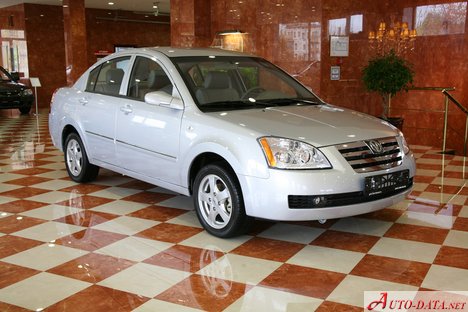
The TagAz Vortex Estina 1.6 (119 Hp) represents a significant offering from the Russian automotive manufacturer TagAZ (Taganrog Automobile Plant), produced between 2008 and 2012. Positioned as a compact sedan, the Vortex Estina was, in essence, a rebadged version of the Chinese Chery A5 (also known as the Chery Fora in some markets), adapted for the Russian domestic market and other CIS countries. This strategy allowed TagAZ to quickly introduce a modern, competitive vehicle into a rapidly evolving market segment, offering a blend of contemporary design, practical utility, and accessible pricing. The 1.6-liter variant, with its 119 horsepower engine, was a core model, balancing performance with fuel efficiency, catering to a broad demographic of buyers seeking a reliable and economical family car.
Engine and Performance Characteristics of the TagAz Vortex Estina
At the heart of the TagAz Vortex Estina 1.6 (119 Hp) lies a robust 1.6-liter (1597 cm3 or 97.45 cu. in.) naturally aspirated inline-four gasoline engine. This powerplant, featuring a Double Overhead Camshaft (DOHC) valvetrain with four valves per cylinder, was designed for a balance of durability and responsive performance. It utilized a multi-port manifold injection system to precisely deliver fuel, ensuring efficient combustion and contributing to its Euro 3 emission standard compliance, which was typical for vehicles of its era and market. The engine’s configuration, mounted front and transversely, optimized space within the engine bay and contributed to the vehicle’s front-wheel-drive architecture.
The engine produced a respectable 119 horsepower at 6150 revolutions per minute (rpm), making it quite capable for daily driving and highway cruising. Torque output stood at 160 Nm, or 118.01 lb.-ft., available at 4000 rpm. This torque curve provided adequate pulling power across a usable range, contributing to the car’s overall drivability. In terms of acceleration, the Vortex Estina 1.6 was able to achieve 0-60 mph in a calculated 10.5 seconds, with a 0-100 km/h sprint taking 11 seconds. The maximum speed was rated at 180 km/h, or approximately 111.85 mph, which was competitive within its class. The power-to-weight ratio was 89.7 Hp per tonne (or 11.1 kg/Hp), while the torque-to-weight ratio was 120.7 Nm per tonne (or 8.3 kg/Nm), indicating a reasonable balance for its segment.
Fuel economy was an important consideration for buyers in its target markets. The Vortex Estina 1.6 delivered a combined fuel consumption figure of 7.8 liters per 100 kilometers, translating to an estimated 30.2 US miles per gallon (mpg). In urban driving conditions, it achieved 9 l/100 km (26.1 US mpg), while on extra-urban cycles, it improved to 6.8 l/100 km (34.6 US mpg). These figures underlined its suitability as an economical choice for families and commuters, especially when considering the petrol (gasoline) fuel type and a fuel tank capacity of 52 liters (13.74 US gallons).
Design and Features of the Vortex Estina
The TagAz Vortex Estina adopted a classic four-door sedan body type, a popular choice in its primary markets due to its practical trunk space and traditional styling. Its design, inherited from the Chery A5, presented a contemporary yet conservative aesthetic for its time, aiming for broad appeal rather than radical innovation. The exterior featured clean lines, a moderately sized grille, and headlights that integrated smoothly into the front fascia, giving it a somewhat understated but modern appearance. The overall dimensions contributed to its presence on the road while maintaining maneuverability.
Measuring 4552 mm (179.21 inches) in length, 1750 mm (68.9 inches) in width, and 1483 mm (58.39 inches) in height, the Vortex Estina was squarely positioned in the compact sedan segment. Its wheelbase of 2600 mm (102.36 inches) was generous for its class, contributing to a stable ride and providing a relatively spacious cabin for five occupants. Both the front and rear tracks measured 1505 mm (59.25 inches), further aiding stability. The minimum turning circle of 10.6 meters (34.78 feet) ensured reasonable agility in urban environments.
Inside, the Vortex Estina prioritized functionality and comfort, offering a straightforward dashboard layout and practical features expected in its class. While specific interior amenities were not detailed in the provided data, typical offerings for sedans of this era and market would include air conditioning, power windows, and a basic audio system, all geared towards providing a comfortable and convenient driving experience. One of its key practical advantages was its generous trunk (boot) space, which measured 483 liters (17.06 cu. ft.). This substantial cargo capacity made it well-suited for family trips, grocery runs, or carrying luggage, reinforcing its role as a versatile family vehicle. The kerb weight of the vehicle was 1326 kg (2923.33 lbs.), with a maximum permissible weight of 1701 kg (3750.06 lbs.), allowing for a maximum load of 375 kg (826.73 lbs.), highlighting its robust construction and load-carrying capability.
Chassis and Drivetrain Engineering
The drivetrain architecture of the TagAz Vortex Estina 1.6 (119 Hp) was based on a conventional front-wheel-drive (FWD) setup, where the internal combustion engine directly powered the front wheels. This configuration is widely favored in compact sedans for its efficiency, packaging advantages, and predictable handling characteristics, especially in varying road conditions. The power was transmitted to the wheels through a 5-speed manual transmission, offering drivers direct control over gear selection and contributing to the vehicle’s fuel efficiency through optimal gear ratios.
The suspension system of the Vortex Estina was engineered to provide a comfortable ride quality while maintaining stable handling. The front suspension featured an independent McPherson strut design, complete with coil springs and an anti-roll bar. This setup is renowned for its simplicity, robustness, and ability to effectively absorb road imperfections. At the rear, the vehicle employed an independent multi-link spring suspension, also equipped with a stabilizer. The multi-link design, typically found in more sophisticated vehicles, allows for greater control over wheel alignment and movement, enhancing ride comfort and stability, particularly on uneven surfaces or during cornering. This combination of independent suspension systems at both ends aimed to deliver a refined driving experience for its segment.
Braking performance was handled by disc brakes on both the front and rear axles. All-disc braking systems generally offer superior stopping power and heat dissipation compared to drum brakes, which were still common on the rear of some compact cars in this period. This feature contributed to the vehicle’s overall safety and driver confidence. The steering system utilized a rack and pinion setup, providing direct and responsive steering feedback. The vehicle was fitted with tires of size 195/55 R15 85V, which are standard dimensions for a compact sedan, balancing grip, ride comfort, and replacement cost. These specifications collectively underscored the TagAz Vortex Estina’s design as a practical, dependable, and capable vehicle for its target market.
Technical Specifications
| Brand | TagAz |
| Model | Vortex Estina |
| Generation | Vortex Estina |
| Type (Engine) | 1.6 (119 Hp) |
| Start of production | 2008 year |
| End of production | 2012 year |
| Powertrain Architecture | Internal Combustion engine |
| Body type | Sedan |
| Doors | 4 |
| Fuel consumption (economy) – urban | 9 l/100 km / 26.1 US mpg |
| Fuel consumption (economy) – extra urban | 6.8 l/100 km / 34.6 US mpg |
| Fuel consumption (economy) – combined | 7.8 l/100 km / 30.2 US mpg |
| Fuel Type | Petrol (Gasoline) |
| Acceleration 0 – 60 mph | 10.5 sec |
| Maximum speed | 180 km/h / 111.85 mph |
| Emission standard | Euro 3 |
| Weight-to-power ratio | 11.1 kg/Hp, 89.7 Hp/tonne |
| Weight-to-torque ratio | 8.3 kg/Nm, 120.7 Nm/tonne |
| Power | 119 Hp @ 6150 rpm |
| Power per litre | 74.5 Hp/l |
| Torque | 160 Nm @ 4000 rpm / 118.01 lb.-ft. @ 4000 rpm |
| Engine layout | Front, Transverse |
| Engine displacement | 1597 cm3 / 97.45 cu. in. |
| Number of cylinders | 4 |
| Engine configuration | Inline |
| Cylinder Bore | 81 mm / 3.19 in. |
| Piston Stroke | 77.5 mm / 3.05 in. |
| Compression ratio | 10:1 |
| Number of valves per cylinder | 4 |
| Fuel injection system | Multi-port manifold injection |
| Engine aspiration | Naturally aspirated engine |
| Valvetrain | DOHC |
| Kerb Weight | 1326 kg / 2923.33 lbs. |
| Max. weight | 1701 kg / 3750.06 lbs. |
| Max load | 375 kg / 826.73 lbs. |
| Trunk (boot) space – maximum | 483 l / 17.06 cu. ft. |
| Fuel tank capacity | 52 l / 13.74 US gal |
| Length | 4552 mm / 179.21 in. |
| Width | 1750 mm / 68.9 in. |
| Height | 1483 mm / 58.39 in. |
| Wheelbase | 2600 mm / 102.36 in. |
| Front track | 1505 mm / 59.25 in. |
| Rear (Back) track | 1505 mm / 59.25 in. |
| Minimum turning circle (turning diameter) | 10.6 m / 34.78 ft. |
| Drivetrain Architecture | Front wheel drive (ICE drives front wheels) |
| Drive wheel | Front wheel drive |
| Number of gears and type of gearbox | 5 gears, manual transmission |
| Front suspension | Independent, type McPherson with coil spring and anti-roll bar |
| Rear suspension | Independent multi-link spring suspension with stabilizer |
| Front brakes | Disc |
| Rear brakes | Disc |
| Steering type | Steering rack and pinion |
| Tires size | 195/55 R15 85V |
