
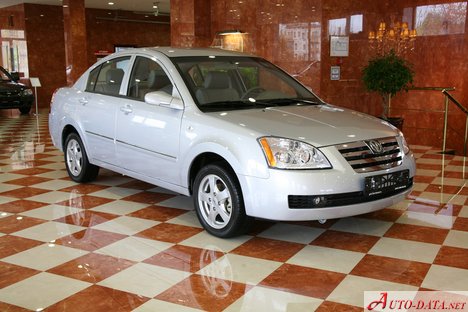
The TagAz Vortex Estina, specifically the 2.0-liter variant producing 136 horsepower, represents a significant chapter in the history of the Russian automotive industry. Produced by Taganrog Automobile Plant (TagAZ) from 2008 to 2012, this mid-size sedan was a rebadged version of the Chinese Chery A21, also known as the Chery Fora or Chery Eastar in other markets. Positioned as an affordable and practical family car, the Vortex Estina aimed to cater to the demand for accessible yet modern vehicles in Russia and neighboring Commonwealth of Independent States (CIS) countries. Its introduction marked a period where local assembly of foreign platforms, particularly from China, became a common strategy for Russian manufacturers to offer diverse models at competitive price points. The Estina offered a straightforward approach to motoring, emphasizing reliability and cost-effectiveness over cutting-edge technology or luxury appointments, making it a popular choice for budget-conscious consumers seeking a new sedan.
The TagAz Vortex Estina: A Market Overview
The Taganrog Automobile Plant, or TagAZ, located in Taganrog, Russia, embarked on a strategy in the early 2000s to assemble vehicles under license from various international manufacturers. This approach allowed the company to quickly expand its model lineup and meet local market demands without the extensive research and development costs associated with designing entirely new vehicles. The Vortex Estina was a direct result of this strategy, being based on the Chery A21 platform. While not sold in the United States, its role in its primary market mirrored that of many entry-level or mid-range sedans in developing economies – providing adequate space, comfort, and performance for daily commuting and family use at an attractive price. The vehicle’s production tenure from 2008 to 2012 saw it compete in a segment increasingly populated by both domestic Russian models and other rebadged foreign vehicles, establishing itself as a viable option for buyers prioritizing value.
The Estina’s market presence was defined by its practicality. It offered a robust chassis and a proven powertrain, making it a reliable workhorse for many owners. The decision to assemble the vehicle locally also meant that it could potentially benefit from lower import duties and offer more readily available spare parts and servicing within the region. Its design, while not groundbreaking, was contemporary enough for its time, featuring a conventional three-box sedan silhouette that appealed to a broad demographic. The availability of a reasonably powerful 2.0-liter engine, coupled with a manual transmission, provided a driving experience that was both engaging for its class and economical, further solidifying its position in the competitive Russian automotive landscape.
Engine and Performance Dynamics
At the heart of the TagAz Vortex Estina 2.0 (136 Hp) lay a naturally aspirated 2.0-liter inline four-cylinder engine, a powerplant designed for dependable performance and efficiency. This unit produced 136 horsepower at 5500 revolutions per minute (rpm), delivering a respectable power output for a sedan of its size and market segment. The engine’s architecture featured a Double Overhead Camshaft (DOHC) valvetrain with four valves per cylinder, a configuration known for optimizing airflow and enhancing combustion efficiency. Fuel delivery was managed by a multi-port manifold injection system, ensuring precise fuel metering for consistent performance and improved fuel economy.
Peak torque for the 2.0-liter engine was rated at 131.29 lb.-ft. (178 Nm) at 4500 rpm, providing ample pulling power for everyday driving conditions. This torque figure, coupled with the engine’s power, contributed to the Estina’s acceleration capabilities. The vehicle could achieve 0 to 60 mph in an estimated 10.5 seconds, a competitive figure for an economy sedan of its era. Its maximum speed reached 114.95 mph (185 km/h), making it capable of comfortable highway cruising. The powertrain architecture was a conventional front, transverse engine layout, driving the front wheels through a 5-speed manual transmission. This front-wheel-drive setup is a common and efficient choice for sedans, offering good traction and packaging efficiency.
Fuel efficiency was a key consideration for the Estina’s target market. The combined fuel consumption was rated at 34.6 US mpg (6.8 l/100 km), which was a commendable figure for a 2.0-liter engine in the late 2000s, especially considering its Euro 3 emission standard compliance. This balance of performance and economy made the Vortex Estina an attractive proposition for drivers seeking a cost-effective vehicle to operate. The weight-to-power ratio of 9.8 kg/Hp (102.6 Hp/tonne) and a weight-to-torque ratio of 7.4 kg/Nm (134.2 Nm/tonne) further underscore the engine’s ability to move the sedan’s 2923.33 lbs (1326 kg) curb weight with reasonable alacrity, providing a balanced driving experience.
Design, Features, and Ergonomics
The TagAz Vortex Estina adopted a classic four-door sedan body type, a design choice that prioritizes practicality, passenger comfort, and cargo capacity. Its exterior dimensions – 179.21 inches (4552 mm) in length, 68.9 inches (1750 mm) in width, and 58.39 inches (1483 mm) in height – placed it firmly in the compact to mid-size sedan segment. A wheelbase of 102.36 inches (2600 mm) contributed to a stable ride and adequate interior space for both front and rear passengers. The front and rear tracks, both measuring 59.25 inches (1505 mm), provided a solid stance and contributed to the vehicle’s handling characteristics. With a minimum turning circle of 34.78 feet (10.6 m), the Estina offered reasonable maneuverability in urban environments.
Underneath its conventional styling, the Estina featured a well-engineered chassis designed for a comfortable and predictable ride. The front suspension utilized an independent McPherson strut setup with coil springs and an anti-roll bar, a common and effective design for front-wheel-drive vehicles, offering a good balance of comfort and handling. At the rear, an independent multi-link spring suspension with a stabilizer was employed, a more sophisticated arrangement for enhanced ride quality and better wheel control over varying road surfaces compared to simpler torsion beam setups often found in budget-friendly cars. Braking performance was ensured by disc brakes on both the front and rear axles, providing consistent stopping power. The steering system was a familiar rack and pinion type, offering direct and responsive control. The vehicle rode on 195/55 R15 85V tires, a sensible choice balancing grip, comfort, and cost.
Inside, the TagAz Vortex Estina focused on functionality and ease of use. While specific luxury features might have been limited given its price point, the design would have emphasized ergonomics and durable materials. The cabin was designed to comfortably accommodate up to five occupants, with attention paid to practical storage solutions. The 13.74 US gallons (52 liters) fuel tank capacity provided a decent cruising range, making it suitable for longer journeys. The kerb weight of 2923.33 lbs (1326 kg) and a maximum permissible weight of 3750.06 lbs (1701 kg), allowing for a maximum load of 826.73 lbs (375 kg), highlight its capability as a family hauler. For its time and market, the Estina offered a compelling package of essential features and a dependable mechanical foundation.
Technical Specifications of the TagAz Vortex Estina 2.0 (136 Hp)
| Brand | TagAz |
| Model | Vortex Estina |
| Generation | Vortex Estina |
| Type (Engine) | 2.0 (136 Hp) |
| Start of production | 2008 year |
| End of production | 2012 year |
| Powertrain Architecture | Internal Combustion engine |
| Body type | Sedan |
| Doors | 4 |
| Fuel consumption (economy) – combined | 6.8 l/100 km (34.6 US mpg) |
| Fuel Type | Petrol (Gasoline) |
| Acceleration 0 – 60 mph | 10.5 sec |
| Maximum speed | 114.95 mph (185 km/h) |
| Emission standard | Euro 3 |
| Weight-to-power ratio | 9.8 kg/Hp (102.6 Hp/tonne) |
| Weight-to-torque ratio | 7.4 kg/Nm (134.2 Nm/tonne) |
| Power | 136 Hp @ 5500 rpm |
| Power per liter | 69 Hp/l |
| Torque | 131.29 lb.-ft. (178 Nm) @ 4500 rpm |
| Engine layout | Front, Transverse |
| Engine displacement | 120.28 cu. in. (1971 cm3) |
| Number of cylinders | 4 |
| Engine configuration | Inline |
| Cylinder Bore | 3.29 in. (83.5 mm) |
| Piston Stroke | 3.54 in. (90 mm) |
| Compression ratio | 10:1 |
| Number of valves per cylinder | 4 |
| Fuel injection system | Multi-port manifold injection |
| Engine aspiration | Naturally aspirated engine |
| Valvetrain | DOHC |
| Kerb Weight | 2923.33 lbs (1326 kg) |
| Max. weight | 3750.06 lbs (1701 kg) |
| Max load | 826.73 lbs (375 kg) |
| Fuel tank capacity | 13.74 US gal (52 l) |
| Length | 179.21 in. (4552 mm) |
| Width | 68.9 in. (1750 mm) |
| Height | 58.39 in. (1483 mm) |
| Wheelbase | 102.36 in. (2600 mm) |
| Front track | 59.25 in. (1505 mm) |
| Rear (Back) track | 59.25 in. (1505 mm) |
| Minimum turning circle (turning diameter) | 34.78 ft. (10.6 m) |
| Drivetrain Architecture | Front wheel drive (ICE drives front wheels) |
| Drive wheel | Front wheel drive |
| Number of gears and type of gearbox | 5 gears, manual transmission |
| Front suspension | Independent, McPherson with coil spring and anti-roll bar |
| Rear suspension | Independent multi-link spring suspension with stabilizer |
| Front brakes | Disc |
| Rear brakes | Disc |
| Steering type | Steering rack and pinion |
| Tires size | 195/55 R15 85V |
