
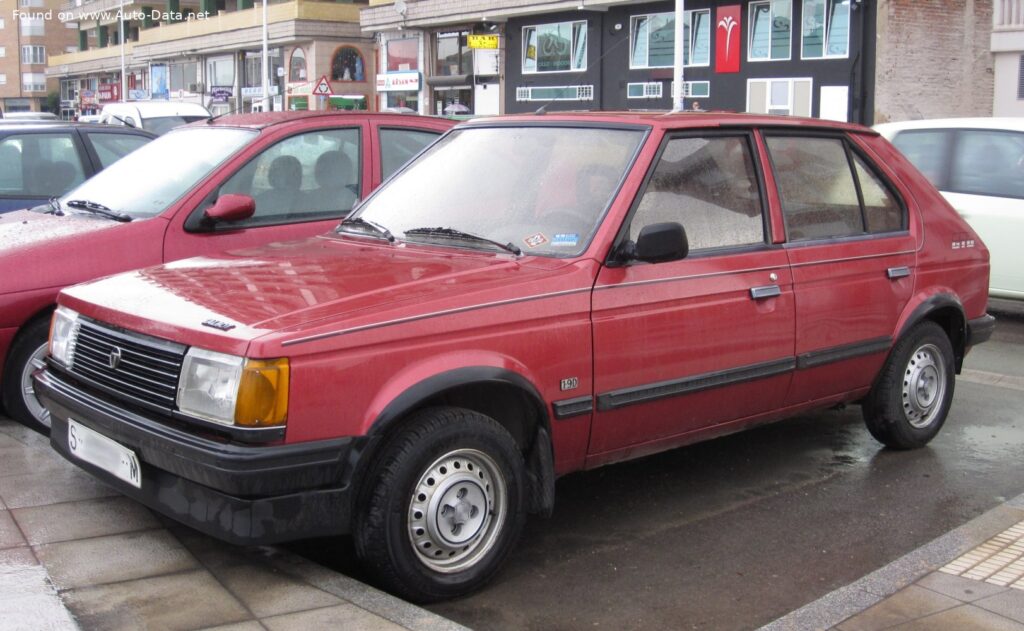
The Talbot Horizon, specifically the 1.1 (54 Hp) variant, represents a significant chapter in European automotive history, emerging during a period of intense competition and evolving consumer demands. Introduced in 1979, the Horizon was a compact family car designed to offer practicality, economy, and a modern aesthetic for its time. Originating from the complex lineage of Chrysler Europe, which included French manufacturer Simca, the Horizon was ultimately branded under the resurrected Talbot marque after Peugeot-Citroën (PSA) acquired Chrysler’s European operations. This front-wheel-drive hatchback quickly established itself in the fiercely contested C-segment, serving as a versatile and accessible option for families across the continent until its production concluded in 1984. Its design and engineering were geared towards the practicalities of daily European motoring, prioritizing interior space, fuel efficiency, and ease of maneuverability in urban environments, a philosophy that resonated strongly with its target demographic.
Talbot Horizon: A European Compact with Transatlantic Roots
The development of the Talbot Horizon began under Chrysler Europe, initially conceived as the “C2” project, intended to replace the aging Simca 1100 and Chrysler Alpine (Simca 1307/1308). Its gestation was marked by the financial difficulties of its parent company, leading to the sale of Chrysler Europe to PSA in 1978. As a result, the C2 project was rebranded, and the car launched as the Talbot Horizon, marking the revival of the historic British brand. This strategic move aimed to leverage the Talbot name in markets like the UK, while retaining Simca badging in France for a brief period. The Horizon was notable for being one of the first truly “world cars” from a European perspective, as a derivative, the Dodge Omni/Plymouth Horizon, was also produced and sold in North America, albeit with significant modifications to suit the US market’s regulations and consumer preferences. However, the European Talbot Horizon remained distinct, tailored specifically for its primary markets.
Upon its launch, the Talbot Horizon was met with considerable acclaim, even being awarded the prestigious European Car of the Year in 1979. This recognition underscored its innovative design, practical packaging, and overall competence in a crowded market. Its success was a testament to its forward-thinking approach, combining a spacious interior with a relatively compact exterior footprint. The car’s robust build quality for its class and its straightforward mechanicals contributed to its reputation for reliability, a crucial factor for family car buyers. The Horizon’s role was to provide affordable, dependable transportation, and it largely succeeded in fulfilling this mission throughout its production run, becoming a common sight on European roads during the late 1970s and early 1980s.
Engine & Performance: The Talbot Horizon 1.1 (54 Hp) Powertrain
The heart of the Talbot Horizon 1.1 (54 Hp) was a modest yet effective 1.1-liter (1118 cubic centimeters) naturally aspirated gasoline engine. This four-cylinder unit was a derivative of the well-proven Simca Poissy engine, known for its robustness and reliability. Producing 54 horsepower (Hp), this powertrain was engineered for economy and daily usability rather than outright performance. The engine’s design emphasized durability and ease of maintenance, characteristics highly valued by the average European motorist. Its naturally aspirated configuration meant a straightforward design, contributing to lower production costs and, typically, fewer complex components prone to failure, a significant advantage for a budget-conscious family vehicle.
In terms of performance, the 54 Hp output provided adequate power for urban commuting and gentle highway cruising. While not a powerhouse, the engine delivered sufficient torque at lower RPMs, making the car feel responsive enough in city traffic. Its relatively lightweight construction for its segment also aided in its perceived agility. Fuel efficiency was a key selling point for the 1.1-liter engine, especially during a period marked by fluctuating oil prices and increasing environmental awareness. The engine was designed to sip gasoline economically, making the Talbot Horizon an attractive proposition for buyers looking to minimize running costs. The integration of this reliable engine with a front-wheel-drive architecture provided predictable handling characteristics and maximized interior space, as the engine and transmission were packaged efficiently at the front of the vehicle. This setup, common for compact cars of the era, ensured that the power was delivered smoothly to the front wheels, offering a stable and secure driving experience for its target audience.
Design & Features: Practicality and Innovation in the Talbot Horizon
The design of the Talbot Horizon was a pragmatic response to the demands of the late 1970s European market. Its hatchback body type was a defining characteristic, offering a versatile combination of passenger comfort and cargo capacity. This five-door configuration, which was rapidly gaining popularity, allowed for easy access to the rear seating area and a large, accessible trunk opening when the rear seats were folded down. This adaptability made the Horizon an ideal choice for families, providing ample space for groceries, luggage, or even larger items for weekend trips. The exterior styling was clean and functional, eschewing unnecessary adornments in favor of a straightforward, modern aesthetic that has aged relatively gracefully.
Inside, the Horizon prioritized ergonomics and passenger comfort within its compact dimensions. The interior layout was logical, with controls intuitively placed for the driver. Large windows contributed to excellent all-around visibility, a crucial safety feature in busy urban environments. While not luxurious by modern standards, the materials and finishes were durable and designed to withstand the rigors of family use. Features for the era included comfortable seating for five, a clear instrument cluster, and often a basic heating and ventilation system. Depending on the trim level, options like a radio and more advanced upholstery could be found. Safety considerations for the period focused on robust body construction and effective braking systems, which the Horizon incorporated. Its design ethos was fundamentally about providing a dependable, spacious, and easy-to-live-with vehicle that met the practical needs of everyday European life, a philosophy that underpinned its widespread appeal and its recognition as a leading compact car of its time.
Technical Specifications: Talbot Horizon 1.1 (54 Hp)
| Brand | Talbot |
| Model | Horizon |
| Generation | Horizon |
| Type (Engine) | 1.1 (54 Hp) |
| Start of production | 1979 year |
| End of production | 1984 year |
| Powertrain Architecture | Internal Combustion engine |
| Body type | Hatchback |
| Fuel Type | Petrol (Gasoline) |
| Power | 54 Hp |
| Engine aspiration | Naturally aspirated engine |
