
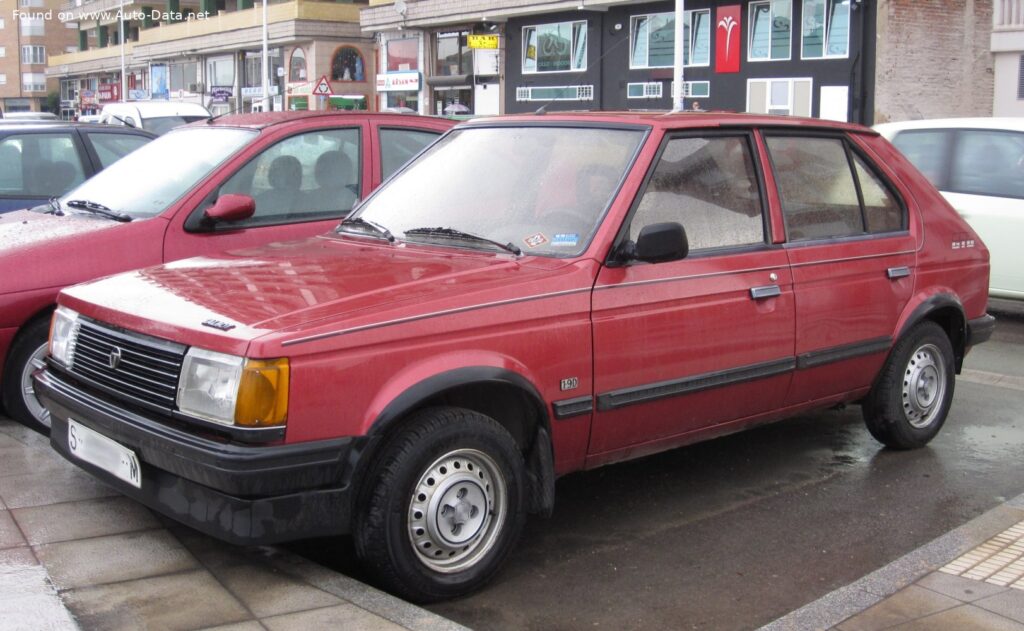
The Talbot Horizon, specifically the 1.4 (65 Hp) variant produced between 1982 and 1984, represents a significant chapter in the European automotive landscape of the early 1980s. Originally conceived under the Chrysler Europe banner as the C2 project, it was launched as the Simca-Talbot Horizon in 1978 before being solely branded as a Talbot following PSA Peugeot Citroën’s acquisition of Chrysler Europe in 1979. This compact hatchback, a staple of the C-segment, was designed with practicality, economy, and spaciousness in mind, catering to the needs of European families seeking an affordable and versatile daily driver. While never officially sold in the United States under its Talbot badge, a heavily re-engineered version was marketed as the Dodge Omni and Plymouth Horizon, sharing a common lineage but diverging significantly in technical specifications and market positioning. The European Talbot Horizon, however, carved out its own identity, embodying the transitional period for many European manufacturers grappling with evolving market demands and increasing competition.
The Talbot Horizon: A Legacy of European Engineering
The Talbot Horizon was more than just a car; it was a product of its time, reflecting the shift towards more fuel-efficient, space-optimized designs that became paramount in the post-oil crisis era. Its design was a collaborative effort, initially involving American and French engineering teams, aimed at creating a “world car” — a concept that proved challenging to execute across diverse markets. In Europe, the Horizon quickly established itself as a competent, if unadventurous, competitor in the fiercely contested compact segment, going head-to-head with rivals such as the Volkswagen Golf, Ford Escort, and Renault 14. Its appeal lay in its sensible approach to motoring, offering a comfortable ride, decent interior room for its footprint, and straightforward mechanicals that promised reliability and ease of maintenance. The 1.4-liter variant, introduced later in the model’s production cycle, served as a sweet spot in the range, balancing performance with economical operation.
Engine and Performance: The 1.4-liter Heart of the Horizon
At the core of the 1982-1984 Talbot Horizon 1.4 (65 Hp) was a naturally aspirated, inline four-cylinder gasoline engine. This 1.4-liter unit, a development of Simca’s long-standing Poissy engine family, was renowned for its robustness and simplicity. Delivering 65 horsepower, this engine was perfectly adequate for the Horizon’s primary role as a practical family car. While 65 horsepower might seem modest by today’s standards, in the early 1980s, for a compact car weighing roughly 2,000 pounds, it provided sufficient motivation for urban commuting and reasonable highway cruising. The naturally aspirated design meant predictable power delivery, without the complexities or additional costs associated with forced induction systems. Its focus was on efficiency and reliability rather than outright speed, offering a smooth, if not exhilarating, driving experience. Fuel consumption was a key selling point, and the 1.4-liter engine was designed to be economical, aligning with the prevailing consumer demand for lower running costs. While specific torque figures are not provided, it can be inferred that the engine delivered a usable spread of torque at lower RPMs, making it tractable in everyday driving conditions and reducing the need for constant gear changes. The powertrain architecture was typical for front-wheel-drive hatchbacks of the era, with the engine mounted transversely, optimizing interior space and packaging efficiency.
Design and Features: Practicality in a Hatchback Form
The Talbot Horizon’s design was emblematic of the early 1980s European compact car aesthetic: functional, unpretentious, and focused on maximizing interior volume. Its hatchback body type was inherently practical, offering a versatile cargo area accessible via a large rear tailgate, making it ideal for families and individuals who frequently needed to transport goods. The exterior styling, characterized by clean lines and a relatively boxy profile, prioritized aerodynamic efficiency (for its time) and interior space over flamboyant design flourishes. The large glass area contributed to good visibility, a crucial safety aspect. Inside, the Horizon’s cabin was designed for durability and ease of use. While luxury appointments were minimal, the emphasis was on comfortable seating, straightforward instrumentation, and logical control placement. Features typical of the era included manual windows, basic heating and ventilation systems, and often an optional radio. Safety features, by modern benchmarks, were rudimentary, primarily consisting of three-point seatbelts for front occupants and basic crumple zones integrated into the body structure. However, for its time, the Horizon met prevailing safety standards and offered a secure environment for its occupants. The suspension system, typically independent at the front with a semi-independent or torsion bar setup at the rear, provided a comfortable ride quality well-suited to varying European road conditions, prioritizing passenger comfort over sporty handling. The overall design ethos was one of thoughtful utility, providing European consumers with a dependable and adaptable vehicle that could meet a wide range of needs without breaking the bank.
Technical Specifications: Talbot Horizon 1.4 (65 Hp)
| Brand | Talbot |
| Model | Horizon |
| Generation | Horizon |
| Type (Engine) | 1.4 (65 Hp) |
| Start of production | 1982 year |
| End of production | 1984 year |
| Powertrain Architecture | Internal Combustion engine |
| Body type | Hatchback |
| Fuel Type | Petrol (Gasoline) |
| Power | 65 Hp |
| Engine aspiration | Naturally aspirated engine |
The Talbot Horizon, particularly in its 1.4 (65 Hp) guise, stands as a testament to the European automotive industry’s focus on practical, economical, and versatile transportation in the early 1980s. Its heritage, rooted in the complex mergers and acquisitions that shaped the era, gives it a unique place in automotive history. Though the Talbot brand itself eventually faded, the Horizon’s contribution to the compact car segment, its emphasis on interior space, and its robust mechanicals ensured its relevance during its production run. It represented a sensible choice for millions of drivers across Europe, embodying the qualities of a dependable family hatchback for a specific and challenging period in automotive development.
