
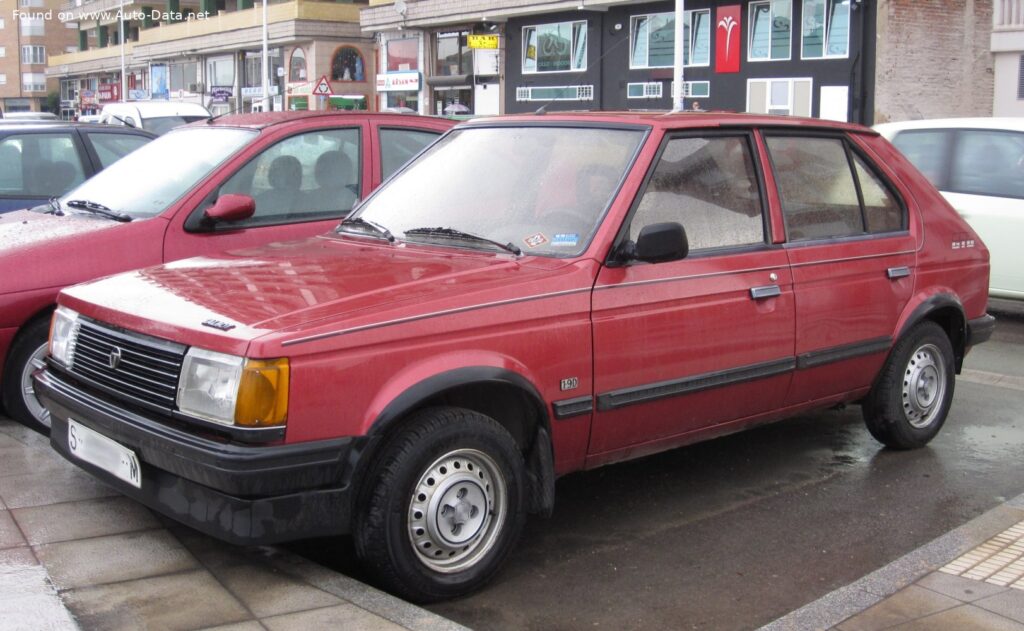
The Talbot Horizon, a compact hatchback introduced to the European market in 1979, emerged during a transformative period for the automotive industry. Originating from Chrysler Europe’s design philosophy before the brand’s acquisition by PSA Peugeot Citroën, the Horizon was conceived as a versatile, economical, and spacious family car tailored for the demanding European consumer. Its development, initially under the codename C2, aimed to create a modern successor to models like the Simca 1100 and Chrysler Alpine (also known as the Simca 1307/1308). Though never officially marketed in the United States under the Talbot badge, a derivative, the Dodge Omni and Plymouth Horizon, shared its foundational architecture, adapted significantly for the North American market. In its primary European markets, the Talbot Horizon quickly gained recognition for its innovative packaging, front-wheel-drive layout, and practical design, earning the prestigious European Car of the Year award in 1979.
The Talbot Horizon: A European Compact’s Enduring Legacy
The Talbot Horizon represented a critical chapter in European automotive history, marking the transition from the Simca brand to the newly resurrected Talbot marque under PSA ownership. Its introduction in 1979 came at a time when global oil crises had firmly shifted consumer demand towards smaller, more fuel-efficient vehicles. The Horizon excelled in this environment, offering a compelling blend of interior space, ride comfort, and economic operation in a compact footprint. Its design was a testament to the prevailing trends of the late 1970s and early 1980s, characterized by a functional, angular aesthetic that maximized interior volume and visibility. Despite its relatively short production run under the Talbot name, from 1979 to 1986, the Horizon left a significant mark, embodying the practical and sensible approach to family transportation that defined its era.
Powertrain and Performance: The 1.4 (69 Hp) Engine
At the heart of many Talbot Horizon models, particularly those aimed at balancing economy with adequate performance, was the 1.4-liter (1397 cc) naturally aspirated inline-four engine, producing 69 horsepower. This powerplant was a refined evolution of a long-standing Simca engine design, known for its robustness and reliability. In the context of the late 1970s and early 1980s, an output of 69 Hp from a 1.4-liter engine was considered competitive for a compact family hatchback. It provided sufficient power for urban commuting and comfortable highway cruising, without sacrificing fuel efficiency—a paramount concern for buyers at the time. The engine’s naturally aspirated nature meant a straightforward design, contributing to ease of maintenance and predictable power delivery. Fueling this unit was standard gasoline, reflecting the common practices of the period before the widespread adoption of more complex fuel injection systems across all segments. The front-wheel-drive powertrain architecture was a key element, contributing to superior traction, improved interior packaging, and stable handling characteristic of modern compact cars.
While 69 horsepower might seem modest by today’s standards, for a vehicle of its size and intended purpose in the early 1980s, it delivered a respectable driving experience. The Horizon was not designed for blistering acceleration, but rather for smooth, predictable power delivery in everyday driving scenarios. Its light curb weight for the time, combined with the responsive 1.4-liter engine, allowed for agile maneuverability in city traffic and sufficient capability for longer journeys. The engine’s design prioritized longevity and low running costs, making the Talbot Horizon an attractive proposition for families and individuals seeking dependable transportation without excessive expenditure on fuel or maintenance. This particular engine variant underscored the Horizon’s commitment to practicality and efficiency, making it a popular choice across various European markets.
Design and Features: Practicality and Innovation
The design of the Talbot Horizon was a hallmark of its era, characterized by its distinctive two-box hatchback body type. This configuration was rapidly gaining popularity in Europe during the late 1970s due to its inherent versatility, combining the benefits of a sedan’s passenger comfort with a wagon’s cargo capacity via a large rear hatch and folding rear seats. The Horizon’s exterior styling, while functional, incorporated subtle design cues that set it apart. Its clean lines and relatively large glass area contributed to excellent outward visibility, a significant safety and convenience feature. The compact dimensions belied a surprisingly spacious interior, a testament to clever packaging enabled by its front-wheel-drive layout. This allowed for a flat floor and generous legroom for both front and rear passengers, a considerable advantage over many rear-wheel-drive competitors.
Inside, the Horizon prioritized ergonomics and user-friendliness. The dashboard layout was straightforward, with clearly legible instrumentation and logically placed controls. While luxury features were scarce in the base models, higher trims offered amenities like improved upholstery, a clock, and perhaps a more advanced radio. Safety features, standard for its time, included three-point seatbelts for front occupants and laminated windshields. The Horizon’s commitment to practicality extended to its ride quality; its suspension was tuned to provide a comfortable and compliant ride, absorbing the imperfections of varied European road surfaces. This blend of spaciousness, practical design, and comfortable dynamics made the Talbot Horizon an ideal family car, capable of handling daily commutes, school runs, and extended holiday trips with equal ease. Its success in these areas contributed significantly to its critical acclaim and market acceptance during its production lifespan.
Technical Specifications: Talbot Horizon 1.4 (69 Hp)
| Brand | Talbot |
| Model | Horizon |
| Generation | Horizon |
| Type (Engine) | 1.4 (69 Hp) |
| Start of production | 1979 year |
| End of production | 1986 year |
| Powertrain Architecture | Internal Combustion engine |
| Body type | Hatchback |
| Fuel Type | Petrol (Gasoline) |
| Power | 69 Hp |
| Engine aspiration | Naturally aspirated engine |
