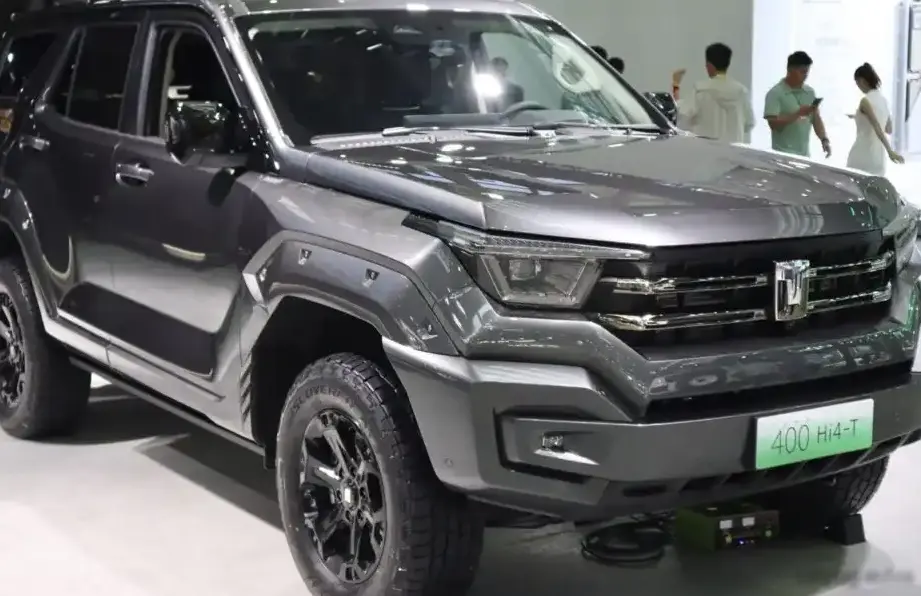
The Tank 400 2.0T, launched in January 2025, represents a significant entry into the mid-size SUV segment for the Tank brand, a sub-brand of Great Wall Motors focused on off-road capable vehicles. Positioned as a robust and capable SUV, the 2.0T variant serves as the primary offering, balancing performance with modern technology. It’s designed to appeal to drivers seeking a blend of on-road comfort and genuine off-road prowess. The Tank 400 is currently marketed primarily in the Chinese domestic market, with potential for expansion into other regions. This specific configuration, featuring a 2.0-liter turbocharged engine paired with a 9-speed automatic transmission and four-wheel drive, is the flagship powertrain option.
Technical Specifications
| Brand | Tank |
| Model | 400 |
| Generation | 400 |
| Type (Engine) | 2.0T (245 Hp) 4WD Automatic |
| Start of production | January, 2025 |
| Powertrain Architecture | Internal Combustion engine |
| Body type | SUV |
| Seats | 5 |
| Doors | 5 |
| Fuel consumption (economy) – urban | 11.9 l/100 km (19.8 US mpg, 23.7 UK mpg, 8.4 km/l) |
| Fuel consumption (economy) – extra urban | 9.2 l/100 km (25.6 US mpg, 30.7 UK mpg, 10.9 km/l) |
| Fuel consumption (economy) – combined | 10.2 l/100 km (23.1 US mpg, 27.7 UK mpg, 9.8 km/l) |
| Fuel Type | Petrol (Gasoline) |
| Acceleration 0 – 100 km/h | 9.7 sec |
| Acceleration 0 – 62 mph | 9.7 sec |
| Acceleration 0 – 60 mph | 9.2 sec |
| Maximum speed | 180 km/h (111.85 mph) |
| Weight-to-power ratio | 9.9 kg/Hp, 100.6 Hp/tonne |
| Weight-to-torque ratio | 6.4 kg/Nm, 156.1 Nm/tonne |
| Power | 245 Hp @ 5500-6000 rpm |
| Power per litre | 122.6 Hp/l |
| Torque | 380 Nm @ 1700-4000 rpm (280.27 lb.-ft. @ 1700-4000 rpm) |
| Engine layout | Front, Longitudinal |
| Engine Model/Code | E20NA |
| Engine displacement | 1998 cm3 (121.93 cu. in.) |
| Number of cylinders | 4 |
| Engine configuration | Inline |
| Cylinder Bore | 82 mm (3.23 in.) |
| Piston Stroke | 94.6 mm (3.72 in.) |
| Compression ratio | 11:1 |
| Number of valves per cylinder | 4 |
| Fuel injection system | Direct injection |
| Engine aspiration | Turbocharger, Intercooler |
| Valvetrain | DOHC |
| Engine oil capacity | 5.9 l (6.23 US qt | 5.19 UK qt) |
| Coolant | 8.3 l (8.77 US qt | 7.3 UK qt) |
| Kerb Weight | 2435 kg (5368.26 lbs.) |
| Max. weight | 2910 kg (6415.45 lbs.) |
| Max load | 475 kg (1047.2 lbs.) |
| Trunk (boot) space – minimum | 566 l (19.99 cu. ft.) |
| Trunk (boot) space – maximum | 1803 l (63.67 cu. ft.) |
| Fuel tank capacity | 80 l (21.13 US gal | 17.6 UK gal) |
| Permitted trailer load with brakes (12%) | 2500 kg (5511.56 lbs.) |
| Permitted trailer load without brakes | 750 kg (1653.47 lbs.) |
| Length | 4985 mm (196.26 in.) |
| Width | 1960 mm (77.17 in.) |
| Height | 1905 mm (75 in.) |
| Wheelbase | 2850 mm (112.2 in.) |
| Front track | 1635 mm (64.37 in.) |
| Rear (Back) track | 1635 mm (64.37 in.) |
| Ride height (ground clearance) | 235 mm (9.25 in.) |
| Approach angle | 33° |
| Departure angle | 31° |
| Ramp-over (brakeover) angle | 22.5° |
| Climb angle | 31° |
| Wading depth | 800 mm (31.5 in.) |
| Drivetrain Architecture | The Internal combustion engine (ICE) drives the rear wheels permanently, and the front wheels are driven through an electrically or mechanically operated clutch if necessary. |
| Drive wheel | All wheel drive (4×4) |
| Number of gears and type of gearbox | 9 gears, automatic transmission |
| Front suspension | Double wishbone, Independent coil spring, Transverse stabilizer |
| Rear suspension | dependent spring suspension, Transverse stabilizer |
| Front brakes | Ventilated discs |
| Rear brakes | Ventilated discs |
| Assisting systems | ABS (Anti-lock braking system) |
| Steering type | Steering rack and pinion |
| Power steering | Electric Steering |
| Tires size | 265/65 R18 |
| Wheel rims size | 18 |
Powertrain & Engine Architecture
The Tank 400 2.0T is powered by the E20NA, a 2.0-liter inline-four cylinder turbocharged gasoline engine. This engine utilizes direct fuel injection and a double overhead camshaft (DOHC) valvetrain, contributing to its efficient combustion and power output. The turbocharger, coupled with an intercooler, enhances performance by increasing air density entering the engine. The engine produces 245 horsepower at 5500-6000 rpm and 380 Nm (280.27 lb.-ft.) of torque between 1700-4000 rpm. This broad torque curve is a key characteristic, providing strong pulling power at lower engine speeds, beneficial for off-road driving. The engine also incorporates a Start & Stop system for improved fuel efficiency in urban conditions.
The engine is mated to a 9-speed automatic transmission. This transmission is designed to provide smooth gear changes and optimize fuel economy. The four-wheel drive system is a permanent rear-wheel drive setup with an electronically controlled clutch engaging the front wheels when needed, enhancing traction in challenging terrain.
Driving Characteristics
The Tank 400 2.0T delivers a driving experience geared towards capability and comfort. The 9-speed automatic transmission provides adequate acceleration, with a 0-60 mph time of approximately 9.2 seconds and a 0-100 km/h time of 9.7 seconds. While not a performance-oriented vehicle, the engine’s torque output ensures responsive acceleration in most driving situations. The four-wheel drive system provides excellent traction on various surfaces, making it well-suited for off-road adventures. The gear ratios are tuned to balance on-road cruising efficiency with off-road crawling ability. Compared to potential higher-output variants (if offered in the future), this 2.0T version prioritizes fuel economy and a more relaxed driving experience.
Equipment & Trim Levels
Specific trim levels and standard equipment for the Tank 400 2.0T can vary depending on the market and optional packages. Generally, the base model includes features such as automatic climate control, a touchscreen infotainment system, power windows and locks, and a comprehensive suite of safety features including ABS. Higher trim levels add features like leather upholstery, a premium sound system, advanced driver-assistance systems (ADAS), and enhanced interior trim. The interior design emphasizes durability and functionality, with a focus on providing a comfortable and practical space for both driver and passengers.
Chassis & Braking
The Tank 400 2.0T features a robust chassis designed to withstand off-road stresses. The front suspension utilizes a double wishbone independent coil spring setup with a transverse stabilizer bar, while the rear suspension employs a dependent spring suspension, also with a transverse stabilizer. This configuration provides a balance of on-road comfort and off-road articulation. The braking system consists of ventilated discs on all four wheels, providing ample stopping power. An Anti-lock Braking System (ABS) is standard, enhancing safety during emergency braking situations.
Market Reception & Comparison
The Tank 400 2.0T has been well-received in the Chinese market, where it competes with other mid-size SUVs known for their off-road capabilities. Critics have praised its robust construction, capable four-wheel drive system, and comfortable interior. Fuel economy is rated at 10.2 l/100 km (23.1 US mpg), which is competitive within its class. Compared to potential future higher-performance trims, the 2.0T version offers a more balanced combination of performance, fuel efficiency, and affordability.
Legacy
As a relatively new vehicle, the long-term reliability of the Tank 400 2.0T powertrain remains to be fully established. However, Great Wall Motors has a growing reputation for building durable and reliable vehicles. The E20NA engine is expected to prove reasonably reliable, given its modern design and use of direct injection technology. In the used car market, the Tank 400 2.0T is anticipated to hold its value well, particularly among buyers seeking a capable and well-equipped SUV with genuine off-road credentials.