
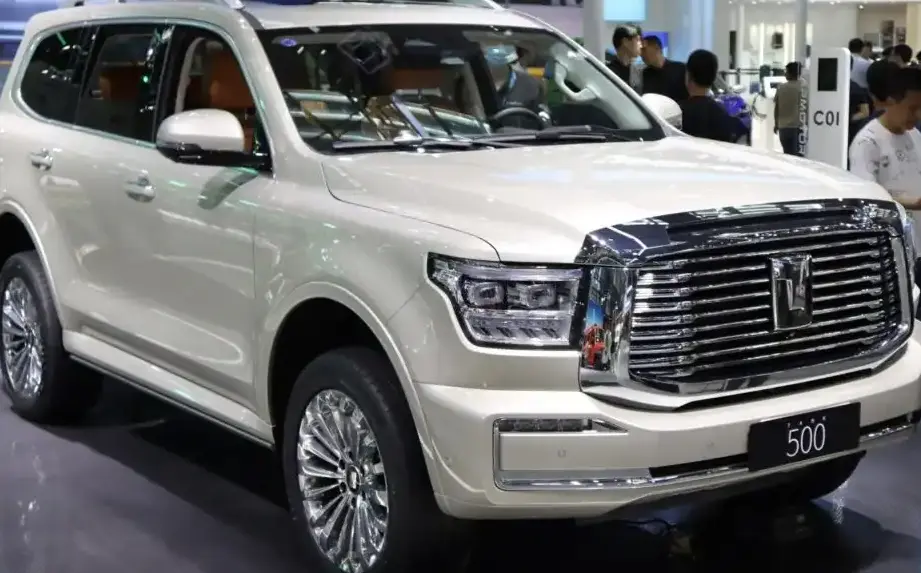
The Tank 500 2.0T Hybrid 4WD Automatic, launched in January 2024, represents a significant offering in the burgeoning full-size SUV market. Positioned as a mid-range option within the Tank 500 lineup, it blends robust off-road capability with a more fuel-efficient powertrain than its higher-output counterparts. This variant caters to buyers seeking a spacious, seven-seat SUV with a balance of performance and economy, particularly appealing to those prioritizing both on-road comfort and occasional off-pavement excursions. The Tank brand, a relatively new entrant, is focused on delivering rugged, body-on-frame SUVs, and the 500 is its flagship model, aiming to establish a foothold in a segment dominated by established players.
Technical Specifications
| Brand | Tank |
| Model | 500 |
| Generation | 500 |
| Type (Engine) | 2.0T (299 Hp) Hybrid 4WD Automatic |
| Start of production | January, 2024 |
| Powertrain Architecture | FHEV (Full Hybrid Electric Vehicle) |
| Body type | SUV |
| Seats | 7 |
| Doors | 5 |
| Fuel consumption (economy) – urban (NEDC) | 7.7 l/100 km (30.5 US mpg, 36.7 UK mpg, 13 km/l) |
| Fuel consumption (economy) – extra urban (NEDC) | 9 l/100 km (26.1 US mpg, 31.4 UK mpg, 11.1 km/l) |
| Fuel consumption (economy) – combined (NEDC) | 8.5 l/100 km (27.7 US mpg, 33.2 UK mpg, 11.8 km/l) |
| Fuel Type | Petrol (Gasoline) |
| Acceleration 0 – 100 km/h | 7.9 sec |
| Acceleration 0 – 62 mph | 7.9 sec |
| Acceleration 0 – 60 mph | 7.5 sec |
| Maximum speed | 180 km/h (111.85 mph) |
| Weight-to-power ratio | 8.7 kg/Hp, 114.8 Hp/tonne |
| Weight-to-torque ratio | 4.2 kg/Nm, 236.5 Nm/tonne |
| Gross battery capacity | 1.75 kWh |
| Battery voltage | 338.56 V |
| Battery technology | Lithium-ion (Li-Ion) |
| Electric motor power | 54 Hp |
| Electric motor Torque | 268 Nm (197.67 lb.-ft.) |
| Electric motor model/code | TZ290XH004 |
| Maximum revolutions of the electric motor | 7000 rpm |
| Electric motor location | Between the combustion engine and the transmission |
| Electric motor type | Synchronous |
| System power | 299 Hp |
| System torque | 616 Nm (454.34 lb.-ft.) |
| Power | 245 Hp @ 5500-6000 rpm |
| Power per litre | 122.6 Hp/l |
| Torque | 380 Nm @ 1700-4000 rpm (280.27 lb.-ft. @ 1700-4000 rpm) |
| Engine layout | Front, Longitudinal |
| Engine Model/Code | E20NA |
| Engine displacement | 1998 cm3 (121.93 cu. in.) |
| Number of cylinders | 4 |
| Engine configuration | Inline |
| Cylinder Bore | 82 mm (3.23 in.) |
| Piston Stroke | 94.6 mm (3.72 in.) |
| Number of valves per cylinder | 4 |
| Fuel injection system | Direct injection |
| Engine aspiration | Turbocharger, Intercooler |
| Valvetrain | DOHC |
| Engine oil capacity | 5.9 l (6.23 US qt | 5.19 UK qt) |
| Coolant | 10.2 l (10.78 US qt | 8.97 UK qt) |
| Kerb Weight | 2605 kg (5743.04 lbs.) |
| Max. weight | 3205 kg (7065.82 lbs.) |
| Max load | 600 kg (1322.77 lbs.) |
| Trunk (boot) space – minimum | 98 l (3.46 cu. ft.) |
| Trunk (boot) space – maximum | 1459 l (51.52 cu. ft.) |
| Fuel tank capacity | 80 l (21.13 US gal | 17.6 UK gal) |
| Permitted trailer load with brakes (12%) | 2500 kg (5511.56 lbs.) |
| Permitted trailer load without brakes | 750 kg (1653.47 lbs.) |
| Length | 5078 mm (199.92 in.) |
| Width | 1934 mm (76.14 in.) |
| Height | 1905 mm (75 in.) |
| Wheelbase | 2850 mm (112.2 in.) |
| Front track | 1635 mm (64.37 in.) |
| Rear (Back) track | 1635 mm (64.37 in.) |
| Ride height (ground clearance) | 224 mm (8.82 in.) |
| Approach angle | 29.5° |
| Departure angle | 24° |
| Ramp-over (brakeover) angle | 20° |
| Climb angle | 36.9° |
| Wading depth | 800 mm (31.5 in.) |
| Drivetrain Architecture | The Internal combustion engine (ICE) and the electric motor permanently drive the rear wheels of the vehicle, capable of running in full electric or mixed mode, and if necessary through the electrically or mechanically controlled clutch, the front wheels are driven. |
| Drive wheel | All wheel drive (4×4) |
| Number of gears and type of gearbox | 9 gears, automatic transmission |
| Front suspension | Double wishbone, Independent coil spring, Transverse stabilizer |
| Rear suspension | Rigid axle suspension, Transverse stabilizer, Coil spring |
| Front brakes | Ventilated discs |
| Rear brakes | Ventilated discs |
| Assisting systems | ABS (Anti-lock braking system) |
| Steering type | Steering rack and pinion |
| Power steering | Electric Steering |
| Tires size | 265/55 R19 |
| Wheel rims size | 8.5J x 19 |
Powertrain & Engine Architecture
The Tank 500 2.0T Hybrid utilizes a 2.0-liter turbocharged inline-four cylinder engine (code E20NA) paired with a 48-volt mild-hybrid system. This engine produces 245 horsepower at 5500-6000 rpm and 380 Nm (280.27 lb-ft) of torque between 1700-4000 rpm. The electric motor contributes an additional 54 horsepower and 268 Nm (197.67 lb-ft) of torque, bringing the total system output to 299 horsepower and 616 Nm (454.34 lb-ft). The engine features direct fuel injection and a double overhead camshaft (DOHC) valvetrain. The 48V system allows for features like regenerative braking and smoother start-stop functionality. Power is delivered to all four wheels via a sophisticated 9-speed automatic transmission. The electric motor is positioned between the engine and transmission, providing immediate torque fill and assisting the engine during acceleration.
Driving Characteristics
The 2.0T Hybrid offers a noticeably different driving experience compared to the higher-powered 3.0-liter V6 versions of the Tank 500. While lacking the outright acceleration of the V6, the 2.0T provides ample power for everyday driving and highway cruising. The hybrid system effectively masks any turbo lag, delivering a smooth and linear power delivery. The 9-speed automatic transmission is well-tuned, offering quick and seamless shifts. The all-wheel-drive system provides excellent traction in various conditions, making it capable both on and off-road. While not as overtly sporty as some competitors, the Tank 500 2.0T prioritizes comfort and refinement, offering a composed ride even on rough surfaces.
Equipment & Trim Levels
The Tank 500 2.0T Hybrid typically comes well-equipped, featuring standard amenities such as leather upholstery, a large touchscreen infotainment system with Apple CarPlay and Android Auto compatibility, a panoramic sunroof, and a comprehensive suite of safety features including automatic emergency braking, lane departure warning, and adaptive cruise control. Higher trim levels add features like premium audio systems, ventilated front seats, and advanced driver-assistance systems. The interior design emphasizes spaciousness and practicality, with ample storage compartments and comfortable seating for up to seven passengers.
Chassis & Braking
The Tank 500 utilizes a traditional body-on-frame construction, providing a robust and durable platform for off-road adventures. The front suspension features a double wishbone setup with independent coil springs and a transverse stabilizer bar, while the rear employs a rigid axle suspension with coil springs and a stabilizer bar. This configuration balances on-road comfort with off-road capability. Braking duties are handled by ventilated discs on all four wheels, coupled with an anti-lock braking system (ABS) for enhanced safety. The steering is electrically assisted, providing a light and responsive feel.
Market Reception & Comparison
The Tank 500 2.0T Hybrid has been generally well-received by automotive critics, who praise its spacious interior, comfortable ride, and capable off-road performance. The hybrid powertrain is seen as a positive step towards improved fuel efficiency, although real-world fuel economy may vary depending on driving conditions. Compared to the V6 models, the 2.0T offers a more affordable entry point into the Tank 500 lineup, making it accessible to a wider range of buyers. However, some critics note that it lacks the outright performance of its more powerful siblings. Competitors in this segment include the Toyota Sequoia, Ford Expedition, and Chevrolet Tahoe.
Legacy
As a relatively new model, the long-term reliability of the Tank 500 2.0T Hybrid remains to be seen. However, the use of proven technology from established suppliers suggests a reasonable expectation of durability. The 2.0-liter turbocharged engine has been used in various other vehicles, and the 9-speed automatic transmission is also a well-regarded unit. In the used car market, the Tank 500 2.0T Hybrid is expected to hold its value reasonably well, particularly among buyers seeking a spacious, capable, and fuel-efficient SUV.

