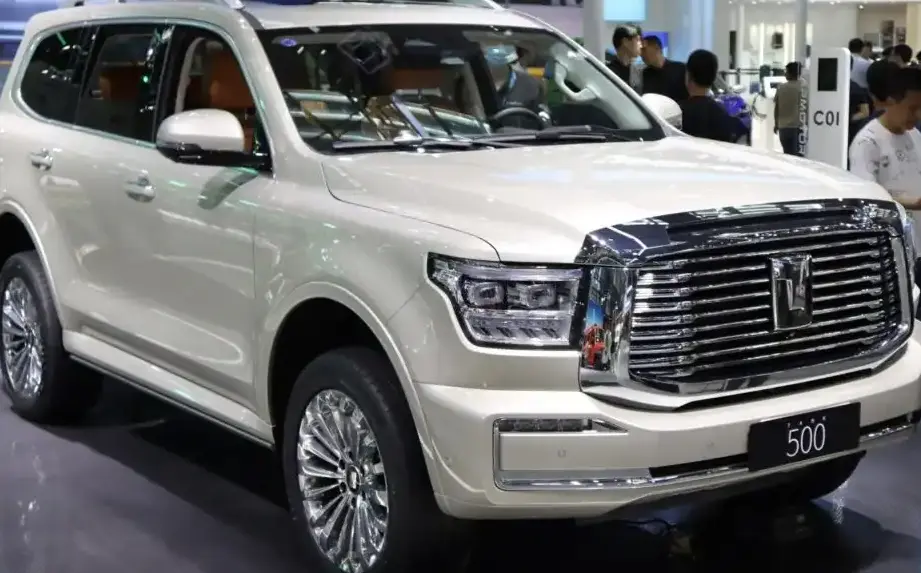
The Tank 500 Hi4-Z 2.0T, introduced in August 2025 as part of the facelifted model year, represents a significant step in the evolution of the Tank 500 SUV. This variant combines a 2.0-liter turbocharged four-cylinder engine with a substantial 59.05 kWh battery pack, creating a plug-in hybrid (PHEV) powertrain delivering a combined system output of 863 horsepower. Positioned as a high-performance, technologically advanced offering within the 500 lineup, it caters to buyers seeking both off-road capability and efficient, powerful motoring. The Tank brand, originating from China, aims to establish itself as a premium SUV manufacturer specializing in robust, capable vehicles, and the Hi4-Z is a flagship expression of that ambition.
Technical Specifications
| Brand | Tank |
| Model | 500 |
| Generation | 500 (facelift 2025) |
| Type (Engine) | Hi4-Z 2.0T 59.05 kWh (863 Hp) Plug-in Hybrid 4WD DHT |
| Start of production | August, 2025 |
| Powertrain Architecture | PHEV (Plug-in Hybrid Electric Vehicle) |
| Body type | SUV |
| Seats | 5 |
| Doors | 5 |
| Fuel consumption (economy) – combined (WLTC) | 0.76-8.6 l/100 km |
| Fuel consumption (economy) – combined (US mpg) | 309.5 – 27.4 US mpg |
| Fuel consumption (economy) – combined (UK mpg) | 371.7 – 32.8 UK mpg |
| Fuel consumption (economy) – combined (km/l) | 131.6 – 11.6 km/l |
| Fuel Type | Petrol / electricity |
| Acceleration 0 – 100 km/h | 4.3 sec |
| Acceleration 0 – 62 mph | 4.3 sec |
| Acceleration 0 – 60 mph | 4.1 sec |
| Maximum speed | 180 km/h (111.85 mph) |
| Weight-to-power ratio | 3.5 kg/Hp, 289.6 Hp/tonne |
| Weight-to-torque ratio | 2.5 kg/Nm, 401 Nm/tonne |
| Gross battery capacity | 59.05 kWh |
| Battery voltage | 518 V |
| Battery technology | Lithium nickel manganese cobalt oxides (Li-NMC) |
| Battery location | Below the floor |
| All-electric range (WLTC) | 201 km (124.9 mi) |
| Average Energy consumption (WLTC) | 27.3 kWh/100 km (43.94 kWh/100 mi) |
| Average Energy consumption (MPGe) | 77 MPGe |
| Average Energy consumption (km/kWh) | 3.7 km/kWh |
| Average Energy consumption (mi/kWh) | 2.3 mi/kWh |
| Electric motor power (Motor 1) | 292 Hp |
| Electric motor Torque (Motor 1) | 400 Nm (295.02 lb.-ft.) |
| Electric motor model/code (Motor 1) | TZ290XH006 |
| Maximum revolutions of the electric motor (Motor 1) | 7000 rpm |
| Electric motor location (Motor 1) | Between the combustion engine and the transmission |
| Electric motor type (Motor 1) | Synchronous |
| Electric motor power (Motor 2) | 326 Hp |
| Electric motor Torque (Motor 2) | 415 Nm (306.09 lb.-ft.) |
| Electric motor model/code (Motor 2) | TZ220XH008 |
| Maximum revolutions of the electric motor (Motor 2) | 18000 rpm |
| Electric motor location (Motor 2) | Rear axle, Transverse |
| Electric motor type (Motor 2) | Synchronous |
| System power | 863 Hp |
| System torque | 1195 Nm (881.39 lb.-ft.) |
| Power | 252 Hp @ 6000 rpm |
| Torque | 385 Nm @ 1700-4000 rpm (283.96 lb.-ft. @ 1700-4000 rpm) |
| Engine layout | Front, Longitudinal |
| Engine Model/Code | E20NB |
| Engine displacement | 1998 cm3 (121.93 cu. in.) |
| Number of cylinders | 4 |
| Engine configuration | Inline |
| Cylinder Bore | 82 mm (3.23 in.) |
| Piston Stroke | 94.6 mm (3.72 in.) |
| Number of valves per cylinder | 4 |
| Fuel injection system | Direct injection |
| Engine aspiration | Turbocharger, Intercooler |
| Valvetrain | DOHC |
| Engine oil capacity | 5.9 l (6.23 US qt | 5.19 UK qt) |
| Coolant | 9.5 l (10.04 US qt | 8.36 UK qt) |
| Kerb Weight | 2980 kg (6569.78 lbs.) |
| Max. weight | 3430 kg (7561.86 lbs.) |
| Max load | 450 kg (992.08 lbs.) |
| Trunk (boot) space – maximum | 1489 l (52.58 cu. ft.) |
| Fuel tank capacity | 77 l (20.34 US gal | 16.94 UK gal) |
| Permitted trailer load with brakes (12%) | 2500 kg (5511.56 lbs.) |
| Length | 5078 mm (199.92 in.) |
| Width | 1934 mm (76.14 in.) |
| Height | 1905 mm (75 in.) |
| Wheelbase | 2850 mm (112.2 in.) |
| Front track | 1635 mm (64.37 in.) |
| Rear (Back) track | 1635 mm (64.37 in.) |
| Ride height (ground clearance) | 210 mm (8.27 in.) |
| Approach angle | 29° |
| Departure angle | 24° |
| Climb angle | 36.9° |
| Drivetrain Architecture | ICE drives front wheels, electric motors drive front and rear wheels. |
| Drive wheel | All wheel drive (4×4) |
| Number of gears and type of gearbox | 3 gears, automatic transmission DHT |
| Front suspension | Double wishbone, Independent coil spring, Transverse stabilizer |
| Rear suspension | Suspension De-Dion, Transverse stabilizer, Coil spring |
| Front brakes | Ventilated discs |
| Rear brakes | Ventilated discs |
| Assisting systems | ABS (Anti-lock braking system) |
| Steering type | Steering rack and pinion |
| Power steering | Electric Steering |
| Tires size | 265/60 R18; 265/55 R19; 265/50 R20 |
| Wheel rims size | 8J x 18; 8.5J x 19; 8.5J x 20 |
Powertrain & Engine Architecture
The heart of the Tank 500 Hi4-Z is the E20NB 2.0-liter inline four-cylinder turbocharged engine. This engine utilizes direct fuel injection and a double overhead camshaft (DOHC) valvetrain to optimize combustion efficiency and power output. The turbocharger, coupled with an intercooler, minimizes intake air temperature, further enhancing performance. The engine produces 252 horsepower at 6000 rpm and 385 Nm (283.96 lb-ft) of torque between 1700 and 4000 rpm. This is paired with two electric motors – one integrated with the front axle and another driving the rear axle – and a 59.05 kWh lithium nickel manganese cobalt oxide (Li-NMC) battery pack positioned under the vehicle floor. The combined system output reaches an impressive 863 horsepower and 1195 Nm (881.39 lb-ft) of torque. The Tank utilizes a DHT (Dedicated Hybrid Transmission), a three-speed automatic transmission designed specifically for hybrid applications, allowing for seamless transitions between electric, hybrid, and combustion power modes.
Driving Characteristics
The Hi4-Z delivers exceptionally quick acceleration, achieving 0-100 km/h (0-62 mph) in just 4.3 seconds. The electric motors provide instant torque, resulting in strong off-the-line performance. The DHT transmission, while only having three gears, is tuned to maximize efficiency and responsiveness. In electric mode, the vehicle offers a quiet and refined driving experience with a range of 201 km (124.9 miles). The all-wheel-drive system, combined with the high ground clearance and capable suspension, ensures excellent off-road performance. Compared to lower-powered Tank 500 variants, the Hi4-Z offers a significantly more dynamic and engaging driving experience, sacrificing some fuel economy for substantial performance gains.
Equipment & Trim Levels
The Hi4-Z trim typically includes a high level of standard equipment. This generally encompasses premium leather upholstery, a large touchscreen infotainment system with advanced connectivity features, a panoramic sunroof, and a comprehensive suite of driver-assistance systems. Optional extras may include upgraded audio systems, adaptive cruise control, and specialized off-road packages. The interior design emphasizes luxury and functionality, with a focus on providing a comfortable and technologically advanced cabin environment.
Chassis & Braking
The Tank 500 Hi4-Z features a robust chassis designed to handle both on-road and off-road conditions. It utilizes a double wishbone independent suspension at the front and a De-Dion suspension setup at the rear, both incorporating coil springs and transverse stabilizers. This configuration provides a balance of ride comfort and handling stability. The braking system consists of ventilated discs on all four wheels, coupled with ABS (Anti-lock Braking System) for enhanced safety. The vehicle’s substantial weight (2980 kg / 6569.78 lbs) necessitates a powerful braking system to ensure adequate stopping performance.
Market Reception & Comparison
The Tank 500 Hi4-Z has been generally well-received by automotive critics, who praise its impressive performance, luxurious interior, and off-road capabilities. The plug-in hybrid powertrain offers a compelling combination of efficiency and power, appealing to environmentally conscious buyers who also demand high performance. Compared to other Tank 500 trims, the Hi4-Z represents the premium offering, commanding a higher price point. Its fuel economy, while improved in hybrid mode, is still relatively high compared to some competitors, but the performance benefits often outweigh this concern for target buyers.
Legacy
The long-term reliability of the Hi4-Z powertrain remains to be fully established, as it is a relatively new offering. However, the combination of a proven 2.0-liter turbo engine and advanced hybrid technology suggests a reasonable expectation of durability. The vehicle’s robust construction and comprehensive warranty further enhance its appeal in the used car market. As Tank establishes itself as a brand, the Hi4-Z is likely to become a sought-after variant, representing the pinnacle of performance and technology within the 500 lineup.