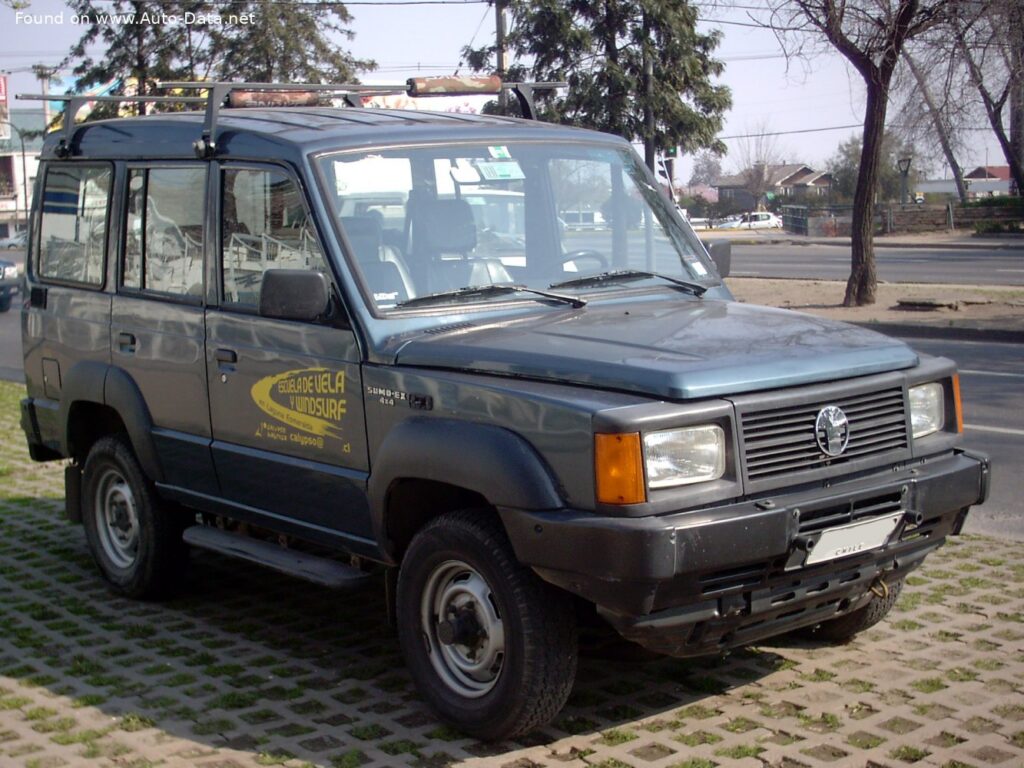
The Tata Sumo 1.9 TD is a rugged, body-on-frame SUV produced by the Indian manufacturer Tata Motors from 1996 to 2004. While largely unknown in North American markets, the Sumo played a significant role in the Indian automotive landscape, offering a relatively affordable and durable vehicle capable of handling the challenging road conditions prevalent throughout the country. It was positioned as a utilitarian vehicle, popular among both private buyers and commercial operators, serving as a passenger carrier, a light goods transport, and even as an ambulance in some instances. The Sumo’s design was heavily influenced by the Mercedes-Benz G-Wagen, a connection that contributed to its robust image and off-road capability. This article details the technical specifications and characteristics of the 1.9 TD variant, a diesel-powered version that was a mainstay of the Sumo lineup.
The Tata Sumo 1.9 TD: A Detailed Overview
The Tata Sumo 1.9 TD represented a key offering in Tata’s portfolio during the late 1990s and early 2000s. It was designed to cater to the demand for a spacious, durable, and relatively affordable SUV in a market where passenger vehicle ownership was growing but infrastructure remained underdeveloped. The vehicle’s body-on-frame construction, coupled with a four-wheel-drive system, made it well-suited for navigating rough terrain and unpaved roads. The 1.9-liter turbocharged diesel engine provided adequate power and torque for its intended purpose, prioritizing fuel efficiency and reliability over outright performance. The Sumo’s simple, functional design and robust mechanicals contributed to its longevity and ease of maintenance, making it a popular choice in rural and semi-urban areas.
Engine & Performance
The heart of the Tata Sumo 1.9 TD is a 1.9-liter inline-four cylinder diesel engine. This engine, displacing 1948 cm³ (118.87 cubic inches), produces 90 horsepower at 4300 rpm and 186 Nm (137.19 lb.-ft.) of torque at 2500 rpm. The engine utilizes a precombustion chamber injection system and is turbocharged, enhancing its power output and efficiency. The power-to-weight ratio stands at 19.1 kg/Hp (52.3 Hp/tonne), while the torque-to-weight ratio is 9.2 kg/Nm (108.1 Nm/tonne). The engine’s longitudinal front-engine layout contributes to the vehicle’s balanced handling. The Sumo 1.9 TD achieves a maximum speed of 118 km/h (73.32 mph). While not a performance vehicle, the engine provides sufficient power for everyday driving and off-road excursions. The compression ratio of 21:1 is typical for diesel engines of this era, contributing to their efficiency. The engine features an Overhead Camshaft (OHC) valvetrain and 2 valves per cylinder.
Design & Features
The Tata Sumo 1.9 TD is a four-door, five-seater off-road vehicle. Its boxy, utilitarian design reflects its intended purpose. The body-on-frame construction provides a high degree of structural rigidity, essential for off-road driving and carrying heavy loads. The vehicle’s dimensions are as follows: length 4450 mm (175.2 in), width 1755 mm (69.09 in), and height 1975 mm (77.76 in). The wheelbase measures 2400 mm (94.49 in), and the front and rear tracks are 1460 mm (57.48 in) and 1450 mm (57.09 in) respectively. The Sumo features a hydraulic power steering system for ease of maneuverability. Safety features, while basic by modern standards, included an Anti-lock Braking System (ABS). The front brakes are discs, while the rear brakes are drums. The vehicle rides on 215/75 R15 tires. The Sumo’s interior is functional and spartan, prioritizing durability and practicality over luxury. The fuel tank capacity is 65 liters (17.17 US gal | 14.3 UK gal).
Technical Specifications
| Brand | Tata |
| Model | Sumo |
| Generation | Sumo |
| Type (Engine) | 1.9 TD (90 Hp) |
| Start of production | 1996 year |
| End of production | 2004 year |
| Powertrain Architecture | Internal Combustion engine |
| Body type | Off-road vehicle |
| Seats | 5 |
| Doors | 4 |
| Fuel Type | Diesel |
| Maximum speed | 118 km/h (73.32 mph) |
| Weight-to-power ratio | 19.1 kg/Hp, 52.3 Hp/tonne |
| Weight-to-torque ratio | 9.2 kg/Nm, 108.1 Nm/tonne |
| Power | 90 Hp @ 4300 rpm |
| Power per litre | 46.2 Hp/l |
| Torque | 186 Nm @ 2500 rpm (137.19 lb.-ft. @ 2500 rpm) |
| Engine layout | Front, Longitudinal |
| Engine displacement | 1948 cm3 (118.87 cu. in.) |
| Number of cylinders | 4 |
| Engine configuration | Inline |
| Cylinder Bore | 83 mm (3.27 in.) |
| Piston Stroke | 90 mm (3.54 in.) |
| Compression ratio | 21:1 |
| Number of valves per cylinder | 2 |
| Fuel injection system | Precombustion chamber injection |
| Engine aspiration | Turbocharger |
| Valvetrain | OHC |
| Kerb Weight | 1720 kg (3791.95 lbs.) |
| Max. weight | 2730 kg (6018.62 lbs.) |
| Max load | 1010 kg (2226.67 lbs.) |
| Fuel tank capacity | 65 l (17.17 US gal | 14.3 UK gal) |
| Length | 4450 mm (175.2 in.) |
| Width | 1755 mm (69.09 in.) |
| Height | 1975 mm (77.76 in.) |
| Wheelbase | 2400 mm (94.49 in.) |
| Front track | 1460 mm (57.48 in.) |
| Rear (Back) track | 1450 mm (57.09 in.) |
| Drive wheel | All wheel drive (4×4) |
| Number of gears and type of gearbox | 5 gears, manual transmission |
| Front suspension | Double wishbone |
| Rear suspension | Coil spring |
| Front brakes | Disc |
| Rear brakes | Drum |
| Assisting systems | ABS (Anti-lock braking system) |
| Power steering | Hydraulic Steering |
| Tires size | 215/75 R15 |
In conclusion, the Tata Sumo 1.9 TD was a significant vehicle in the Indian automotive market, offering a blend of affordability, durability, and off-road capability. While not known for its speed or luxury, it served a vital role in transporting people and goods across the diverse and often challenging terrain of the Indian subcontinent. Its robust construction and simple mechanicals ensured its longevity and made it a popular choice for those seeking a reliable and practical SUV.