
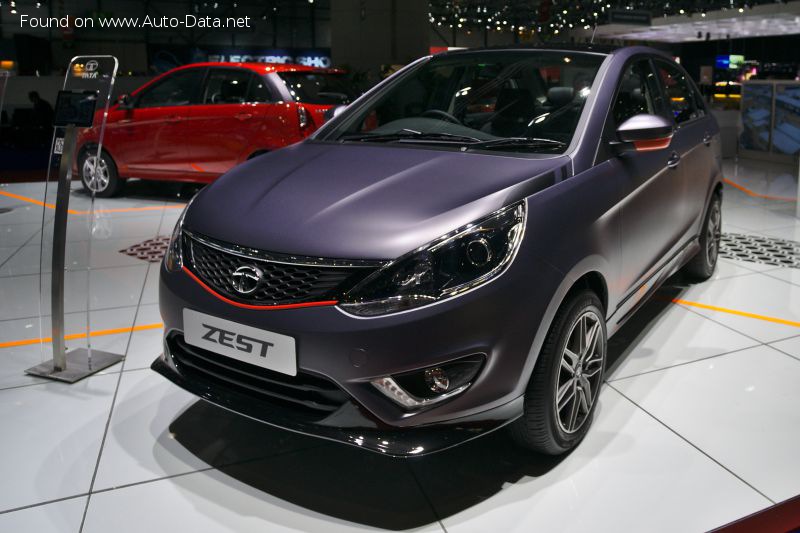
The Tata Zest 1.2 (90 hp) was a subcompact sedan produced by the Indian manufacturer Tata Motors from 2014 onwards. It represented a significant step forward for Tata in terms of design, features, and overall refinement, aiming to compete with established players in the increasingly competitive Indian automotive market. This particular variant, powered by a 1.2-liter turbocharged petrol engine producing 90 horsepower, served as a key entry point into the Zest lineup, offering a balance of affordability and acceptable performance. The Zest was built on a modified version of the Tata Vista platform, and was notable for being the first Tata vehicle to offer an automatic transmission option.
Powertrain & Engine Architecture
The heart of the Tata Zest 1.2 (90 hp) is the Revotron 1.2T engine, specifically the turbocharged variant. This engine, designated as the XET, is a 1193cc inline-four cylinder unit. It features a single overhead camshaft (SOHC) valvetrain with two valves per cylinder. A key feature of this engine was its use of a turbocharger and intercooler, which significantly boosted power output compared to naturally aspirated engines of similar displacement. The fuel injection system is a multi-point manifold injection system, providing precise fuel delivery for optimal combustion. The engine produces a peak power output of 90 hp at 5000 rpm and a maximum torque of 140 Nm (103.26 lb-ft) between 1500 and 4000 rpm. This relatively flat torque curve aimed to provide good drivability in urban conditions.
The Zest 1.2 was offered with both a 5-speed manual transmission and a 6-speed automated manual transmission (AMT). The AMT, sourced from Magneti Marelli, was a significant selling point, being one of the first affordable automatic options in the subcompact sedan segment in India. The AMT operates as a conventional manual transmission but utilizes actuators to shift gears automatically, eliminating the need for a clutch pedal. While not as smooth as a traditional torque-converter automatic, it offered improved fuel efficiency and lower cost.
Engine Codes & Variations
The Revotron 1.2T engine family included several variations. While the 90 hp version was the most common in the Zest, a slightly higher output version was also available in other Tata models. The engine code XET specifically identifies the 90 hp turbocharged variant used in the Zest. The engine’s design prioritized fuel efficiency and reliability, making it suitable for the demands of the Indian market.
Driving Characteristics
The Tata Zest 1.2 (90 hp) with the manual transmission offered adequate performance for city driving and occasional highway trips. Acceleration from 0 to 100 km/h (0-62 mph) took approximately 17 seconds, while 0-60 mph was achieved in around 16.2 seconds. The top speed was rated at 154 km/h (95.69 mph). The turbocharger provided a noticeable boost in power during acceleration, but turbo lag was present, particularly at lower engine speeds. The 5-speed manual transmission had relatively short gear ratios, aimed at maximizing acceleration.
The AMT version, while offering the convenience of automatic operation, exhibited slightly slower acceleration due to the inherent limitations of the automated manual transmission technology. Gear shifts were not as seamless as those of a traditional automatic, and a slight jerkiness could be felt during shifts. However, the AMT proved popular among drivers seeking an easy-to-drive vehicle in congested urban environments. The weight-to-power ratio of 12.4 kg/hp and weight-to-torque ratio of 8 kg/Nm indicated a reasonable, though not exceptional, power-to-weight balance.
Equipment & Trim Levels
The Tata Zest 1.2 (90 hp) was available in several trim levels, including Base, DX, LX, and XZ+. The base models offered essential features such as air conditioning, power steering, and basic instrumentation. Higher trim levels added features like alloy wheels, a touchscreen infotainment system, Bluetooth connectivity, steering-mounted audio controls, and rear parking sensors. The XZ+ trim, being the top-of-the-line variant, included additional features like automatic climate control, a voice command system, and a rear center armrest.
Interior upholstery varied depending on the trim level, ranging from basic fabric in the lower trims to premium fabric or leatherette in the higher trims. The dashboard design was relatively modern for its time, with a focus on functionality and ergonomics. Optional extras included a navigation system, a reverse parking camera, and various cosmetic enhancements.
Chassis & Braking
The Tata Zest featured an independent McPherson strut suspension at the front and a semi-independent coil spring suspension at the rear. This suspension setup provided a reasonable balance between ride comfort and handling. The front brakes were disc brakes, while the rear brakes were drum brakes. Anti-lock braking system (ABS) was available on higher trim levels, enhancing braking performance and safety. The steering system was an electric power steering (EPS) system, providing light and easy steering feel. The Zest rode on 185/60 R15 tires, mounted on 15-inch steel or alloy wheels.
Market Reception & Comparison
The Tata Zest 1.2 (90 hp) received mixed reviews from automotive critics. It was praised for its spacious interior, comfortable ride, and the availability of an automatic transmission at an affordable price point. However, it was also criticized for its engine refinement, turbo lag, and the somewhat jerky gear shifts of the AMT. Compared to its rivals, such as the Maruti Suzuki Swift Dzire and the Honda Amaze, the Zest offered a more spacious interior and a more powerful engine, but it lacked the overall refinement and brand reputation of its competitors.
Fuel economy was a strong point for the Zest, with a combined fuel consumption of 5.7 l/100 km (41.3 US mpg, 49.6 UK mpg, 17.5 km/l). Reliability was generally considered to be average, with some reports of minor issues with the AMT and the engine’s cooling system. However, overall, the Zest proved to be a relatively reliable vehicle.
Technical Specifications
| Brand | Tata |
| Model | Zest |
| Engine Type | 1.2L Turbo Petrol |
| Engine Displacement | 1193 cm3 (72.8 cu. in.) |
| Number of Cylinders | 4, Inline |
| Valves per Cylinder | 2 |
| Fuel Injection | Multi-point Manifold Injection |
| Engine Aspiration | Turbocharged, Intercooled |
| Maximum Power | 90 hp @ 5000 rpm |
| Maximum Torque | 140 Nm (103.26 lb-ft) @ 1500-4000 rpm |
| Transmission | 5-speed Manual / 6-speed AMT |
| Drive Type | Front Wheel Drive |
| Kerb Weight | 1115 kg (2458.15 lbs) |
| Fuel Consumption (Combined) | 5.7 l/100 km (41.3 US mpg, 49.6 UK mpg, 17.5 km/l) |
| Fuel Tank Capacity | 44 l (11.62 US gal, 9.68 UK gal) |
| Trunk Space | 390 l (13.77 cu. ft.) |
| Dimensions (L x W x H) | 3995 mm x 1706 mm x 1570 mm (157.28 in x 67.17 in x 61.81 in) |
| Wheelbase | 2470 mm (97.24 in) |
Legacy
The Tata Zest 1.2 (90 hp) played a crucial role in Tata Motors’ turnaround strategy. It demonstrated the company’s ability to develop and produce a modern, feature-rich, and relatively refined vehicle. While it has been discontinued, the Zest remains a popular choice in the used car market, particularly among buyers seeking an affordable and spacious sedan with an automatic transmission. The Revotron 1.2T engine, despite its limitations, proved to be a capable and reliable powerplant, and its development paved the way for future Tata engines. The Zest’s success helped to establish Tata as a more credible player in the Indian automotive industry, setting the stage for the launch of more successful models in subsequent years.
