
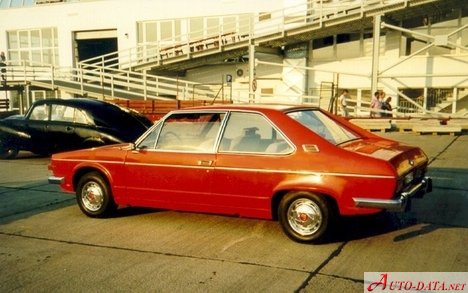
The Tatra T613 3.5 V8 16V, produced between 1973 and 1980, represents a significant evolution in the Tatra lineage, continuing the Czech manufacturer’s tradition of rear-engined, air-cooled luxury automobiles. This variant, powered by a 3.5-liter V8 engine producing 170 horsepower, occupied the top-tier position within the T613 range during its production run. It was designed as a prestige vehicle, intended for high-ranking government officials and select private buyers, embodying both engineering innovation and a distinct aesthetic. The T613 series, built upon a backbone chassis, was a departure from earlier Tatra designs, incorporating more modern styling and improved comfort while retaining the brand’s signature rear-engine layout.
Tatra T613 3.5 V8 16V: An Overview
The T613 was conceived as a replacement for the aging T603, aiming to provide a more contemporary and refined experience. The 3.5 V8 16V model, introduced in 1973, was the flagship of the range, offering increased power and performance compared to earlier iterations. It represented a considerable investment in engineering and design, reflecting Tatra’s commitment to maintaining its position as a producer of high-quality, uniquely designed vehicles. The car’s production coincided with a period of political and economic change in Czechoslovakia, influencing its availability and target market.
Powertrain & Engine Architecture
The heart of the T613 3.5 V8 16V is its 3,495 cc (213.28 cu. in.) naturally aspirated V8 engine. This engine, designated as a high-performance variant, featured a 9.3:1 compression ratio and utilized a carburetor fuel injection system. The engine’s architecture is notable for its longitudinal rear-engine placement, a defining characteristic of Tatra vehicles. The valvetrain employed a double overhead camshaft (DOHC) design with two valves per cylinder, contributing to its 170 hp output at 5,200 rpm and 270 Nm (199.14 lb.-ft.) of torque at 3,300 rpm. The engine’s power-to-weight ratio was 74.6 hp per tonne, and its torque-to-weight ratio was 118.4 Nm per tonne. The engine’s air-cooled design, while complex, eliminated the need for a traditional radiator and coolant system, simplifying maintenance in some respects. The engine’s layout and cooling system necessitated a unique underbody design to facilitate airflow.
Driving Characteristics
The T613 3.5 V8 16V offered a distinctive driving experience, largely dictated by its rear-engine layout and the characteristics of the V8 engine. Acceleration from 0 to 62 mph (0-100 km/h) took approximately 11.4 seconds, with a calculated 0-60 mph time of 10.8 seconds. The car achieved a maximum speed of 190 km/h (118.06 mph). While not a sports car, the engine provided ample power for comfortable and confident cruising. The rear-engine placement contributed to a unique handling balance, requiring a skilled driver to fully exploit its capabilities. The four-speed manual transmission allowed for precise control over the engine’s power delivery. Compared to potential future iterations or hypothetical turbocharged versions, the 3.5 V8 16V prioritized smooth power delivery and reliability over outright performance.
Equipment & Trim Levels
The T613 3.5 V8 16V was generously equipped, reflecting its status as a luxury vehicle. Standard features included comfortable seating for five passengers, a spacious interior, and high-quality materials. Interior upholstery typically consisted of leather or high-grade vinyl. The dashboard layout was functional and elegant, featuring a comprehensive array of gauges and controls. Optional extras included power steering, a radio, and upgraded sound systems. The car’s exterior styling was characterized by its flowing lines and distinctive Tatra grille. While trim levels were not extensively differentiated, variations in interior color schemes and optional equipment allowed for a degree of personalization.
Chassis & Braking
The T613 3.5 V8 16V utilized a robust backbone chassis, providing a rigid and stable platform. The front suspension employed a spring-loaded rack system, while the rear suspension featured an inclined lever design. This suspension setup aimed to balance ride comfort with handling stability. Braking duties were handled by ventilated discs on all four wheels, providing adequate stopping power for the car’s weight and performance. The steering system was a rack and pinion type with hydraulic power steering, enhancing maneuverability. The car rode on 205/70 R14 S tires, providing a good balance of grip and ride comfort. The kerb weight of the vehicle was 2,280 kg (5,026.54 lbs), with a maximum weight of 2,660 kg (5,864.3 lbs).
Market Reception & Comparison
The Tatra T613 3.5 V8 16V received generally positive reviews from automotive critics, who praised its unique design, comfortable ride, and powerful engine. However, its rear-engine layout and complex air-cooling system were sometimes cited as drawbacks. Compared to contemporary Western European luxury cars, the T613 offered a different character, emphasizing engineering ingenuity and a distinctive aesthetic. Fuel economy was relatively poor, with combined consumption figures of 12.1 l/100 km (19.4 US mpg, 23.3 UK mpg, 8.3 km/l). Reliability was generally good, although the air-cooling system required regular maintenance. Within the T613 range, the 3.5 V8 16V represented the pinnacle of performance and luxury, appealing to a discerning clientele.
Technical Specifications
| Brand | Tatra |
| Model | T613 |
| Generation | T613 |
| Type (Engine) | 3.5 V8 16V (170 Hp) |
| Start of production | 1973 year |
| End of production | 1980 year |
| Powertrain Architecture | Internal Combustion engine |
| Body type | Sedan |
| Seats | 5 |
| Doors | 5 |
| Fuel consumption (economy) – urban | 15.3 l/100 km (15.4 US mpg, 18.5 UK mpg, 6.5 km/l) |
| Fuel consumption (economy) – extra urban | 10 l/100 km (23.5 US mpg, 28.2 UK mpg, 10 km/l) |
| Fuel consumption (economy) – combined | 12.1 l/100 km (19.4 US mpg, 23.3 UK mpg, 8.3 km/l) |
| Fuel Type | Petrol (Gasoline) |
| Acceleration 0 – 100 km/h | 11.4 sec |
| Acceleration 0 – 62 mph | 11.4 sec |
| Acceleration 0 – 60 mph | 10.8 sec |
| Maximum speed | 190 km/h (118.06 mph) |
| Weight-to-power ratio | 13.4 kg/Hp, 74.6 Hp/tonne |
| Weight-to-torque ratio | 8.4 kg/Nm, 118.4 Nm/tonne |
| Power | 170 Hp @ 5200 rpm |
| Power per litre | 48.6 Hp/l |
| Torque | 270 Nm @ 3300 rpm (199.14 lb.-ft. @ 3300 rpm) |
| Engine layout | Rear, Longitudinal |
| Engine displacement | 3495 cm3 (213.28 cu. in.) |
| Number of cylinders | 8 |
| Engine configuration | V-engine |
| Cylinder Bore | 85 mm (3.35 in.) |
| Piston Stroke | 77 mm (3.03 in.) |
| Compression ratio | 9.3:1 |
| Number of valves per cylinder | 2 |
| Fuel injection system | Carburettor |
| Engine aspiration | Naturally aspirated engine |
| Valvetrain | DOHC |
| Kerb Weight | 2280 kg (5026.54 lbs.) |
| Max. weight | 2660 kg (5864.3 lbs.) |
| Max load | 380 kg (837.76 lbs.) |
| Fuel tank capacity | 72 l (19.02 US gal | 15.84 UK gal) |
| Length | 5530 mm (217.72 in.) |
| Width | 1800 mm (70.87 in.) |
| Height | 1450 mm (57.09 in.) |
| Wheelbase | 3520 mm (138.58 in.) |
| Front track | 1500 mm (59.06 in.) |
| Rear (Back) track | 1505 mm (59.25 in.) |
| Drivetrain Architecture | The Internal combustion engine (ICE) drives the rear wheels of the vehicle. |
| Drive wheel | Rear wheel drive |
| Number of gears and type of gearbox | 4 gears, manual transmission |
| Front suspension | Spring-loaded rack |
| Rear suspension | Inclined Lever |
| Front brakes | Ventilated discs |
| Rear brakes | Ventilated discs |
| Steering type | Steering rack and pinion |
| Power steering | Hydraulic Steering |
| Tires size | 205/70 R14 S |
Legacy
The Tatra T613 3.5 V8 16V, while produced in relatively small numbers, remains a highly sought-after classic car. Its unique design, engineering sophistication, and historical significance contribute to its enduring appeal. The powertrain, while complex, proved to be reasonably reliable with proper maintenance. Today, surviving examples are prized by collectors and enthusiasts, representing a fascinating chapter in automotive history. The car’s air-cooled V8 engine and rear-engine layout continue to intrigue and captivate those interested in unconventional automotive engineering. The T613 3.5 V8 16V stands as a testament to Tatra’s innovative spirit and its commitment to producing distinctive and high-quality automobiles.
