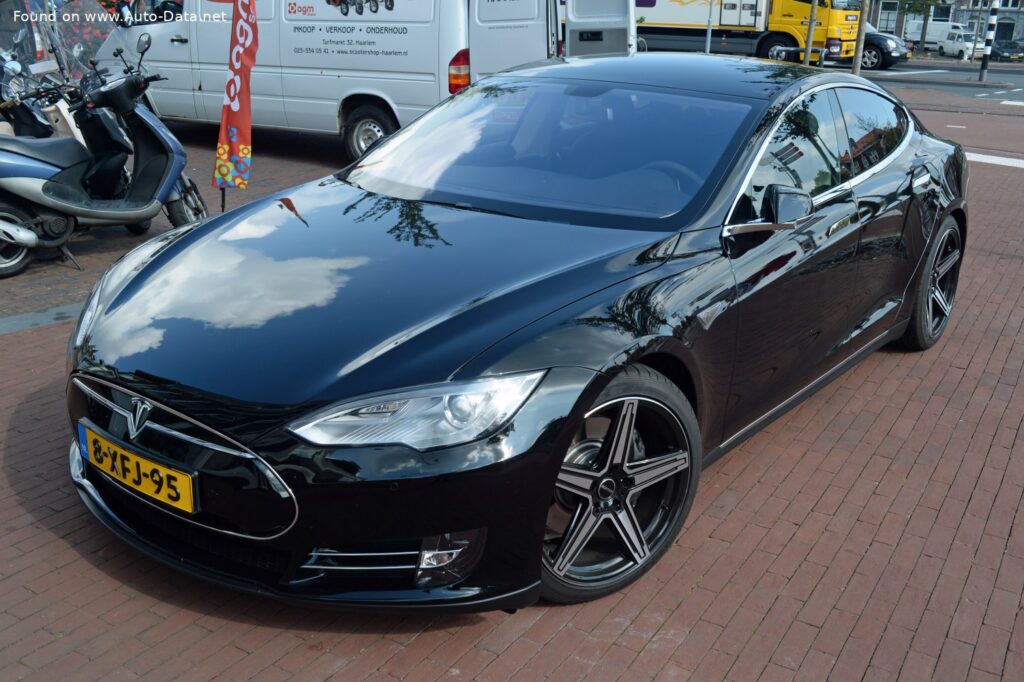
The Tesla Model S 85D, produced from November 2014 to February 2016, represents a pivotal moment in the adoption of electric vehicles. As the second iteration of Tesla’s flagship sedan, the 85D offered a compelling blend of performance, range, and technology, solidifying Tesla’s position as a leader in the burgeoning EV market. Positioned in the premium large car segment, the Model S 85D aimed to challenge established luxury automakers by demonstrating that electric vehicles could be both desirable and practical. It was initially sold primarily in North America and Europe, with Tesla gradually expanding its global reach.
Tesla Model S 85D: A Technological Leap
The Model S 85D distinguished itself through its dual-motor, all-wheel-drive (AWD) configuration. This setup, utilizing two independent electric motors – one powering the front wheels and one powering the rear – provided enhanced traction, improved acceleration, and a more balanced driving experience compared to single-motor variants. The “85” designation refers to the battery pack’s usable capacity of 85 kilowatt-hours (kWh), which was a substantial figure for the time and contributed significantly to the vehicle’s impressive range. The 85D was a key model in demonstrating the viability of long-range electric travel, alleviating range anxiety – a major concern for potential EV buyers.
Engine & Performance
The powertrain of the Tesla Model S 85D is fundamentally different from traditional internal combustion engine vehicles. It doesn’t have an “engine” in the conventional sense, but rather two independent three-phase AC induction electric motors. Each motor produces 259 horsepower, combining for a total system output of 417 horsepower. The instant torque delivery characteristic of electric motors allows for rapid acceleration. The 85D could accelerate from 0 to 60 mph in approximately 4.2 seconds, and 0 to 100 km/h in 4.4 seconds, with a top speed electronically limited to 155.34 mph (250 km/h). The weight-to-power ratio of 5.3 kg/Hp (or 189.6 Hp/tonne) further highlights the vehicle’s performance capabilities. The battery, a lithium-ion pack with a voltage of 346V, is located beneath the floor of the vehicle, contributing to a low center of gravity and improved handling.
Design & Features
The Tesla Model S 85D is a five-door liftback, offering a unique blend of sedan practicality and hatchback versatility. Its sleek, aerodynamic design, with a drag coefficient of just 0.24, minimizes air resistance and contributes to its efficiency. The vehicle seats up to seven passengers, although the third-row seats are best suited for children. Key features included a large touchscreen display that served as the central control interface for most vehicle functions, over-the-air software updates that continuously improved the car’s capabilities, and a sophisticated autopilot system (though early versions were less advanced than current iterations). Safety was also a priority, with the Model S 85D incorporating features like anti-lock brakes (ABS) and a robust structural design. The spacious interior offered 745 liters (26.31 cubic feet) of trunk space with the rear seats up, expanding to 1645 liters (58.09 cubic feet) with the seats folded down. The air suspension system provided a comfortable ride and allowed for adjustable ride height (between 119-163 mm or 4.69 – 6.42 inches).
Technical Specifications
| Brand | Tesla |
| Model | Model S |
| Generation | Model S |
| Type | 85D 85 kWh (417 Hp) Dual Motor AWD |
| Start of production | November, 2014 |
| End of production | February, 2016 |
| Powertrain Architecture | BEV (Electric Vehicle) |
| Body type | Liftback |
| Seats | 7 |
| Doors | 5 |
| Fuel Type | Electricity |
| Acceleration 0 – 100 km/h | 4.4 sec |
| Acceleration 0 – 62 mph | 4.4 sec |
| Acceleration 0 – 60 mph | 4.2 sec |
| Maximum speed | 155.34 mph (250 km/h) |
| Weight-to-power ratio | 5.3 kg/Hp, 189.6 Hp/tonne |
| Gross battery capacity | 85 kWh |
| Battery voltage | 346 V |
| Battery technology | Lithium-ion (Li-Ion) |
| Battery location | Below the floor |
| All-electric range (NEDC) | 328.08 mi (528 km) |
| Average Energy consumption (NEDC) | 24.62 kWh/100 mi (15.3 kWh/100 km) |
| MPGe | 137 |
| km/kWh | 6.5 |
| mi/kWh | 4.1 |
| Electric motor power (Rear) | 259 Hp |
| Electric motor location (Rear) | Rear axle, Transverse |
| Electric motor power (Front) | 259 Hp |
| Electric motor location (Front) | Front axle, Transverse |
| System power | 417 Hp |
| Kerb Weight | 4847.97 lbs (2199 kg) |
| Max. weight | 5820.2 lbs (2640 kg) |
| Max load | 972.24 lbs (441 kg) |
| Trunk (boot) space – minimum | 26.31 cu. ft (745 l) |
| Trunk (boot) space – maximum | 58.09 cu. ft (1645 l) |
| Max. roof load | 165.35 lbs (75 kg) |
| Length | 195.67 in (4970 mm) |
| Width | 77.32 in (1964 mm) |
| Width including mirrors | 86.18 in (2189 mm) |
| Height | 56.89 in (1445 mm) |
| Wheelbase | 116.54 in (2960 mm) |
| Front track | 65.43 in (1662 mm) |
| Rear track | 66.93 in (1700 mm) |
| Front overhang | 36.57 in (929 mm) |
| Rear overhang | 42.52 in (1080 mm) |
| Ride height (ground clearance) | 4.69 – 6.42 in (119-163 mm) |
| Drag coefficient (Cd) | 0.24 |
| Minimum turning circle | 40.68 ft (12.4 m) |
| Drivetrain Architecture | One electric motor drives the front wheels, one electric motor drives the rear wheels. |
| Drive wheel | All wheel drive (4×4) |
| Number of gears | 1 |
| Type of gearbox | automatic transmission |
| Front suspension | Double wishbone, Transverse stabilizer, Air suspension |
| Rear suspension | Independent multi-link suspension, Air suspension, Transverse stabilizer |
| Front brakes | Ventilated discs, 355×32 mm |
| Rear brakes | Ventilated discs, 365×28 mm |
| Assisting systems | ABS (Anti-lock braking system) |
| Steering type | Steering rack and pinion |
| Power steering | Electric Steering |
| Front Tires | 245/45 R19; 245/35 R21 |
| Rear Tires | 245/45 R19; 245/35 R21; 265/35 R21 |
| Front Wheel Rims | 8J x 19; 8.5J x 21 |
| Rear Wheel Rims | 8J x 19; 8.5J x 21; 9J x 21 |
The Tesla Model S 85D was a significant step forward in electric vehicle technology, demonstrating that EVs could offer performance, range, and practicality comparable to traditional gasoline-powered cars. It paved the way for future Tesla models and helped accelerate the global transition towards sustainable transportation.