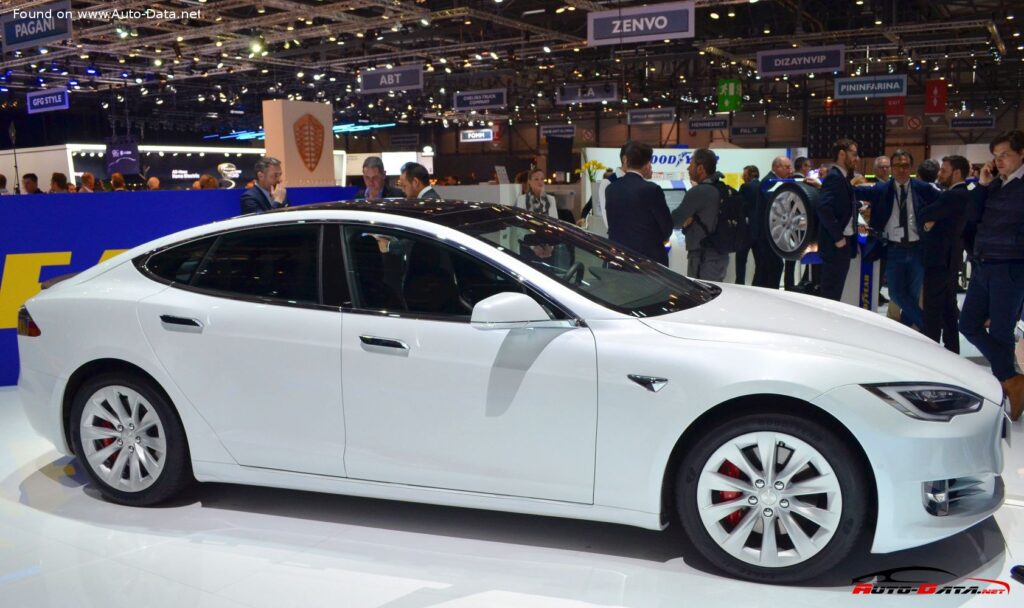
The Tesla Model S, launched in 2012, represented a pivotal moment in the automotive industry, demonstrating the viability of high-performance, long-range electric vehicles. The 2016 facelift, specifically the 75 kWh variant producing 315 horsepower, refined the original design and improved upon its already impressive capabilities. Positioned in the premium large car segment, the Model S aimed to challenge established luxury brands while offering a unique, technologically advanced driving experience. This iteration of the Model S was primarily sold in North America, Europe, and Asia, becoming a flagship product for Tesla and a symbol of the electric revolution.
Tesla Model S (Facelift 2016) 75: An Overview
The 2016 Model S 75 represents a mid-cycle refresh of Tesla’s groundbreaking electric sedan. It featured subtle exterior styling updates and interior enhancements, but the core innovation remained its all-electric powertrain and focus on long-range capability. The “75” designation refers to the battery pack’s kilowatt-hour capacity, providing a balance between range and cost compared to the higher-capacity 90 and 100 kWh versions. This model was produced from April 2016 to July 2017, serving as a crucial stepping stone in Tesla’s evolution and solidifying its position as a leader in the electric vehicle market.
Engine & Performance
The Tesla Model S 75 is powered by a single electric motor located on the rear axle, delivering 315 horsepower and 440 Nm (324.53 lb.-ft.) of torque. This powertrain architecture provides rear-wheel drive, offering a traditional driving feel while leveraging the instant torque characteristic of electric motors. Acceleration from 0 to 60 mph is achieved in 5.5 seconds, and the vehicle boasts a maximum speed of 139.81 mph (225 km/h). The electric motor operates at up to 18,000 rpm. The weight-to-power ratio stands at 6.4 kg/Hp, and the weight-to-torque ratio is 4.6 kg/Nm, contributing to its responsive performance. The system power and torque are both rated at 315 Hp and 440 Nm respectively.
Design & Features
The Model S 75 retains the sleek, liftback body style of the original, offering a practical combination of sedan elegance and hatchback versatility. It seats up to seven passengers, making it a viable option for families. The 2016 facelift included minor cosmetic changes, primarily focused on refining the front fascia. Key features include a large touchscreen interface controlling most vehicle functions, over-the-air software updates that continuously improve the car’s capabilities, and Tesla’s Autopilot system, offering advanced driver-assistance features. Safety was a paramount concern, with a low center of gravity due to the battery pack placement and a comprehensive suite of active safety systems, including ABS. The vehicle’s dimensions are substantial, measuring 4979 mm (196.02 in.) in length and 1964 mm (77.32 in.) in width. The liftback design provides a generous cargo capacity, ranging from 745 liters (26.31 cu. ft.) with the rear seats up to 1645 liters (58.09 cu. ft.) with them folded down.
Technology and Efficiency
The Model S 75’s core strength lies in its advanced battery technology. It utilizes a 75 kWh lithium-ion battery pack located beneath the floor, providing a usable capacity of 72.6 kWh. This battery operates at 300V and allows for an all-electric range of up to 480 km (298.26 mi) based on the New European Driving Cycle (NEDC) standard. Energy consumption is rated at 15.1 kWh/100 km (24.3 kWh/100 mi), translating to 139 MPGe, 6.6 km/kWh, or 4.1 mi/kWh. The vehicle supports charging via various ports (specifics not provided in the data). The air suspension system, both front and rear, contributes to ride comfort and handling. The drag coefficient of 0.24 is exceptionally low, further enhancing efficiency and range.
Technical Specifications
| Brand | Tesla |
| Model | Model S |
| Generation | Model S (facelift 2016) |
| Type (Engine) | 75 75 kWh (315 Hp) |
| Start of production | April, 2016 |
| End of production | July, 2017 |
| Powertrain Architecture | BEV (Electric Vehicle) |
| Body type | Liftback |
| Seats | 7 |
| Doors | 5 |
| Fuel Type | Electricity |
| Acceleration 0 – 60 mph | 5.5 sec |
| Maximum speed | 225 km/h (139.81 mph) |
| Weight-to-power ratio | 6.4 kg/Hp |
| Weight-to-torque ratio | 4.6 kg/Nm |
| Gross battery capacity | 75 kWh |
| Net (usable) battery capacity | 72.6 kWh |
| Battery voltage | 300 V |
| Battery technology | Lithium-ion (Li-Ion) |
| Battery location | Below the floor |
| All-electric range (NEDC) | 480 km (298.26 mi) |
| Average Energy consumption (NEDC) | 15.1 kWh/100 km (24.3 kWh/100 mi) |
| Electric motor power | 315 Hp @ 6850 rpm |
| Electric motor Torque | 440 Nm (324.53 lb.-ft.) |
| Maximum revolutions of the electric motor | 18000 rpm |
| Electric motor location | Rear axle, Transverse |
| System power | 315 Hp |
| System torque | 440 Nm (324.53 lb.-ft.) |
| Kerb Weight | 2027 kg (4468.77 lbs.) |
| Max. weight | 2590 kg (5709.97 lbs.) |
| Max load | 563 kg (1241.2 lbs.) |
| Trunk (boot) space – minimum | 745 l (26.31 cu. ft.) |
| Trunk (boot) space – maximum | 1645 l (58.09 cu. ft.) |
| Max. roof load | 75 kg (165.35 lbs.) |
| Length | 4979 mm (196.02 in.) |
| Width | 1964 mm (77.32 in.) |
| Width including mirrors | 2189 mm (86.18 in.) |
| Height | 1445 mm (56.89 in.) |
| Wheelbase | 2960 mm (116.54 in.) |
| Front track | 1662 mm (65.43 in.) |
| Rear (Back) track | 1700 mm (66.93 in.) |
| Front overhang | 937 mm (36.89 in.) |
| Rear overhang | 1081 mm (42.56 in.) |
| Ride height (ground clearance) | 117-160 mm (4.61 – 6.3 in.) |
| Drag coefficient (Cd) | 0.24 |
| Minimum turning circle (turning diameter) | 12.4 m (40.68 ft.) |
| Drivetrain Architecture | One electric motor drives the rear wheels. |
| Drive wheel | Rear wheel drive |
| Number of gears and type of gearbox | 1 gears, automatic transmission |
| Front suspension | Double wishbone, Transverse stabilizer, Air suspension |
| Rear suspension | Independent multi-link suspension, Air suspension, Transverse stabilizer |
| Front brakes | Ventilated discs, 355×32 mm |
| Rear brakes | Ventilated discs, 365×28 mm |
| Assisting systems | ABS (Anti-lock braking system) |
| Steering type | Steering rack and pinion |
| Power steering | Electric Steering |
| Tires size | Front wheel tires: 245/45 R19; 245/35 R21Rear wheel tires: 245/45 R19; 265/35 R21 |
| Wheel rims size | Front wheel rims: 8J x 19; 8.5J x 21Rear wheel rims: 8J x 19; 9J x 21 |