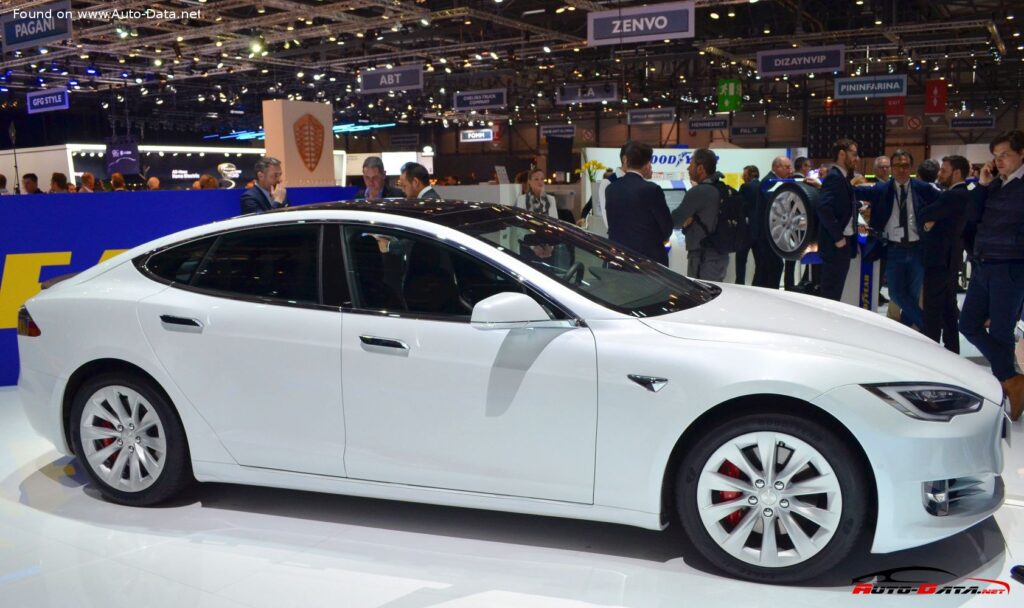
The Tesla Model S, particularly the facelifted version introduced in 2016, represents a pivotal moment in the adoption of electric vehicles. Positioned within the premium large car segment, the Model S challenged established luxury automakers by offering a compelling combination of performance, range, and technology. The Performance variant, equipped with a 100 kWh battery pack and dual-motor all-wheel-drive system, further solidified Tesla’s reputation for building high-performance electric vehicles. Production of this specific configuration ran from February 2019 to January 2021, marking a significant period in Tesla’s model evolution.
Tesla Model S (Facelift 2016) Performance: A Technological Leap
The 2016 facelift brought subtle but important refinements to the original Model S design, focusing on improving aerodynamics and interior quality. However, the core innovation remained the vehicle’s all-electric powertrain. The Performance model, with its larger 100 kWh battery, became the benchmark for electric vehicle range and performance. It demonstrated that electric cars could not only be environmentally friendly but also deliver exhilarating acceleration and a luxurious driving experience. The Model S was initially conceived to prove the viability of electric vehicles and to disrupt the automotive industry, and the Performance variant exemplified this ambition.
Engine & Performance
The Tesla Model S Performance 100 kWh utilizes a dual-motor, all-wheel-drive (AWD) powertrain. Unlike traditional internal combustion engine vehicles, it doesn’t have an “engine” in the conventional sense. Instead, it employs two independent electric motors – one driving the front wheels and the other powering the rear wheels. The front motor produces 279 horsepower and 420 Nm (309.78 lb.-ft.) of torque, while the rear motor delivers a substantial 510 horsepower and 720 Nm (531.04 lb.-ft.) of torque. Combined, these motors generate a system output of 611 horsepower and 967 Nm (713.22 lb.-ft.) of torque. This potent power delivery translates to astonishing acceleration figures: 0 to 60 mph in just 2.4 seconds, 0 to 62 mph in 2.5 seconds, and 0 to 100 km/h also in 2.5 seconds. The top speed is electronically limited to 162.18 mph (261 km/h). The powertrain architecture features a single-speed automatic transmission, simplifying the driving experience and maximizing efficiency. The weight-to-power ratio is an impressive 3.7 kg/Hp, and the weight-to-torque ratio is 2.3 kg/Nm.
Design & Features
The Tesla Model S is a five-door liftback, offering a practical blend of sedan aesthetics and hatchback versatility. Its sleek, aerodynamic profile contributes to its efficiency and performance. The interior is minimalist and technology-focused, dominated by a large central touchscreen that controls most vehicle functions. The 2016 facelift included improvements to the suspension, enhancing ride comfort and handling. The battery pack is located beneath the floor, contributing to a low center of gravity and improved stability. Safety features are paramount, including advanced driver-assistance systems (ADAS) such as Autopilot, automatic emergency braking, and lane-keeping assist. The Model S offers seating for five passengers and provides ample cargo space, with a minimum trunk capacity of 26.31 cubic feet, expandable to 58.09 cubic feet with the rear seats folded down. The vehicle’s drag coefficient of 0.23 further enhances its aerodynamic efficiency.
Technical Specifications
| Brand | Tesla |
| Model | Model S |
| Generation | Model S (facelift 2016) |
| Type | Performance 100 kWh (611 Hp) Dual Motor AWD |
| Start of production | February, 2019 |
| End of production | January, 2021 |
| Powertrain Architecture | BEV (Electric Vehicle) |
| Body type | Liftback |
| Seats | 5 |
| Doors | 5 |
| Fuel Type | Electricity |
| Acceleration 0 – 100 km/h | 2.5 sec |
| Acceleration 0 – 62 mph | 2.5 sec |
| Acceleration 0 – 60 mph | 2.4 sec |
| Maximum speed | 162.18 mph (261 km/h) |
| Weight-to-power ratio | 3.7 kg/Hp |
| Weight-to-torque ratio | 2.3 kg/Nm |
| Gross battery capacity | 100 kWh |
| Battery voltage | 350 V |
| Battery technology | Lithium-ion (Li-Ion) |
| Battery location | Below the floor |
| All-electric range (WLTP) | 387.11 mi (623 km) |
| All-electric range | 347.97 mi (560 km) |
| Average Energy consumption (WLTP) | 22 kWh/100 km |
| Average Energy consumption | 32.03 kWh/100 mi |
| Kerb Weight | 4967.01 lbs (2253 kg) |
| Max. weight | 5996.57 lbs (2720 kg) |
| Max load | 1029.56 lbs (467 kg) |
| Trunk (boot) space – minimum | 26.31 cu. ft. (745 l) |
| Trunk (boot) space – maximum | 58.09 cu. ft. (1645 l) |
| Max. roof load | 165.35 lbs (75 kg) |
| Length | 195.67 in. (4970 mm) |
| Width | 77.32 in. (1964 mm) |
| Width including mirrors | 86.18 in. (2189 mm) |
| Height | 56.89 in. (1445 mm) |
| Wheelbase | 116.54 in. (2960 mm) |
| Front track | 65.43 in. (1662 mm) |
| Rear (Back) track | 66.93 in. (1700 mm) |
| Ride height (ground clearance) | 4.61 – 6.3 in. (117-160 mm) |
| Drag coefficient (Cd) | 0.23 |
| Minimum turning circle (turning diameter) | 38.71 ft (11.8 m) |
| Drivetrain Architecture | One electric motor drives the front wheels, one electric motor drives the rear wheels. |
| Drive wheel | All wheel drive (4×4) |
| Number of gears and type of gearbox | 1 gears, automatic transmission |
| Front suspension | Double wishbone, Transverse stabilizer, Air suspension |
| Rear suspension | Independent multi-link suspension, Air suspension, Transverse stabilizer |
| Front brakes | Ventilated discs, 355×32 mm |
| Rear brakes | Ventilated discs, 365×28 mm |
| Tires size | Front wheel tires: 245/45 R19; 245/35 R21Rear wheel tires: 245/45 R19; 265/35 R21 |
The Tesla Model S Performance 100 kWh represents a significant milestone in the evolution of electric vehicles. Its combination of performance, range, and technology helped to establish Tesla as a leader in the automotive industry and paved the way for the widespread adoption of electric cars. It remains a highly sought-after vehicle, demonstrating the enduring appeal of its innovative design and exhilarating driving experience.