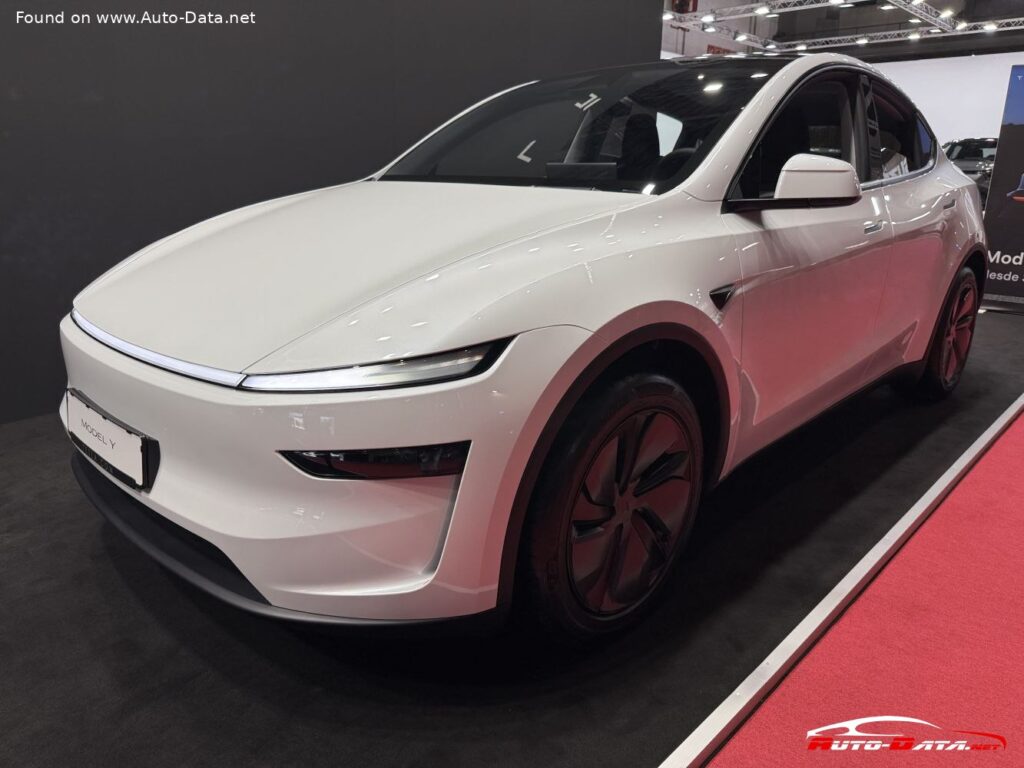
The Tesla Model Y (Juniper, facelift 2025) represents the latest iteration of Tesla’s immensely popular compact SUV, building upon the success of the original Model Y introduced in 2020. Positioned as a more accessible entry point into the Tesla lineup, the Juniper refresh focuses on enhanced efficiency, updated styling, and improved interior features. This version, equipped with a 62.5 kWh battery pack delivering 299 horsepower, is primarily targeted towards markets where range anxiety is a concern or where a lower price point is desired, while still offering the core Tesla experience of electric performance and advanced technology. The Model Y continues to be a key player in the rapidly expanding electric vehicle (EV) segment, competing with vehicles like the Hyundai IONIQ 5, Kia EV6, and Ford Mustang Mach-E.
Tesla Model Y (Juniper, Facelift 2025): An Overview
The Model Y Juniper is a significant update to Tesla’s best-selling vehicle. The “Juniper” designation refers to a comprehensive refresh encompassing both exterior and interior changes, alongside improvements to the vehicle’s powertrain and overall efficiency. While Tesla initially focused on longer-range variants, the introduction of the 62.5 kWh model broadens the appeal of the Model Y to a wider customer base. This model maintains the core attributes of the Model Y – a spacious interior, practical SUV body style, and Tesla’s signature technology – while offering a more attainable price point. The 2025 facelift aims to address some of the criticisms leveled at earlier Model Y iterations, particularly regarding ride quality and interior refinement.
Engine & Performance
The 2025 Tesla Model Y Juniper with the 62.5 kWh battery pack is powered by a single rear-mounted electric motor producing 299 horsepower and 420 Nm (309.78 lb.-ft.) of torque. This configuration results in a 0-60 mph acceleration time of approximately 5.6 seconds, and a 0-100 km/h time of 5.9 seconds. The vehicle boasts a maximum speed of 201 km/h (124.9 mph). Utilizing a Lithium Iron Phosphate (LiFePO4) battery technology, the 62.5 kWh battery provides a WLTP-rated all-electric range of 500 km (310.69 miles). Energy consumption is rated at 13.9 kWh per 100 km (22.37 kWh per 100 miles), translating to 151 MPGe and an efficiency of 7.2 km/kWh (4.5 mi/kWh). The powertrain architecture is a straightforward BEV (Battery Electric Vehicle) setup, with a single-speed automatic transmission driving the rear wheels. The weight-to-power ratio is 6.4 kg/Hp, and the weight-to-torque ratio is 4.6 kg/Nm.
Design & Features
The Model Y Juniper retains the crossover SUV body style of its predecessor, offering five seats and five doors. The exterior design incorporates subtle but noticeable changes, including revised front and rear fascias, updated headlights and taillights, and aerodynamic improvements to enhance efficiency. The interior has undergone a more substantial overhaul, with a redesigned dashboard, a new steering wheel, and improved materials. A key feature is the rear-seat display, providing entertainment and vehicle information to passengers. Safety features are comprehensive, including ABS (Anti-lock Braking System) and a suite of advanced driver-assistance systems (ADAS) such as Autopilot. The vehicle’s spacious interior offers 822 liters (29.03 cu. ft.) of trunk space with the rear seats up, expanding to 2138 liters (75.5 cu. ft.) with the seats folded down. The Model Y Juniper also has a permitted trailer load with brakes of 1600 kg (3527.4 lbs).
Technical Specifications
| Brand | Tesla |
| Model | Model Y |
| Generation | Model Y (Juniper, facelift 2025) |
| Type (Engine) | 62.5 kWh (299 Hp) |
| Start of production | 2025 |
| Powertrain Architecture | BEV (Electric Vehicle) |
| Body type | SUV, Crossover |
| Seats | 5 |
| Doors | 5 |
| Fuel Type | Electricity |
| Acceleration 0 – 100 km/h | 5.9 sec |
| Acceleration 0 – 62 mph | 5.9 sec |
| Acceleration 0 – 60 mph | 5.6 sec |
| Maximum speed | 201 km/h (124.9 mph) |
| Weight-to-power ratio | 6.4 kg/Hp |
| Weight-to-torque ratio | 4.6 kg/Nm |
| Net (usable) battery capacity | 62.5 kWh |
| Battery voltage | 345 V |
| Battery technology | Lithium iron phosphate (LiFePO4) |
| Battery weight | 475 kg (1047.2 lbs.) |
| Battery location | Below the floor |
| All-electric range (WLTP) | 500 km (310.69 mi) |
| Average Energy consumption (WLTP) | 13.9 kWh/100 km (22.37 kWh/100 mi) |
| Electric motor power | 299 Hp |
| Electric motor Torque | 420 Nm (309.78 lb.-ft.) |
| Electric motor location | Rear axle, Transverse |
| Electric motor type | Synchronous |
| System power | 299 Hp |
| System torque | 420 Nm (309.78 lb.-ft.) |
| Kerb Weight | 1928 kg (4250.51 lbs.) |
| Trunk (boot) space – minimum | 822 l (29.03 cu. ft.) |
| Trunk (boot) space – maximum | 2138 l (75.5 cu. ft.) |
| Permitted trailer load with brakes (12%) | 1600 kg (3527.4 lbs.) |
| Length | 4790 mm (188.58 in.) |
| Width | 1920 mm (75.59 in.) |
| Width with mirrors folded | 1982 mm (78.03 in.) |
| Width including mirrors | 2129 mm (83.82 in.) |
| Height | 1624 mm (63.94 in.) |
| Wheelbase | 2890 mm (113.78 in.) |
| Front track | 1636 mm (64.41 in.) |
| Rear (Back) track | 1636 mm (64.41 in.) |
| Front overhang | 889 mm (35 in.) |
| Rear overhang | 1011 mm (39.8 in.) |
| Ride height (ground clearance) | 167 mm (6.57 in.) |
| Minimum turning circle (turning diameter) | 12.13 m (39.8 ft.) |
| Drivetrain Architecture | One electric motor drives the rear wheels. |
| Drive wheel | Rear wheel drive |
| Number of gears and type of gearbox | 1 gears, automatic transmission |
| Front suspension | Coil spring, Double wishbone, Transverse stabilizer |
| Rear suspension | Independent multi-link spring suspension with stabilizer |
| Front brakes | Ventilated discs, 355×25 mm |
| Rear brakes | Ventilated discs, 335×20 mm |
| Steering type | Steering rack and pinion |
| Power steering | Electric Steering |
| Tires size | 255/45 R19; 255/40 R20 |
| Wheel rims size | 9.5J x 19; 9.5J x 20 |