
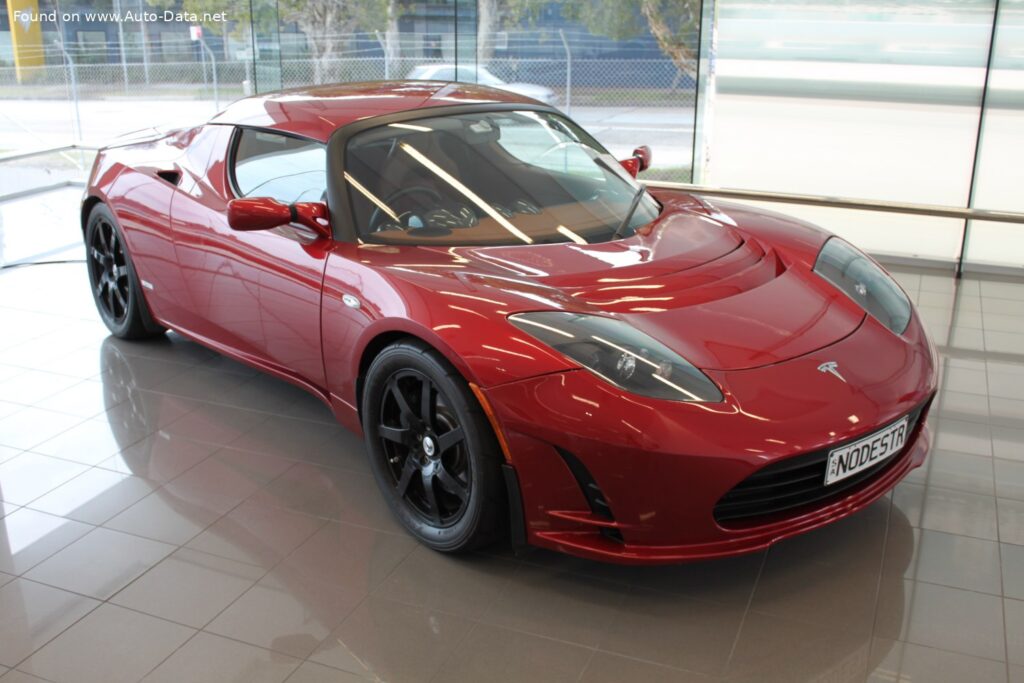
The Tesla Roadster I Sport 53 kWh, produced between 2008 and 2012, represents a pivotal moment in the evolution of electric vehicles. As Tesla’s first production car, it wasn’t simply an electric alternative to existing sports cars; it aimed to redefine the category, proving that electric propulsion could deliver exhilarating performance and respectable range. Positioned in the sports car segment, the Roadster I was a two-seat, open-top vehicle designed to challenge perceptions of electric car capabilities. It served as a technological demonstrator, paving the way for Tesla’s future models and accelerating the adoption of electric vehicle technology globally.
Tesla Roadster I Sport 53 kWh: A Groundbreaking Electric Sports Car
The Roadster I wasn’t conceived as a mass-market vehicle. Instead, it was built upon the chassis of the Lotus Elise, a lightweight British sports car, allowing Tesla to focus its engineering efforts on the electric powertrain. This strategic decision significantly reduced development time and cost, enabling Tesla to bring its vision to reality. The Roadster I’s impact extended beyond its performance figures; it established Tesla as a serious automotive manufacturer and demonstrated the viability of long-range, high-performance electric vehicles.
Engine & Performance
At the heart of the Tesla Roadster I Sport 53 kWh lies a single electric motor, transversely mounted on the rear axle. This motor delivers a peak power output of 292 horsepower (Hp) between 4400 and 6000 rpm, and a torque figure of 400 Newton-meters (295.02 lb.-ft.) available from 0 to 5100 rpm. This instant torque delivery is a hallmark of electric motors, providing rapid acceleration. The car achieves 0 to 60 mph in approximately 3.5 seconds (as calculated by Auto-Data.net), and 0 to 100 km/h in 3.7 seconds. Its maximum speed is electronically limited to 124.9 mph (201 km/h). The 53 kWh battery pack provides an all-electric range of 244.2 miles (393 km), a significant achievement for its time. The weight-to-power ratio is an impressive 4.2 kg/Hp, or 236.4 Hp/tonne, contributing to its agile handling characteristics.
Design & Features
The Tesla Roadster I Sport 53 kWh retains much of the Lotus Elise’s iconic design, characterized by its lightweight construction and aerodynamic profile. However, Tesla made several modifications to accommodate the electric powertrain and enhance the vehicle’s aesthetics. The body is a two-door roadster configuration with seating for two passengers. The car’s low stance and sculpted lines contribute to its sporty appearance. While lacking the extensive infotainment systems found in modern vehicles, the Roadster I featured a basic instrument cluster and essential controls. Safety features were limited by the Elise platform, but included ABS (Anti-lock braking system). The focus was primarily on delivering a pure driving experience, emphasizing performance and handling over luxury amenities. The drag coefficient of 0.36 is respectable for a vehicle of its era and body style, contributing to its efficiency.
Technical Specifications
| Brand | Tesla |
| Model | Roadster |
| Generation | Roadster I |
| Type (Engine) | Sport 53 kWh (292 Hp) |
| Start of production | 2008 |
| End of production | 2012 |
| Powertrain Architecture | BEV (Electric Vehicle) |
| Body type | Roadster |
| Seats | 2 |
| Doors | 2 |
| Fuel Type | Electricity |
| Acceleration 0 – 100 km/h | 3.7 sec |
| Acceleration 0 – 62 mph | 3.7 sec |
| Acceleration 0 – 60 mph | 3.5 sec |
| Maximum speed | 124.9 mph (201 km/h) |
| Weight-to-power ratio | 4.2 kg/Hp, 236.4 Hp/tonne |
| Gross battery capacity | 53 kWh |
| All-electric range | 244.2 mi (393 km) |
| Electric motor power | 292 Hp @ 4400-6000 rpm |
| Electric motor Torque | 400 Nm @ 0-5100 rpm (295.02 lb.-ft. @ 0-5100 rpm) |
| Electric motor location | Rear axle, Transverse |
| System power | 292 Hp |
| Kerb Weight | 2722.71 lbs (1235 kg) |
| Max. weight | 3273.86 lbs (1485 kg) |
| Max load | 551.16 lbs (250 kg) |
| Length | 155.35 in (3946 mm) |
| Width including mirrors | 72.87 in (1851 mm) |
| Height | 44.37 in (1127 mm) |
| Wheelbase | 92.56 in (2351 mm) |
| Front track | 57.32 in (1456 mm) |
| Rear (Back) track | 58.46 in (1485 mm) |
| Front overhang | 34.29 in (871 mm) |
| Rear overhang | 28.46 in (723 mm) |
| Ride height (ground clearance) | 5.12 in (130 mm) |
| Drag coefficient (Cd) | 0.36 |
| Minimum turning circle (turning diameter) | 36.25 ft (11.05 m) |
| Approach angle | 11° |
| Departure angle | 18° |
| Ramp-over (brakeover) angle | 12.7° |
| Drivetrain Architecture | One electric motor drives the rear wheels |
| Drive wheel | Rear wheel drive |
| Number of gears and type of gearbox | 1 gears, automatic transmission |
| Front suspension | Double wishbone |
| Rear suspension | Double wishbone |
| Front brakes | Ventilated discs |
| Rear brakes | Disc |
| Assisting systems | ABS (Anti-lock braking system) |
| Steering type | Steering rack and pinion |
| Power steering | Electric Steering |
| Front wheel tires | 195/50 R16 |
| Rear wheel tires | 225/45 R17 |
| Front wheel rims | 6J x 16 |
| Rear wheel rims | 7.5J x 17 |
The Tesla Roadster I Sport 53 kWh was more than just a car; it was a statement. It demonstrated that electric vehicles could be desirable, high-performing, and capable of challenging the established automotive order. Its legacy continues to influence the development of electric vehicles today, solidifying its place as a landmark achievement in automotive history.
