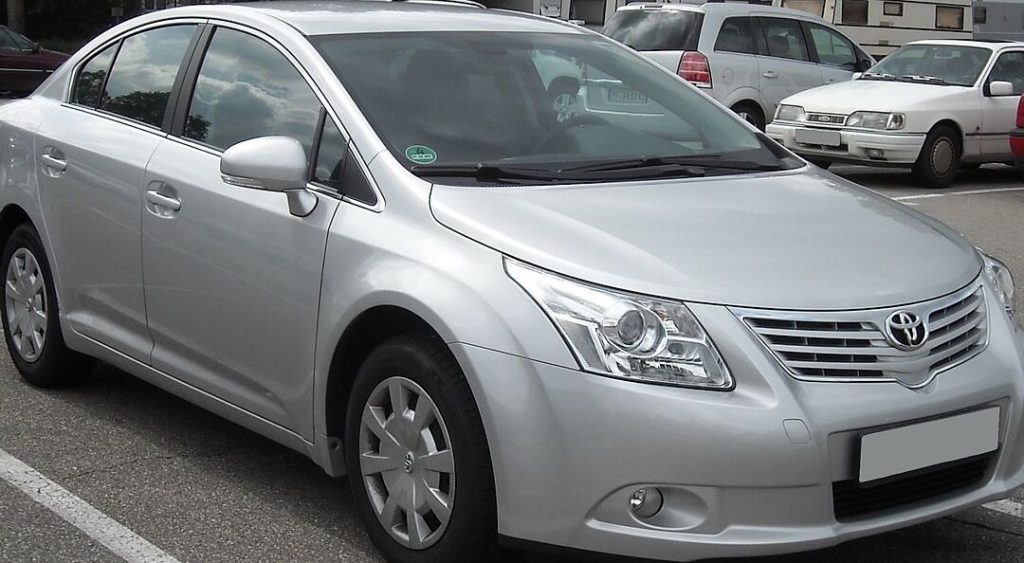
The Toyota Avensis Verso 2.0D (116 hp) represents a significant iteration of Toyota’s multi-purpose vehicle (MPV) offering, specifically the facelifted version introduced in November 2003 and continuing through February 2009. Positioned as a practical and family-oriented vehicle, the Avensis Verso aimed to compete with other European and Japanese MPVs, offering seven-seat capability within a relatively compact footprint. This particular 2.0-liter diesel variant served as a mid-range option within the Verso lineup, balancing fuel efficiency with adequate performance for everyday driving needs. It was primarily sold in the European market, where demand for diesel-powered MPVs was strong.
Technical Specifications
| Brand | Toyota |
| Model | Avensis Verso |
| Generation | Avensis Verso (facelift 2003) |
| Type (Engine) | 2.0d (116 Hp) |
| Start of production | November, 2003 |
| End of production | February, 2009 |
| Powertrain Architecture | Internal Combustion engine |
| Body type | MPV |
| Seats | 7 |
| Doors | 5 |
| Fuel consumption (urban) | 8.1 l/100 km (29 US mpg, 34.9 UK mpg, 12.3 km/l) |
| Fuel consumption (extra urban) | 5.6 l/100 km (42 US mpg, 50.4 UK mpg, 17.9 km/l) |
| Fuel consumption (combined) | 6.5 l/100 km (36.2 US mpg, 43.5 UK mpg, 15.4 km/l) |
| CO2 emissions | 173 g/km |
| Fuel Type | Diesel |
| Acceleration 0 – 100 km/h | 12.5 sec |
| Acceleration 0 – 62 mph | 12.5 sec |
| Acceleration 0 – 60 mph | 11.9 sec |
| Maximum speed | 180 km/h (111.85 mph) |
| Weight-to-power ratio | 13 kg/Hp, 77.1 Hp/tonne |
| Weight-to-torque ratio | 6 kg/Nm, 166.1 Nm/tonne |
| Power | 116 Hp @ 4000 rpm |
| Power per litre | 58.1 Hp/l |
| Torque | 250 Nm @ 1800 rpm (184.39 lb.-ft. @ 1800 rpm) |
| Engine layout | Front, Transverse |
| Engine Model/Code | 1CD-FTV |
| Engine displacement | 1995 cm3 (121.74 cu. in.) |
| Number of cylinders | 4 |
| Engine configuration | Inline |
| Cylinder Bore | 82.2 mm (3.24 in.) |
| Piston Stroke | 94 mm (3.7 in.) |
| Compression ratio | 18.6:1 |
| Number of valves per cylinder | 4 |
| Fuel injection system | Diesel Commonrail |
| Engine aspiration | Turbocharger, Intercooler |
| Valvetrain | DOHC |
| Engine oil capacity | 5.9 l (6.23 US qt | 5.19 UK qt) |
| Coolant | 8.8 l (9.3 US qt | 7.74 UK qt) |
| Kerb Weight | 1505 kg (3317.96 lbs.) |
| Trunk (boot) space – minimum | 282 l (9.96 cu. ft.) |
| Trunk (boot) space – maximum | 2422 l (85.53 cu. ft.) |
| Fuel tank capacity | 60 l (15.85 US gal | 13.2 UK gal) |
| Length | 4690 mm (184.65 in.) |
| Width | 1760 mm (69.29 in.) |
| Height | 1680 mm (66.14 in.) |
| Wheelbase | 2820 mm (111.02 in.) |
| Front track | 1506 mm (59.29 in.) |
| Rear (Back) track | 1500 mm (59.06 in.) |
| Ride height (ground clearance) | 150 mm (5.91 in.) |
| Minimum turning circle | 11 m (36.09 ft.) |
| Drivetrain Architecture | Front wheel drive |
| Number of gears and type of gearbox | 5 gears, manual transmission |
| Front suspension | Independent type McPherson |
| Rear suspension | Torsion |
| Front brakes | Disc |
| Rear brakes | Disc |
| Assisting systems | ABS (Anti-lock braking system) |
| Steering type | Steering rack and pinion |
| Tires size | 205/60 R16 |
| Wheel rims size | 16 |
Powertrain & Engine Architecture
The heart of the Avensis Verso 2.0D is the 1CD-FTV engine, a 1.995-liter inline-four cylinder diesel. This engine is a representative of Toyota’s D-4D common rail direct injection technology, which was becoming increasingly sophisticated in the early 2000s. The 1CD-FTV utilizes a turbocharger with an intercooler to boost power and torque, delivering 116 horsepower at 4000 rpm and 250 Nm (184 lb-ft) of torque at a relatively low 1800 rpm. The engine features a double overhead camshaft (DOHC) valvetrain with four valves per cylinder, contributing to its efficiency and power output. The 5-speed manual transmission was the standard offering for this variant, providing a balance between fuel economy and drivability. The engine’s design prioritized low-end torque, making it well-suited for hauling passengers and cargo, a key requirement for an MPV.
Driving Characteristics
The 2.0D Avensis Verso, equipped with the 5-speed manual transmission, offered a practical and comfortable driving experience. While not particularly sporty, the engine provided sufficient power for everyday driving, including highway cruising and overtaking. The relatively low-revving nature of the diesel engine meant that most of the torque was available from low in the rev range, resulting in effortless acceleration in most situations. The gear ratios were tuned for fuel efficiency, and the shift quality was generally smooth. Compared to higher-output petrol versions of the Avensis Verso, the 2.0D offered significantly better fuel economy, but at the expense of outright performance. The manual transmission allowed for greater driver control compared to the optional automatic, which could sometimes feel sluggish with this engine.
Equipment & Trim Levels
The 2.0D trim level of the Avensis Verso typically included features such as air conditioning, power windows, central locking, and an audio system. Safety features included ABS brakes, front airbags, and seatbelt pretensioners. Higher trim levels added features like alloy wheels, rear parking sensors, climate control, and upgraded upholstery. The interior was designed with practicality in mind, offering a spacious cabin with flexible seating arrangements. The third-row seats could be folded flat into the floor to maximize cargo space when not in use. Interior materials were durable and aimed at withstanding the demands of family use.
Chassis & Braking
The Avensis Verso utilized a McPherson strut front suspension and a torsion beam rear suspension. This setup provided a comfortable ride quality, although it wasn’t particularly sporty. The front and rear brakes were both disc brakes, providing adequate stopping power for the vehicle’s weight. ABS (Anti-lock Braking System) was standard, enhancing safety during emergency braking situations. The steering was a rack and pinion system, offering reasonable precision and feedback. The suspension was tuned to prioritize comfort and stability, making it well-suited for carrying passengers and cargo.
Market Reception & Comparison
The Toyota Avensis Verso 2.0D was generally well-received by automotive critics for its practicality, fuel efficiency, and reliability. It was often praised for its spacious interior and flexible seating arrangements. However, some critics noted that the engine could be somewhat noisy and lacked the refinement of some of its competitors. Compared to petrol-powered versions of the Avensis Verso, the 2.0D offered significantly better fuel economy, making it a popular choice for drivers who covered long distances. Compared to other diesel MPVs in its class, such as the Ford C-Max or Renault Scenic, the Avensis Verso offered a strong reputation for reliability and build quality.
Legacy
The 1CD-FTV engine, found in the Avensis Verso 2.0D, has proven to be a relatively reliable powertrain. While not immune to age-related issues, it is generally known for its durability and longevity. In the used car market, the Avensis Verso 2.0D remains a popular choice for buyers seeking a practical and affordable MPV. Its reputation for reliability and fuel efficiency continues to make it a compelling option, even after many years of service. Regular maintenance, including oil changes and timing belt replacements, is crucial for ensuring the long-term health of this engine.