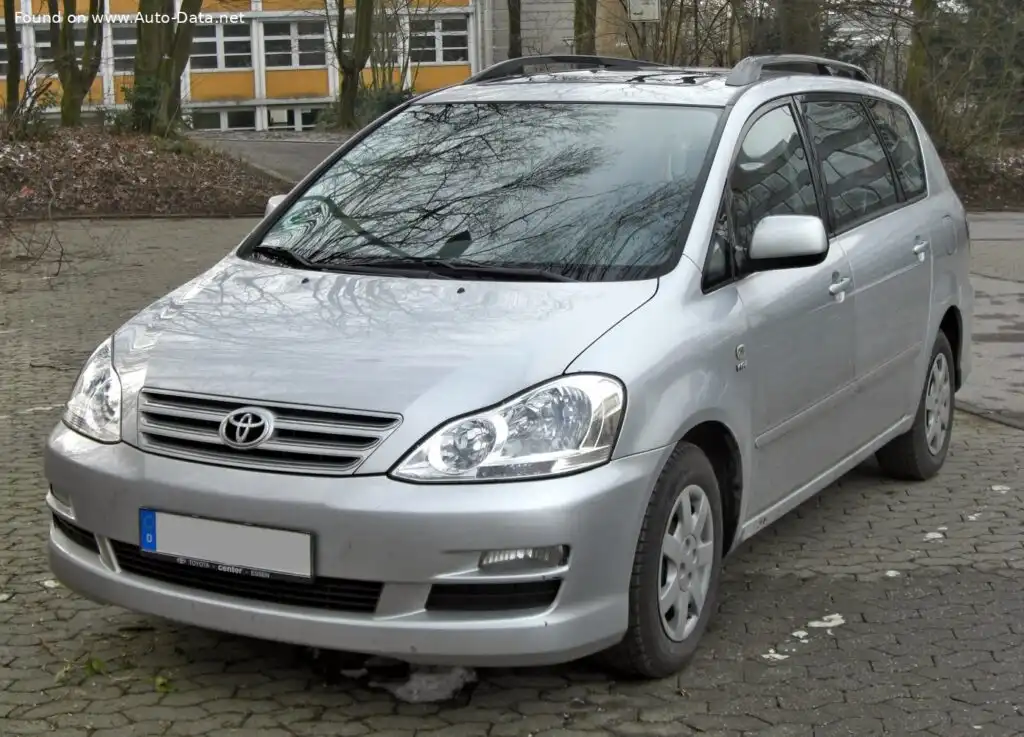
The Toyota Avensis Verso (facelift, introduced in November 2003 and produced through February 2009) represented Toyota’s entry into the increasingly popular compact MPV (Multi-Purpose Vehicle) segment in Europe. This facelifted version, building upon the original Avensis Verso launched in 2001 (based on the Toyota MC platform, shared with the Corolla), offered a seven-seat configuration in a relatively compact package. The 2.0i variant, producing 150 horsepower, occupied a mid-range position within the Verso lineup, offering a balance between performance and fuel economy. It was positioned above the lower-powered 1.8L engine options and below the diesel variants, appealing to families seeking a practical and reasonably efficient vehicle.
Technical Specifications
| Brand | Toyota |
| Model | Avensis Verso |
| Generation | Avensis Verso (facelift 2003) |
| Type (Engine) | 2.0i (150 Hp) |
| Start of production | November, 2003 |
| End of production | February, 2009 |
| Powertrain Architecture | Internal Combustion engine |
| Body type | MPV |
| Seats | 7 |
| Doors | 5 |
| Fuel consumption (urban) | 11.5 l/100 km (20.5 US mpg, 24.6 UK mpg, 8.7 km/l) |
| Fuel consumption (extra urban) | 6.8 l/100 km (34.6 US mpg, 41.5 UK mpg, 14.7 km/l) |
| Fuel consumption (combined) | 8.6 l/100 km (27.4 US mpg, 32.8 UK mpg, 11.6 km/l) |
| CO2 emissions | 202 g/km |
| Fuel Type | Petrol (Gasoline) |
| Acceleration 0 – 100 km/h | 11.4 sec |
| Acceleration 0 – 62 mph | 11.4 sec |
| Acceleration 0 – 60 mph | 10.8 sec |
| Maximum speed | 180 km/h (111.85 mph) |
| Weight-to-power ratio | 9.3 kg/Hp, 107.1 Hp/tonne |
| Weight-to-torque ratio | 7.3 kg/Nm, 137.1 Nm/tonne |
| Power | 150 Hp @ 6000 rpm |
| Power per litre | 75.1 Hp/l |
| Torque | 192 Nm @ 4000 rpm (141.61 lb.-ft. @ 4000 rpm) |
| Engine layout | Front, Transverse |
| Engine Model/Code | 1AZ-FE |
| Engine displacement | 1998 cm3 (121.93 cu. in.) |
| Number of cylinders | 4 |
| Engine configuration | Inline |
| Cylinder Bore | 86 mm (3.39 in.) |
| Piston Stroke | 86 mm (3.39 in.) |
| Compression ratio | 9.8:1 |
| Number of valves per cylinder | 4 |
| Fuel injection system | Multi-port manifold injection |
| Engine aspiration | Naturally aspirated engine |
| Valvetrain | DOHC |
| Engine oil capacity | 4.2 l (4.44 US qt | 3.7 UK qt) |
| Coolant | 5.9 l (6.23 US qt | 5.19 UK qt) |
| Kerb Weight | 1400 kg (3086.47 lbs.) |
| Trunk (boot) space – minimum | 282 l (9.96 cu. ft.) |
| Trunk (boot) space – maximum | 2422 l (85.53 cu. ft.) |
| Fuel tank capacity | 60 l (15.85 US gal | 13.2 UK gal) |
| Length | 4690 mm (184.65 in.) |
| Width | 1760 mm (69.29 in.) |
| Height | 1680 mm (66.14 in.) |
| Wheelbase | 2820 mm (111.02 in.) |
| Front track | 1506 mm (59.29 in.) |
| Rear (Back) track | 1500 mm (59.06 in.) |
| Ride height (ground clearance) | 150 mm (5.91 in.) |
| Minimum turning circle | 11 m (36.09 ft.) |
| Drivetrain Architecture | The Internal combustion engine (ICE) drives the front wheels of the vehicle. |
| Drive wheel | Front wheel drive |
| Number of gears and type of gearbox | 5 gears, manual transmission |
| Front suspension | Independent type McPherson |
| Rear suspension | Torsion |
| Front brakes | Disc |
| Rear brakes | Disc |
| Assisting systems | ABS (Anti-lock braking system) |
| Steering type | Steering rack and pinion |
| Tires size | 205/60 R16 |
| Wheel rims size | 16 |
Powertrain & Engine Architecture
The heart of the Avensis Verso 2.0i was the 1AZ-FE engine, a 1.998-liter (2.0L) inline-four cylinder gasoline engine. This engine was a mainstay in Toyota’s lineup during the early 2000s, known for its reliability and relatively smooth operation. The 1AZ-FE featured a double overhead camshaft (DOHC) valvetrain with four valves per cylinder, contributing to its respectable power output. Fuel delivery was handled by a multi-port fuel injection system, optimizing fuel atomization for efficient combustion. The engine’s 9.8:1 compression ratio was a compromise between performance and the ability to run on readily available fuel grades. The 150 horsepower and 192 Nm (141.61 lb-ft) of torque were delivered at 6000 rpm and 4000 rpm respectively. The engine was transversely mounted in the front of the vehicle, driving the front wheels. The standard transmission for this variant was a five-speed manual gearbox, although a four-speed automatic transmission was also available, impacting fuel economy and acceleration.
Driving Characteristics
The 2.0i engine in the Avensis Verso provided adequate performance for everyday driving, particularly with the five-speed manual transmission. Acceleration to 60 mph took around 10.8 seconds, which was competitive for its class. The engine felt reasonably responsive in the mid-range, making overtaking maneuvers manageable. However, it wasn’t a particularly sporty engine; power tapered off noticeably at higher RPMs. The automatic transmission, while offering convenience, resulted in slightly slower acceleration and increased fuel consumption. The gear ratios were tuned for fuel efficiency rather than outright performance. Compared to the diesel variants, the 2.0i offered less torque, resulting in a need to downshift more frequently when climbing hills or carrying a full load of passengers. Compared to the 1.8L engine, the 2.0i provided a noticeable improvement in power and responsiveness.
Equipment & Trim Levels
The Avensis Verso 2.0i typically came with a reasonable level of standard equipment. This included power windows, central locking, air conditioning, and an audio system. Higher trim levels offered features such as alloy wheels, fog lights, a sunroof, and upgraded interior upholstery. The interior generally featured a practical and durable design, with seating for seven passengers. The third-row seats were best suited for children or shorter adults. Optional extras included a navigation system and leather upholstery. Safety features included ABS brakes and front airbags.
Chassis & Braking
The Avensis Verso utilized an independent McPherson strut suspension at the front and a torsion beam suspension at the rear. This setup provided a comfortable ride quality, although it wasn’t particularly sporty. The torsion beam rear suspension was a cost-effective solution that helped to maximize interior space. The braking system consisted of disc brakes on all four wheels, providing adequate stopping power. ABS (Anti-lock Braking System) was standard, enhancing safety during emergency braking situations. The steering was a rack and pinion system, offering reasonable precision and feedback.
Market Reception & Comparison
The Toyota Avensis Verso 2.0i was generally well-received by automotive critics as a practical and reliable family vehicle. It was praised for its spacious interior, comfortable ride, and Toyota’s reputation for build quality. However, some critics noted that the engine lacked the refinement and performance of some of its competitors. Fuel economy was considered average for its class. Compared to other MPVs in the segment, such as the Renault Scenic and Citroën Picasso, the Avensis Verso offered a more conservative and understated design. The 2.0i variant offered a good balance between performance and fuel economy, making it a popular choice for families who didn’t require the extra torque of a diesel engine.
Legacy
The 1AZ-FE engine, found in the Avensis Verso 2.0i, is known for its long-term reliability. With proper maintenance, these engines can accumulate high mileage without major issues. The Avensis Verso itself has developed a reputation as a dependable and practical family vehicle. On the used car market, these models are often sought after for their affordability and reliability. While not a particularly exciting vehicle to drive, the Avensis Verso 2.0i remains a sensible and practical choice for those seeking a spacious and dependable MPV.