Toyota Corolla XI (E170) 1.33 Dual VVT-i (100 Hp): A Global Workhorse
The Toyota Corolla, a name synonymous with reliability and practicality, has been a cornerstone of the global automotive market for decades. The eleventh generation, known internally as the E170, continued this venerable lineage, offering a blend of efficiency, comfort, and Toyota’s renowned durability. This article specifically focuses on the Toyota Corolla XI (E170) 1.33 Dual VVT-i (100 Hp), a variant primarily targeted at European and Asian markets, where its compact, fuel-efficient powertrain met the demands for economical daily transport. Produced from 2012 to 2015, this sedan represented Toyota’s commitment to delivering a dependable family car that excelled in fuel economy and low running costs, a critical factor in many international markets.
While the North American market received its own distinct E170 Corolla, often equipped with larger 1.8-liter engines, the 1.33-liter Dual VVT-i variant showcased Toyota’s engineering prowess in extracting maximum efficiency from a smaller displacement engine. It maintained the Corolla’s reputation as a no-nonsense, highly practical vehicle, designed to serve a broad spectrum of drivers seeking a reliable and affordable sedan without compromising on essential features or comfort.
Engine and Performance of the Toyota Corolla XI (E170) 1.33 Dual VVT-i (100 Hp)
At the heart of this specific Toyota Corolla XI (E170) 1.33 Dual VVT-i (100 Hp) model lies the 1NR-FE engine, a naturally aspirated 1.33-liter (1329 cm3 or 81.1 cu. in.) inline four-cylinder gasoline unit. This engine is a testament to Toyota’s mastery of small-displacement engine design, incorporating Dual VVT-i (Variable Valve Timing with intelligence) technology. Dual VVT-i continuously adjusts the timing on both the intake and exhaust camshafts, optimizing valve overlap for improved fuel efficiency, reduced emissions, and enhanced power delivery across the engine’s rev range.
The 1NR-FE engine delivers a respectable 100 horsepower at 6000 rpm, paired with 94.41 lb.-ft. (128 Nm) of torque peaking at 3800 rpm. While these figures might seem modest by American standards, they are well-suited for the car’s intended purpose and target markets, where urban driving and fuel economy are paramount. Power is sent to the front wheels via a smooth-shifting 6-speed manual transmission, which further contributes to the vehicle’s efficiency by allowing the engine to operate in its optimal rev range across various speeds.
Performance figures reflect its economical nature rather than outright speed. The Toyota Corolla XI (E170) 1.33 Dual VVT-i (100 Hp) accelerates from 0 to 60 mph in approximately 12 seconds, reaching a maximum speed of 111.85 mph (180 km/h). More impressive are its fuel consumption figures: a combined economy of 42 US mpg (5.6 l/100 km), with extra-urban driving potentially yielding up to 50 US mpg (4.7 l/100 km). These numbers highlight the engine’s design focus on efficiency, complemented by CO2 emissions of 129 g/km, adhering to Euro 5 J emission standards. This makes it an environmentally conscious choice for drivers in regions with strict emission regulations and high fuel costs.
Design and Features
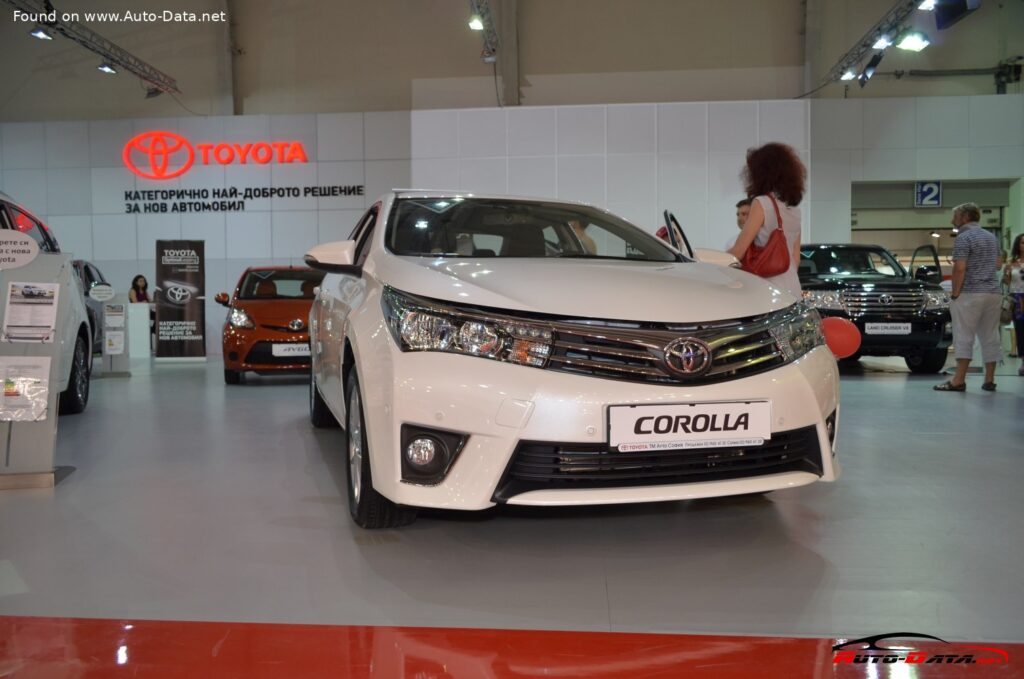
The Toyota Corolla XI (E170) adopted a more refined and contemporary design compared to its predecessors, featuring a sleeker profile and a more upscale appearance. The specific variant discussed here is a four-door sedan, offering seating for five occupants. Its exterior dimensions – 181.89 inches (4620 mm) in length, 69.88 inches (1775 mm) in width, and 57.68 inches (1465 mm) in height – provide a comfortable and spacious cabin while maintaining a manageable footprint for urban environments. A generous wheelbase of 106.3 inches (2700 mm) contributes to both ride comfort and interior room, particularly for rear passengers.
Inside, the E170 Corolla emphasized ergonomic design and user-friendliness. While specific trim levels and features varied by market, the general philosophy was to provide a durable and intuitive cabin. Features typically included air conditioning, power windows, and a capable audio system. Safety was a key consideration, with standard equipment often including an Anti-lock Braking System (ABS) and multiple airbags, depending on regional regulations. The vehicle’s structure was designed with impact absorption in mind, contributing to its overall safety ratings. The sedan body offered a practical trunk space of 15.96 cu. ft. (452 liters), ample for daily errands or family trips.
The driving dynamics of the Toyota Corolla XI (E170) 1.33 Dual VVT-i (100 Hp) were engineered for comfort and predictability. It featured an independent McPherson strut front suspension with coil springs and an anti-roll bar, paired with a torsion beam rear suspension. This setup provided a compliant ride quality, effectively soaking up road imperfections, while the electric power steering offered light and precise control, making it easy to maneuver in city traffic and park. Ventilated disc brakes at the front and disc brakes at the rear ensured confident stopping power.
Technical Specifications: Toyota Corolla XI (E170) 1.33 Dual VVT-i (100 Hp)
| Category | Specification |
|---|---|
General Information |
|
| Brand | Toyota |
| Model | Corolla |
| Generation | Corolla XI (E170) |
| Type (Engine) | 1.33 Dual VVT-i (100 Hp) |
| Start of Production | 2012 year |
| End of Production | 2015 year |
| Powertrain Architecture | Internal Combustion engine |
| Body type | Sedan |
| Seats | 5 |
| Doors | 4 |
Performance Specs |
|
| Fuel consumption (economy) – urban | 7.2 l/100 km (32.7 US mpg) |
| Fuel consumption (economy) – extra urban | 4.7 l/100 km (50 US mpg) |
| Fuel consumption (economy) – combined | 5.6 l/100 km (42 US mpg) |
| CO2 emissions | 129 g/km |
| Fuel Type | Petrol (Gasoline) |
| Acceleration 0 – 60 mph | 12 seconds (Calculated) |
| Acceleration 0 – 100 km/h | 12.6 seconds |
| Maximum speed | 180 km/h (111.85 mph) |
| Emission standard | Euro 5 J |
| Weight-to-power ratio | 12.3 kg/Hp (81.6 Hp/tonne) |
| Weight-to-torque ratio | 9.6 kg/Nm (104.5 Nm/tonne) |
Engine Specs |
|
| Power | 100 Hp @ 6000 rpm |
| Power per liter | 75.2 Hp/l |
| Torque | 128 Nm (94.41 lb.-ft.) @ 3800 rpm |
| Engine layout | Front, Transverse |
| Engine Model/Code | 1NR-FE |
| Engine displacement | 1329 cm3 (81.1 cu. in.) |
| Number of cylinders | 4 |
| Engine configuration | Inline |
| Cylinder Bore | 72.5 mm (2.85 in.) |
| Piston Stroke | 80.5 mm (3.17 in.) |
| Compression ratio | 11.5:1 |
| Number of valves per cylinder | 4 |
| Fuel injection system | Multi-port manifold injection |
| Engine aspiration | Naturally aspirated engine |
| Valvetrain | DOHC – Dual VVT-i |
| Engine oil capacity | 3.4 l (3.59 US qt) |
| Coolant capacity | 4.7 l (4.97 US qt) |
Space, Volume and Weights |
|
| Kerb Weight | 1225 kg (2700.66 lbs.) |
| Max. weight | 1735 kg (3825.02 lbs.) |
| Max load | 510 kg (1124.36 lbs.) |
| Trunk (boot) space – minimum | 452 l (15.96 cu. ft.) |
| Fuel tank capacity | 55 l (14.53 US gal) |
Dimensions |
|
| Length | 4620 mm (181.89 in.) |
| Width | 1775 mm (69.88 in.) |
| Height | 1465 mm (57.68 in.) |
| Wheelbase | 2700 mm (106.3 in.) |
| Front track | 1535 mm (60.43 in.) |
| Rear (Back) track | 1535 mm (60.43 in.) |
| Ride height (ground clearance) | 125 mm (4.92 in.) |
| Drag coefficient (Cd) | 0.27 |
| Minimum turning circle (turning diameter) | 11.4 m (37.4 ft.) |
Drivetrain, Brakes and Suspension Specs |
|
| Drivetrain Architecture | The Internal combustion engine (ICE) drives the front wheels of the vehicle. |
| Drive wheel | Front wheel drive |
| Number of gears and type of gearbox | 6 gears, manual transmission |
| Front suspension | Independent, type McPherson with coil spring and anti-roll bar |
| Rear suspension | Torsion beam |
| Front brakes | Ventilated discs |
| Rear brakes | Disc |
| Assisting systems | ABS (Anti-lock braking system) |
| Steering type | Steering rack and pinion |
| Power steering | Electric Steering |
| Tires size | 195/65 R15; 205/55 R16 |
| Wheel rims size | 15; 16 |
Legacy and Market Impact
The Toyota Corolla has long enjoyed a reputation for bulletproof reliability, an attribute that continued strongly with the E170 generation, including the Toyota Corolla XI (E170) 1.33 Dual VVT-i (100 Hp). This particular variant, with its efficient 1.33-liter engine, played a crucial role in markets where fuel economy, low emissions, and affordability were paramount. In regions like Western Europe, Eastern Europe, and parts of Asia, where smaller engine displacements are often favored due to taxation policies and higher fuel costs, this Corolla offered a compelling package.
Its primary competitors in these markets included vehicles like the Volkswagen Golf (though often with slightly more powerful base engines), the Ford Focus, Honda Civic (non-US variants), Hyundai Elantra (i30 in Europe), and the Opel Astra. What set the Corolla apart was its unwavering commitment to durability and low ownership costs. While some rivals might have offered a sportier driving experience or more avant-garde interior designs, the Corolla consistently delivered a no-fuss, dependable ownership experience that resonated deeply with a broad consumer base.
The Toyota Corolla XI (E170) 1.33 Dual VVT-i (100 Hp) upheld the Corolla’s global legacy as a practical, family-friendly sedan. Its impact was felt in its consistent sales performance in its target markets, reinforcing Toyota’s position as a leader in mainstream automotive manufacturing. It contributed to the Corolla’s ongoing status as one of the best-selling nameplates in automotive history, solidifying its image as the sensible choice for millions of drivers worldwide. Even after the E170 generation concluded production in 2015, its underlying principles of efficiency, reliability, and value continued to influence subsequent Corolla models, ensuring the brand’s enduring appeal in a competitive global landscape.