Toyota Corolla XII (E210) 1.8i (122 Hp) Hybrid e-CVT: A Deep Dive into Efficiency and Modernity
The Toyota Corolla, a name synonymous with reliability and global automotive presence, entered its twelfth generation (E210) in 2018, continuing its legacy as one of the best-selling cars worldwide. Among its numerous variants, the Toyota Corolla XII (E210) 1.8i (122 Hp) Hybrid e-CVT, produced between 2019 and 2022, stands out as a prime example of Toyota’s unwavering commitment to hybrid technology and fuel efficiency. This particular iteration, primarily targeting markets outside the United States with its specific powertrain configuration, cemented the Corolla’s reputation as an accessible and environmentally conscious choice in the compact sedan segment. While the Corolla nameplate has a strong presence in the US, this specific 1.8-liter hybrid configuration with 122 horsepower was a key player in European and Asian markets, offering a compelling blend of performance and exceptional fuel economy.
Engine and Performance: The Hybrid Synergy Drive Advantage
At the heart of the Toyota Corolla XII (E210) 1.8i (122 Hp) Hybrid e-CVT lies Toyota’s renowned Full Hybrid Electric Vehicle (FHEV) powertrain architecture. This sophisticated system seamlessly integrates a 1.8-liter (1798 cm³) naturally aspirated inline four-cylinder gasoline engine (model code 2ZR-FXE) with a potent electric motor, delivering a combined system output of 122 horsepower. The gasoline engine alone contributes 98 horsepower at 5200 rpm and 104.73 lb.-ft. of torque at 3600 rpm. It features a DOHC valvetrain, multi-port manifold injection, and a high compression ratio of 13:1, all engineered for optimal thermal efficiency, a hallmark of Toyota’s Atkinson-cycle engines used in hybrids.
Complementing the internal combustion engine is a synchronous electric motor, providing an additional 72 horsepower and a robust 120.22 lb.-ft. of instant torque. This electric power is drawn from a compact 207.2V Lithium-ion (Li-Ion) battery strategically placed under the rear seats, optimizing weight distribution and interior space. The powertrain architecture is front-wheel drive, with both the ICE and electric motor driving the front wheels, capable of operating in full electric (EV) mode for short distances at low speeds, or in a mixed mode for maximum efficiency.
Power is managed by an electronically controlled continuously variable transmission (e-CVT), which ensures smooth and efficient power delivery across all driving conditions. This setup allows the Corolla Hybrid to achieve commendable performance for its class, accelerating from 0 to 60 mph in a respectable 10.5 seconds and reaching a top speed of 111.85 mph (180 km/h). More impressively, its combined fuel economy figures are outstanding, ranging from 61.9 to 69.2 US mpg (3.4-3.8 l/100 km), with CO2 emissions as low as 77-87 g/km, meeting stringent Euro 6 DG emission standards. This exceptional efficiency underscores the Corolla Hybrid’s role as a leader in sustainable daily commuting.
Design and Features: Modern Sedan Aesthetics and Practicality
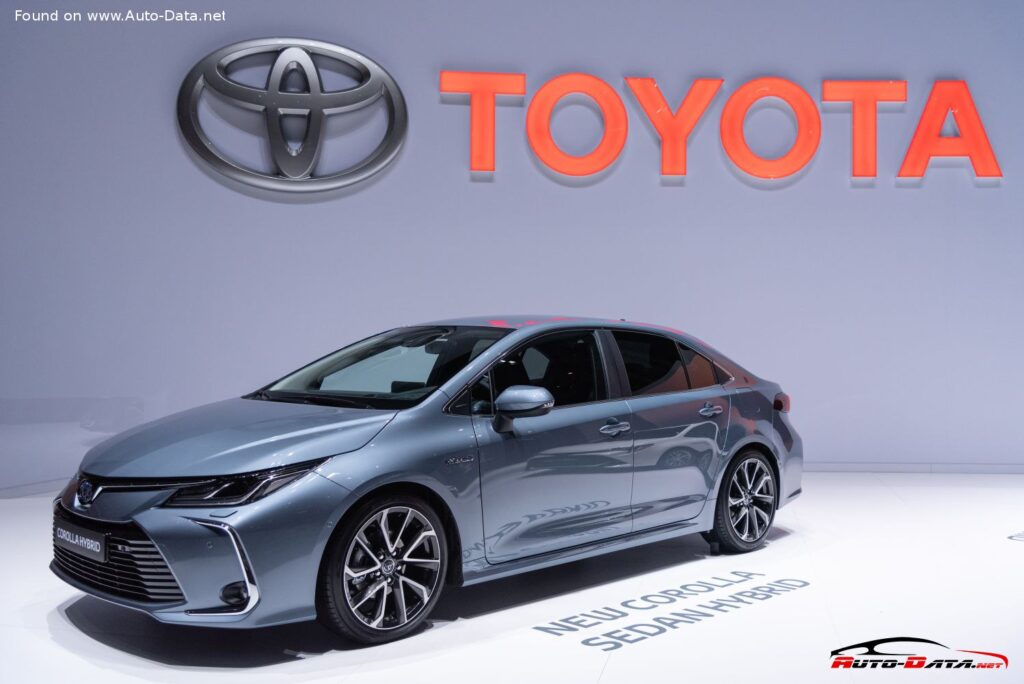
The twelfth-generation Toyota Corolla sedan (E210) presented a more dynamic and contemporary design compared to its predecessors. With a length of 182.28 inches, a width of 70.08 inches, and a height of 56.5 inches, it possessed a sleek profile and an assertive stance. The 106.3-inch wheelbase contributed to both stable handling and a spacious cabin for its five occupants. Its drag coefficient (Cd) of 0.282 further enhanced aerodynamic efficiency, contributing to its impressive fuel economy.
Inside, the Corolla Hybrid offered a practical and comfortable environment. The four-door sedan configuration provided easy access to both front and rear seats. The trunk capacity of 16.63 cubic feet (471 liters) was generous for a compact sedan, making it suitable for families and daily errands. The vehicle’s kerb weight ranged from 2888.06 to 3141.59 lbs (1310-1425 kg), reflecting a balance between structural rigidity and lightweight construction crucial for efficiency.
In terms of chassis and handling, the Corolla XII (E210) featured an independent McPherson strut front suspension with coil springs and an anti-roll bar, paired with a sophisticated double wishbone rear suspension. This combination delivered a comfortable ride quality while maintaining responsive handling. Braking power was provided by ventilated discs at the front and solid discs at the rear, supported by an Anti-lock Braking System (ABS). Electric power steering, a rack and pinion type, offered light and precise control, enhancing maneuverability in urban settings. The vehicle rode on 225/45 R17 tires mounted on 7.5J x 17-inch wheel rims, contributing to its confident road presence.
Technical Specifications: Toyota Corolla XII (E210) 1.8i (122 Hp) Hybrid e-CVT
| Category | Specification |
|---|---|
| General Information | |
| Brand | Toyota |
| Model | Corolla |
| Generation | Corolla XII (E210) |
| Type (Engine) | 1.8i (122 Hp) Hybrid e-CVT |
| Production Start | 2019 |
| Production End | 2022 |
| Powertrain Architecture | FHEV (Full Hybrid Electric Vehicle) |
| Body Type | Sedan |
| Seats | 5 |
| Doors | 4 |
| Performance Specifications | |
| Fuel Consumption (Urban) | 3.5-3.9 l/100 km (60.3-67.2 US mpg) |
| Fuel Consumption (Extra Urban) | 3.1-3.6 l/100 km (65.3-75.9 US mpg) |
| Fuel Consumption (Combined) | 3.4-3.8 l/100 km (61.9-69.2 US mpg) |
| CO2 Emissions | 77-87 g/km |
| Fuel Type | Petrol (Gasoline) |
| Acceleration 0-60 mph | 10.5 seconds |
| Maximum Speed | 111.85 mph (180 km/h) |
| Emission Standard | Euro 6 DG |
| System Power | 122 Hp |
| Weight-to-Power Ratio | 10.7 kg/Hp, 93.1 Hp/tonne |
| Electric Cars and Hybrids Specs | |
| Battery Voltage | 207.2 V |
| Battery Technology | Lithium-ion (Li-Ion) |
| Battery Location | Under the rear seats |
| Electric Motor Power | 72 Hp |
| Electric Motor Torque | 120.22 lb.-ft. (163 Nm) |
| Electric Motor Type | Synchronous |
| Internal Combustion Engine Specs | |
| Power | 98 Hp @ 5200 rpm |
| Torque | 104.73 lb.-ft. (142 Nm) @ 3600 rpm |
| Engine Layout | Front, Transverse |
| Engine Model/Code | 2ZR-FXE |
| Engine Displacement | 1.8 liters (1798 cm³ / 109.72 cu. in.) |
| Number of Cylinders | 4 |
| Engine Configuration | Inline |
| Cylinder Bore | 3.17 in. (80.5 mm) |
| Piston Stroke | 3.48 in. (88.3 mm) |
| Compression Ratio | 13:1 |
| Valves per Cylinder | 4 |
| Fuel Injection System | Multi-port manifold injection |
| Engine Aspiration | Naturally aspirated |
| Valvetrain | DOHC |
| Engine Oil Capacity | 4.44 US qt (4.2 l) |
| Coolant Capacity | 5.71 US qt (5.4 l) |
| Engine Systems | Particulate filter |
| Space, Volume and Weights | |
| Kerb Weight | 2888.06 – 3141.59 lbs (1310-1425 kg) |
| Trunk (Boot) Space – Minimum | 16.63 cu. ft. (471 l) |
| Fuel Tank Capacity | 11.36 US gal (43 l) |
| Permitted Trailer Load with Brakes (12%) | 1653.47 lbs (750 kg) |
| Permitted Trailer Load without Brakes | 992.08 lbs (450 kg) |
| Dimensions | |
| Length | 182.28 in. (4630 mm) |
| Width | 70.08 in. (1780 mm) |
| Height | 56.5 in. (1435 mm) |
| Wheelbase | 106.3 in. (2700 mm) |
| Front Track | 60.28 in. (1531 mm) |
| Rear (Back) Track | 60.79 in. (1544 mm) |
| Front Overhang | 36.81 in. (935 mm) |
| Rear Overhang | 39.17 in. (995 mm) |
| Ride Height (Ground Clearance) | 5.12 in. (130 mm) |
| Drag Coefficient (Cd) | 0.282 |
| Minimum Turning Circle | 34.12 – 35.43 ft. (10.4-10.8 m) |
| Drivetrain, Brakes and Suspension Specs | |
| Drivetrain Architecture | FHEV, ICE and electric motor drive front wheels; full electric or mixed mode operation. |
| Drive Wheel | Front-wheel drive |
| Gearbox Type | Automatic transmission e-CVT |
| Front Suspension | Independent, McPherson with coil spring and anti-roll bar |
| Rear Suspension | Double wishbone |
| Front Brakes | Ventilated discs |
| Rear Brakes | Disc |
| Assisting Systems | ABS (Anti-lock braking system) |
| Steering Type | Steering rack and pinion |
| Power Steering | Electric Steering |
| Tires Size | 225/45 R17 |
| Wheel Rims Size | 7.5J x 17 |
Legacy and Market Impact: The Enduring Appeal of the Toyota Corolla XII (E210)
The Toyota Corolla’s twelfth generation, particularly its hybrid variants like the Toyota Corolla XII (E210) 1.8i (122 Hp) Hybrid e-CVT, continued to build upon a legacy of reliability, practicality, and affordability that has made the Corolla a household name for decades. While this specific 1.8-liter hybrid powertrain was a cornerstone of Toyota’s offerings in markets like Europe and parts of Asia, its underlying principles of efficient hybrid technology resonated globally. In these markets, it competed fiercely with other compact sedans and hatchbacks, including models like the Honda Civic Hybrid, Hyundai Elantra Hybrid, and various diesel-powered European alternatives, often outperforming them in terms of combined fuel efficiency and long-term reliability reputation.
This generation of Corolla hybrids played a crucial role in normalizing hybrid technology, making it accessible to a broader consumer base beyond the dedicated eco-conscious segment. Its low CO2 emissions and exceptional fuel economy were particularly attractive in regions with strict environmental regulations and high fuel prices. Toyota’s strategy of offering a robust hybrid option across its core models, rather than as a niche product, solidified its position as a leader in automotive electrification.
The E210 Corolla Hybrid’s impact extended beyond just sales figures. It served as a testament to Toyota’s continuous refinement of its Hybrid Synergy Drive system, proving that a compact family sedan could deliver both everyday usability and impressive environmental credentials without compromising on driving experience. Its modern design, coupled with Toyota’s reputation for quality and low running costs, ensured its strong resale value and enduring appeal. The Toyota Corolla XII (E210) 1.8i (122 Hp) Hybrid e-CVT thus stands as a significant chapter in the Corolla’s storied history, embodying a period where efficiency, technology, and mainstream appeal converged to redefine the compact sedan segment for a new era.