Toyota Corolla XII (E210, facelift 2022) (USA) 1.8 (134 Hp) Hybrid CVTi
The Toyota Corolla, a nameplate synonymous with reliability and value for decades, entered its twelfth generation (E210) with a significant facelift in 2022, further solidifying its position in the highly competitive compact sedan segment. For the American market, a standout offering within this refreshed lineup is the Toyota Corolla XII (E210, facelift 2022) (USA) 1.8 (134 Hp) Hybrid CVTi. This particular variant represents Toyota’s unwavering commitment to fuel efficiency and environmental responsibility, integrating a sophisticated full-hybrid electric vehicle (FHEV) powertrain into the Corolla’s proven platform. Launched in June 2022, this updated hybrid model builds upon the E210 generation’s foundation of enhanced driving dynamics and modern aesthetics, presenting a compelling package for consumers prioritizing low running costs, a comfortable ride, and Toyota’s renowned reputation for longevity. It blends a traditionally aspirated gasoline engine with an electric motor, managed by a continuously variable transmission (CVT), to deliver a seamless and efficient driving experience that has become a hallmark of Toyota’s hybrid technology.
Powertrain and Performance of the Toyota Corolla XII (E210, facelift 2022) (USA) 1.8 (134 Hp) Hybrid CVTi
At the heart of the Toyota Corolla XII (E210, facelift 2022) (USA) 1.8 (134 Hp) Hybrid CVTi is a meticulously engineered FHEV powertrain, designed to optimize both performance and fuel economy. The system combines a 1.8-liter (1798 cm³) 2ZR-FXE inline four-cylinder internal combustion engine with an electric motor. The gasoline engine, positioned transversely at the front, features a DOHC (Double Overhead Camshaft) valvetrain with Dual VVT-i (Variable Valve Timing with intelligence), a naturally aspirated design, and multi-port manifold injection. It produces 134 horsepower at 5200 rpm and 156.36 lb-ft of torque at 3600 rpm. This engine is specifically tuned for hybrid applications, often operating on an Atkinson cycle to maximize thermal efficiency.
Complementing the gasoline engine is a potent electric motor, integrated into the transmission, which alone generates 93 horsepower and a substantial 136.45 lb-ft of torque. This synchronous electric motor draws power from a compact 0.85 kWh Lithium-ion (Li-Ion) battery, strategically located under the rear seats to maintain cabin space and optimize weight distribution. The combined efforts of the gasoline engine and electric motor result in a total system output of 134 horsepower. While the horsepower figure may seem modest, the immediate torque delivery from the electric motor, combined with the gasoline engine’s output, provides brisk acceleration and a responsive feel, especially in urban driving conditions.
Power is channeled to the front wheels via Toyota’s advanced CVTi (Continuously Variable Transmission with intelligence), which is essentially an electronically controlled planetary gear set in hybrid applications, often referred to as an eCVT. This system seamlessly blends power from the engine and motor, allowing the vehicle to operate in full electric mode at lower speeds, mixed mode, or solely on the gasoline engine when conditions demand. This sophisticated powertrain architecture contributes to the Corolla Hybrid’s exceptional fuel economy, rated at an impressive 47 US mpg combined (50 US mpg in urban settings and 42.8 US mpg on the highway), making it one of the most fuel-efficient non-plug-in compact sedans on the market. Furthermore, the vehicle meets the stringent ULEV 70 emission standard, underscoring its commitment to cleaner air.
Design and Features
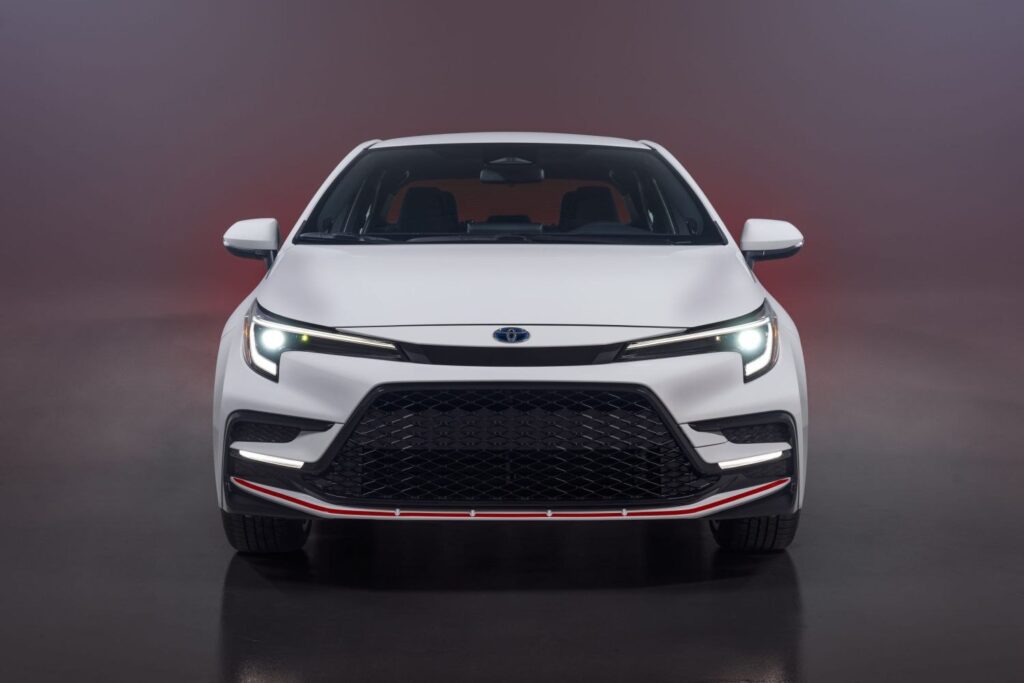
The 2022 facelift brought subtle yet impactful enhancements to the Corolla E210’s design, maintaining its contemporary and athletic stance. As a four-door sedan with seating for five, the Corolla Hybrid offers a practical and comfortable cabin. Its exterior dimensions are well-proportioned for the compact segment, with a length of 182.28 inches, a width of 70.12 inches, and a height of 56.5 inches. The 106.3-inch wheelbase contributes to a stable ride and ample interior space for its class. The refreshed design includes updated lighting elements and grille treatments, giving the car a sharper, more modern appearance. The drag coefficient of 0.28 is indicative of its aerodynamic efficiency, which further aids in fuel economy and reduces wind noise at highway speeds.
Inside, the Corolla Hybrid focuses on ergonomics and user-friendliness. While specific interior features like infotainment screen size or advanced driver-assistance systems (ADAS) are not detailed in the raw data, the E210 generation is known for incorporating modern technology. The standard equipment typically includes a suite of safety features, such as ABS (Anti-lock Braking System), and an electric power steering system that offers a balance of ease of use in parking and stability at speed. The trunk space is a respectable 13.1 cubic feet (371 liters), providing sufficient cargo capacity for daily errands or weekend trips. The vehicle rides on 205/55 R16 tires mounted on 7J x 16-inch wheel rims, offering a comfortable ride quality that is characteristic of the Corolla.
The chassis benefits from an independent McPherson strut front suspension with coil springs and an anti-roll bar, while the rear features a sophisticated double-wishbone setup with a transverse stabilizer and coil springs. This combination provides a compliant ride, good handling characteristics, and improved stability compared to previous generations. Braking duties are handled by ventilated discs at the front (274 mm) and solid discs at the rear (259 mm), ensuring confident stopping power.
Technical Specifications
| Category | Specification |
|---|---|
| General Information | |
| Brand | Toyota |
| Model | Corolla XII (E210, facelift 2022) (USA) |
| Type (Engine) | 1.8 (134 Hp) Hybrid CVTi |
| Start of Production | June, 2022 |
| Powertrain Architecture | FHEV (Full Hybrid Electric Vehicle) |
| Body Type | Sedan |
| Seats | 5 |
| Doors | 4 |
| Performance Specs | |
| Fuel Consumption (Urban) | 50 US mpg (4.7 l/100 km) |
| Fuel Consumption (Extra Urban) | 42.8 US mpg (5.5 l/100 km) |
| Fuel Consumption (Combined) | 47 US mpg (5 l/100 km) |
| Fuel Type | Petrol (Gasoline) |
| Emission Standard | ULEV 70 |
| Weight-to-Power Ratio | 9.6 kg/Hp, 103.6 Hp/tonne |
| Weight-to-Torque Ratio | 6.1 kg/Nm, 164 Nm/tonne |
| Electric Cars and Hybrids Specs | |
| Gross Battery Capacity | 0.85 kWh |
| Battery Voltage | 207.2 V |
| Battery Technology | Lithium-ion (Li-Ion) |
| Battery Location | Under the rear seats |
| Electric Motor Power | 93 Hp |
| Electric Motor Torque | 136.45 lb-ft (185 Nm) |
| Electric Motor Location | Integrated into the transmission |
| Electric Motor Type | Synchronous |
| System Power | 134 Hp |
| Internal Combustion Engine Specs | |
| Power | 134 Hp @ 5200 rpm |
| Power per Liter | 74.5 Hp/l |
| Torque | 156.36 lb-ft (212 Nm) @ 3600 rpm |
| Engine Layout | Front, Transverse |
| Engine Model/Code | 2ZR-FXE |
| Engine Displacement | 1.8 liters (1798 cm³, 109.72 cu. in.) |
| Number of Cylinders | 4 |
| Engine Configuration | Inline |
| Cylinder Bore | 3.17 in (80.5 mm) |
| Piston Stroke | 3.48 in (88.3 mm) |
| Compression Ratio | 13:1 |
| Number of Valves per Cylinder | 4 |
| Fuel Injection System | Multi-port manifold injection |
| Engine Aspiration | Naturally aspirated engine |
| Valvetrain | DOHC, Dual VVT-i |
| Engine Oil Capacity | 4.44 US qt (4.2 l) |
| Coolant Capacity | 5.92 US qt (5.6 l) |
| Engine Systems | Start & Stop System |
| Space, Volume and Weights | |
| Kerb Weight | 2850.58 lbs (1293 kg) |
| Trunk (boot) Space – Minimum | 13.1 cu. ft. (371 l) |
| Fuel Tank Capacity | 11.36 US gal (43 l) |
| Dimensions | |
| Length | 182.28 in (4630 mm) |
| Width | 70.12 in (1781 mm) |
| Height | 56.5 in (1435 mm) |
| Wheelbase | 106.3 in (2700 mm) |
| Front Track | 60.31 in (1532 mm) |
| Rear (Back) Track | 60.39 in (1534 mm) |
| Ride Height (Ground Clearance) | 5.31 in (135 mm) |
| Drag Coefficient (Cd) | 0.28 |
| Minimum Turning Circle (Turning Diameter) | 35.76 ft (10.9 m) |
| Drivetrain, Brakes and Suspension Specs | |
| Drivetrain Architecture | FHEV (Full Hybrid Electric Vehicle). ICE and electric motor drive front wheels with ability to work in full electric or mixed mode. |
| Drive Wheel | Front wheel drive |
| Number of Gears and Type of Gearbox | Automatic transmission CVTi |
| Front Suspension | Independent, McPherson with coil spring and anti-roll bar |
| Rear Suspension | Double wishbone, Transverse stabilizer, Coil spring |
| Front Brakes | Ventilated discs, 10.79 in (274 mm) |
| Rear Brakes | Disc, 10.20 in (259 mm) |
| Assisting Systems | ABS (Anti-lock braking system) |
| Steering Type | Steering rack and pinion |
| Power Steering | Electric Steering |
| Tires Size | 205/55 R16 |
| Wheel Rims Size | 7J x 16 |
Legacy and Market Impact
The Toyota Corolla’s legacy in the automotive world is unparalleled, with millions sold globally since its inception. The twelfth generation, and particularly the 2022 facelifted hybrid variant for the USA, continues this tradition by adapting to evolving market demands for greater efficiency and reduced environmental impact. In the American market, the Corolla Hybrid directly competes with other compact sedans offering hybrid options, such as the Hyundai Elantra Hybrid and the Honda Insight (though the Insight has since been replaced by the Civic Hybrid). Its primary strength lies in Toyota’s long-established reputation for hybrid technology, which boasts a proven track record of reliability and low maintenance costs that often surpasses its rivals.
The introduction of the Toyota Corolla XII (E210, facelift 2022) (USA) 1.8 (134 Hp) Hybrid CVTi reinforces Toyota’s strategy of democratizing hybrid technology, making it accessible to a broader consumer base within the compact segment. Its exceptional combined fuel economy of 47 US mpg is a significant selling point, especially in an era of fluctuating fuel prices, offering tangible savings to owners over the vehicle’s lifespan. The smooth operation of the CVTi, combined with the seamless transition between electric and gasoline power, contributes to a refined driving experience that is often quieter and more comfortable than many non-hybrid counterparts.
Beyond its efficiency, the Corolla Hybrid benefits from the E210 generation’s improved driving dynamics, offering a more engaging experience than Corollas of old, while still maintaining its core values of comfort and practicality. The double-wishbone rear suspension, a significant upgrade over previous generations, contributes to better handling and ride quality, further enhancing its appeal. Its ULEV 70 emission rating also speaks to its forward-thinking design, positioning it as a responsible choice for environmentally conscious drivers. The Corolla Hybrid’s market impact is profound; it serves as a benchmark for efficiency and reliability in the compact sedan class, demonstrating that practical, affordable transportation can also be environmentally friendly and technologically advanced. It continues to be a cornerstone of Toyota’s lineup, appealing to a wide range of buyers from first-time car owners to those seeking a dependable and economical daily driver.