Introduction to the Toyota Corolla XII (E210) (USA) 2.0 (169 Hp)
The Toyota Corolla, a name synonymous with reliability, affordability, and ubiquitous presence across global automotive markets, entered its twelfth generation (E210) with significant advancements. For the United States market, the
Toyota Corolla XII (E210) (USA) 2.0 (169 Hp)
represented a compelling evolution of the compact sedan, blending enhanced driving dynamics, modern design, and Toyota’s renowned engineering prowess. Produced from February 2019 to 2022, this iteration of the Corolla sedan aimed to shed its long-held reputation as merely a sensible appliance, injecting a dose of sportiness and technological sophistication previously uncommon for the model.
The E210 generation, underpinned by Toyota’s New Global Architecture (TNGA) platform (specifically the GA-C variant, though not explicitly detailed in the provided data, it’s the foundation of this generation), brought a lower center of gravity, increased structural rigidity, and a more sophisticated suspension setup. This platform enabled the Corolla to deliver a more engaging driving experience, challenging competitors in the compact segment that had traditionally offered more spirited performance. The 2.0-liter engine variant, in particular, was a key offering for American consumers seeking a balance of power and efficiency in their daily commute or weekend adventures.
Engine and Performance of the Toyota Corolla XII (E210) (USA) 2.0 (169 Hp)
At the heart of the
Toyota Corolla XII (E210) (USA) 2.0 (169 Hp)
sedan lies the M20A-FKS engine, a naturally aspirated 2.0-liter inline-four powerplant from Toyota’s “Dynamic Force” engine family. This engine was engineered with a focus on both power output and fuel efficiency, utilizing several advanced technologies. It delivers a respectable 169 horsepower at 6600 rpm and 151.2 lb.-ft. of torque at 4400 rpm. This output represents a significant upgrade over the base 1.8-liter engine offered in other Corolla trims, providing a more confident acceleration and improved highway passing capability.
Key to the M20A-FKS engine’s performance and efficiency is its sophisticated design. It features a high compression ratio of 13:1, which contributes to greater thermal efficiency. The valvetrain is a Double Overhead Camshaft (DOHC) configuration with 4 valves per cylinder, optimizing airflow for combustion. Furthermore, the engine incorporates Toyota’s D4-S fuel injection system, which combines both direct injection and multi-port manifold injection. This dual-injection strategy allows for precise fuel delivery across the engine’s operating range, enhancing power, reducing emissions, and improving fuel economy.
Power is routed to the front wheels via a 6-speed intelligent Manual Transmission (iMT). This gearbox is a notable inclusion in a market increasingly dominated by automatic transmissions, offering enthusiasts a more direct and engaging driving experience. The “intelligent” aspect of the iMT often includes rev-matching capabilities, which automatically blips the throttle on downshifts for smoother gear changes and reduced driveline shock.
In terms of fuel economy, the 2.0-liter Corolla sedan demonstrates impressive figures for a naturally aspirated engine of its size. It achieves an estimated 29 US mpg in urban driving, 36.2 US mpg on the highway, and a combined rating of 32.2 US mpg. These figures underscore Toyota’s commitment to efficiency without sacrificing performance. The vehicle’s weight-to-power ratio stands at 8.2 kg/Hp (121.9 Hp/tonne), and its weight-to-torque ratio is 6.8 kg/Nm (147.9 Nm/tonne), indicating a well-balanced power-to-weight profile for its class. The engine also features a particulate filter, a technology more commonly associated with European markets, highlighting Toyota’s global engineering standards for emissions control.
Design and Features of the Toyota Corolla XII (E210) Sedan
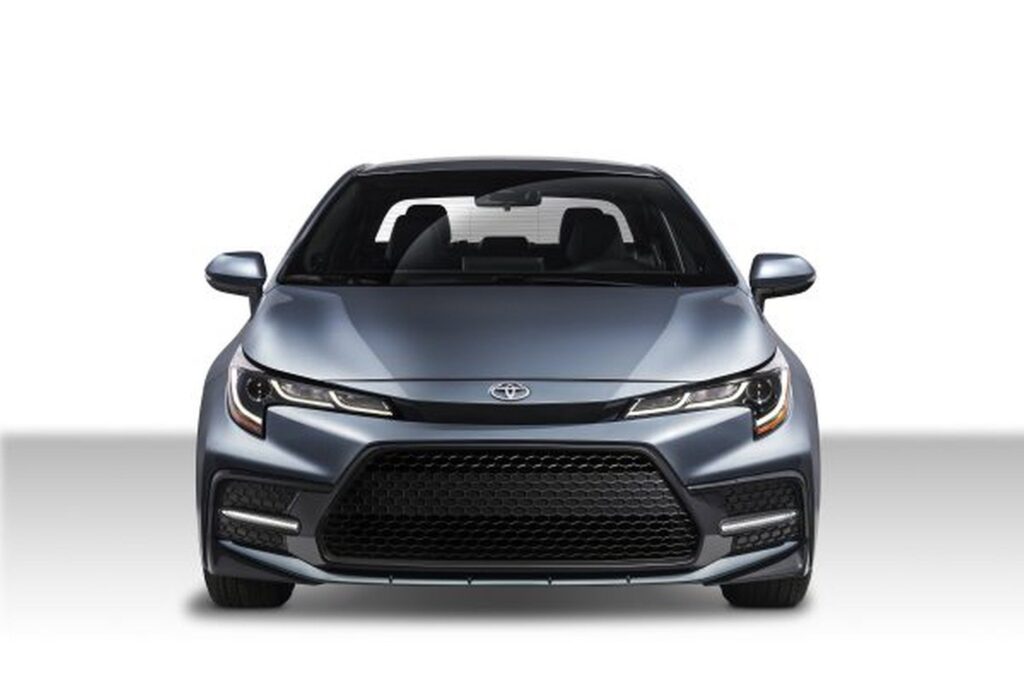
The twelfth-generation Toyota Corolla sedan, including the 2.0-liter variant, adopted a more aggressive and contemporary design language compared to its predecessors. Its sleek, low-slung profile, characterized by sharp lines and a wide stance, aimed to appeal to a younger demographic while retaining the practicality expected of a Corolla. The vehicle measures 182.28 inches in length, 70.12 inches in width, and 56.5 inches in height, with a substantial wheelbase of 106.3 inches. These dimensions contribute to a spacious cabin for five occupants and a planted road presence.
The sedan body type offers four doors and seating for five, making it a highly versatile option for families and individuals alike. Despite its compact exterior, the trunk provides a usable 13.1 cubic feet of cargo space, sufficient for daily errands or weekend trips. The design is complemented by standard 18-inch wheels, shod with 225/40 R18 tires, which fill the wheel wells nicely and contribute to the car’s athletic stance and handling capabilities.
Underneath its stylish skin, the Corolla E210 boasts a refined chassis. The front suspension utilizes an independent McPherson strut setup with coil springs and an anti-roll bar, a common and effective design for front-wheel-drive vehicles, offering a good balance of comfort and handling. At the rear, an independent multi-link spring suspension with a stabilizer bar replaces the torsion beam setup of previous generations, significantly improving ride quality, stability, and responsiveness, especially over uneven surfaces and through corners. This advanced suspension system contributes heavily to the E210’s more dynamic character.
Braking performance is handled by ventilated discs measuring 274 mm at the front and solid discs measuring 259 mm at the rear, complemented by an Anti-lock Braking System (ABS) for enhanced safety and control during emergency stops. Steering is managed by an electric power-assisted rack and pinion system, providing precise feedback and ease of maneuverability, particularly in urban environments with a minimum turning circle of 34.12 feet. The vehicle’s ride height of 5.12 inches is typical for a compact sedan, balancing aerodynamic efficiency with practical ground clearance.
Technical Specifications
| Category | Specification |
|---|---|
|
General Information |
|
| Brand | Toyota |
| Model | Corolla |
| Generation | Corolla XII (E210) (USA) |
| Engine Type | 2.0 (169 Hp) |
| Production Start | February, 2019 |
| Production End | 2022 |
| Powertrain Architecture | Internal Combustion Engine |
| Body Type | Sedan |
| Seats | 5 |
| Doors | 4 |
|
Performance Specs |
|
| Fuel Consumption (Urban) | 29 US mpg (8.1 l/100 km) |
| Fuel Consumption (Extra Urban) | 36.2 US mpg (6.5 l/100 km) |
| Fuel Consumption (Combined) | 32.2 US mpg (7.3 l/100 km) |
| Fuel Type | Petrol (Gasoline) |
| Weight-to-Power Ratio | 8.2 kg/Hp (121.9 Hp/tonne) |
| Weight-to-Torque Ratio | 6.8 kg/Nm (147.9 Nm/tonne) |
|
Engine Specs |
|
| Power | 169 Hp @ 6600 rpm |
| Power per Liter | 85.1 Hp/l |
| Torque | 151.2 lb.-ft. @ 4400 rpm (205 Nm) |
| Engine Layout | Front, Transverse |
| Engine Model/Code | M20A-FKS |
| Engine Displacement | 2.0 Liters (1987 cm3 / 121.25 cu. in.) |
| Number of Cylinders | 4 |
| Engine Configuration | Inline |
| Cylinder Bore | 3.17 in. (80.5 mm) |
| Piston Stroke | 3.84 in. (97.6 mm) |
| Compression Ratio | 13:1 |
| Valves per Cylinder | 4 |
| Fuel Injection System | Direct injection and Multi-port manifold injection |
| Engine Aspiration | Naturally aspirated |
| Valvetrain | DOHC |
| Engine Oil Capacity | 4.86 US qt (4.6 l) |
| Engine Oil Specification | Not specified |
| Coolant Capacity | 6.23 US qt (5.9 l) |
| Engine Systems | Particulate filter |
|
Space, Volume and Weights |
|
| Kerb Weight | 3055.61 lbs. (1386 kg) |
| Trunk (Boot) Space – Minimum | 13.1 cu. ft. (371 l) |
| Fuel Tank Capacity | 13.21 US gal (50 l) |
|
Dimensions |
|
| Length | 182.28 in. (4630 mm) |
| Width | 70.12 in. (1781 mm) |
| Height | 56.5 in. (1435 mm) |
| Wheelbase | 106.3 in. (2700 mm) |
| Ride Height (Ground Clearance) | 5.12 in. (130 mm) |
| Minimum Turning Circle | 34.12 ft. (10.4 m) |
|
Drivetrain, Brakes and Suspension |
|
| Drivetrain Architecture | Front-wheel drive (ICE drives front wheels) |
| Drive Wheel | Front wheel drive |
| Number of Gears and Type | 6 gears, manual transmission iMT |
| Front Suspension | Independent, McPherson with coil spring and anti-roll bar |
| Rear Suspension | Independent multi-link spring suspension with stabilizer |
| Front Brakes | Ventilated discs, 274 mm |
| Rear Brakes | Disc, 259 mm |
| Assisting Systems | ABS (Anti-lock braking system) |
| Steering Type | Steering rack and pinion |
| Power Steering | Electric Steering |
| Tire Size | 225/40 R18 |
| Wheel Rims Size | 18 inches |
Legacy and Market Impact of the Toyota Corolla XII (E210) (USA)
The Toyota Corolla’s legacy in the United States is one of unparalleled success, built on decades of delivering reliable, economical, and practical transportation. The twelfth-generation E210 model, and particularly the 2.0-liter variant with its manual transmission, played a crucial role in evolving this legacy. It demonstrated Toyota’s commitment to making the Corolla more competitive in a segment where driving dynamics and modern features were becoming increasingly important to consumers.
In the fiercely contested US compact sedan market, the Corolla XII (E210) went up against formidable rivals such as the Honda Civic, Hyundai Elantra, Mazda3, and Kia Forte. While the Corolla historically appealed to buyers prioritizing value and bulletproof reliability, the E210 generation, especially with the 2.0-liter engine, aimed to capture a broader audience by offering a more engaging driving experience. Its enhanced chassis, thanks to the TNGA platform, and the more powerful engine made it a genuinely competitive option for those who might have previously overlooked the Corolla for sportier alternatives.
The inclusion of the 6-speed iMT manual transmission in the 2.0-liter model was a significant statement. In an era where manual transmissions are increasingly rare, especially in mainstream compact sedans, Toyota’s decision to offer one signaled an understanding of and appreciation for driving enthusiasts. This move helped to cultivate a more dynamic image for the Corolla, moving it beyond its traditional perception.
The E210 Corolla’s impact extended beyond performance. Its modern exterior design, improved interior quality, and advanced safety features (including ABS as specified, and typically a suite of other active safety systems like Toyota Safety Sense, though not detailed in the provided data) contributed to its strong market position. It continued to be a top seller, upholding the Corolla’s reputation for high resale value and low ownership costs. The 2.0-liter engine variant specifically carved out a niche for itself, offering a “warm” version of the compact sedan that balanced everyday usability with a hint of driving pleasure, without venturing into true “hot hatch” territory.
Ultimately, the Toyota Corolla XII (E210) (USA) 2.0 (169 Hp) solidified the Corolla’s standing as a benchmark in the compact segment. It proved that a car could be both dependable and desirable, efficient and engaging. Its production run from 2019 to 2022 marked a period where the Corolla successfully reinvented itself, maintaining its core values while embracing a more dynamic and technologically advanced future.