As an international automotive expert, I present a detailed analysis of the Toyota Corolla XII (E210) (USA) 2.0 (169 Hp) CVT, a prominent player in the compact sedan segment of the North American market.
Introduction: The Toyota Corolla XII (E210) (USA)
The Toyota Corolla, a name synonymous with reliability and value, entered its twelfth generation (E210) in the United States market with significant enhancements in design, technology, and driving dynamics. Produced from February 2019 to 2022, the Corolla XII (E210) (USA) represented a pivotal evolution for the venerable compact sedan, aiming to shed its long-held reputation for being merely a utilitarian appliance. The specific variant under review, the 2.0-liter (169 Hp) CVT model, was positioned as a more engaging and potent option within the lineup, appealing to drivers seeking a balance of efficiency, modern features, and a touch more performance than its 1.8-liter counterpart. This generation of the Corolla, particularly in its US specification, underscored Toyota’s commitment to the TNGA (Toyota New Global Architecture) platform, which brought about fundamental improvements in chassis rigidity, ride comfort, and handling prowess, transforming the driving experience for this globally recognized nameplate.
Engine & Performance: The Dynamic Force of the Toyota Corolla XII (E210) (USA) 2.0 (169 Hp) CVT
At the heart of this particular Toyota Corolla XII (E210) (USA) lies Toyota’s M20A-FKS 2.0-liter “Dynamic Force” inline four-cylinder engine. This naturally aspirated powerplant is a testament to modern engineering, featuring a high compression ratio of 13:1, a DOHC valvetrain, and an advanced fuel injection system that combines direct injection with multi-port manifold injection. This sophisticated setup allows for optimal fuel atomization and combustion efficiency across a wide range of operating conditions, contributing to both power output and fuel economy.
The engine generates a robust 169 horsepower at 6600 rpm, a substantial increase over previous generation 1.8-liter models and a competitive figure within its segment. Torque peaks at 205 Nm (151.2 lb.-ft.) at 4400 rpm, providing ample low-to-mid-range thrust for daily driving scenarios and highway passing maneuvers. Power is efficiently delivered to the front wheels via a continuously variable transmission (CVT). This CVT is not a traditional unit; it incorporates a physical first launch gear, which provides a more direct and responsive feel during initial acceleration, mitigating the “rubber band” effect often associated with CVTs. Once underway, the transmission seamlessly transitions to its belt-driven system, ensuring smooth power delivery and optimizing fuel efficiency.
Fuel economy figures are impressive for a vehicle of its class, reflecting Toyota’s focus on efficiency. The urban consumption is rated at 7.6 l/100 km (30.9 US mpg), while extra-urban driving yields 5.9-6.2 l/100 km (39.9 – 37.9 US mpg). The combined fuel economy stands at 6.9 l/100 km (34.1 US mpg), making the 2.0-liter Corolla an economical choice for commuters and long-distance travelers alike. With a curb weight ranging from 1411-1429 kg (3110.72 – 3150.41 lbs.), the weight-to-power ratio is a respectable 8.3 kg/Hp (119.8 Hp/tonne), underscoring its lively performance characteristics.
Design & Features: A Modern Interpretation of the Compact Sedan
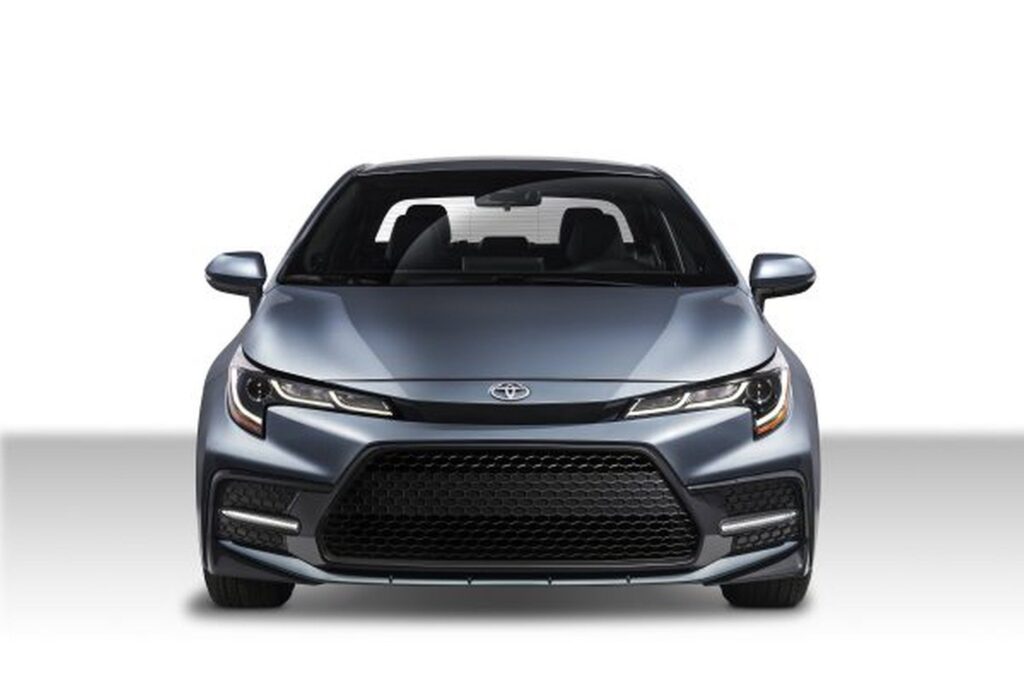
The Toyota Corolla XII (E210) (USA) adopted a more assertive and sculpted design language compared to its predecessors. As a four-door sedan, it projects a sleek and aerodynamic profile, characterized by sharp lines, a prominent grille, and available LED lighting that contributes to its contemporary aesthetic. With a length of 4630 mm (182.28 in.), a width of 1781 mm (70.12 in.), and a height of 1435 mm (56.5 in.), the Corolla maintains a compact footprint suitable for urban environments while offering a spacious interior.
The 2700 mm (106.3 in.) wheelbase contributes to a stable ride and generous cabin space for five occupants. The interior is designed with a focus on ergonomics and modern connectivity. While specific trim-level features are not provided, typical for a US-market Corolla of this era, standard features would include an advanced infotainment system with touchscreen display, smartphone integration (Apple CarPlay and Android Auto were common offerings), and a suite of driver-assistance technologies. Toyota’s commitment to safety is paramount, and this generation of Corolla typically came equipped with Toyota Safety Sense (TSS), including features like a pre-collision system, lane departure alert with steering assist, dynamic radar cruise control, and automatic high beams.
Suspension architecture features an independent McPherson strut setup with a coil spring and anti-roll bar at the front, paired with an independent multi-link spring suspension with a stabilizer at the rear. This sophisticated rear suspension, a significant upgrade for the Corolla, vastly improves ride comfort and handling precision. Braking is handled by ventilated discs at the front (274 mm) and solid discs at the rear (259 mm), complemented by ABS for confident stopping power. The vehicle rides on 225/40 R18 tires, enhancing grip and contributing to the car’s sporty stance. Electric power steering ensures light effort at low speeds and a more weighted feel on the highway, making the Corolla easy to maneuver in various driving conditions.
Technical Specifications
| Category | Specification |
|---|---|
| Brand | Toyota |
| Model | Corolla |
| Generation | Corolla XII (E210) (USA) |
| Type (Engine) | 2.0 (169 Hp) CVT |
| Production Start | February, 2019 |
| Production End | 2022 |
| Powertrain Architecture | Internal Combustion engine |
| Body Type | Sedan |
| Seats | 5 |
| Doors | 4 |
| Performance Specs | |
| Fuel Consumption (Urban) | 7.6 l/100 km (30.9 US mpg) |
| Fuel Consumption (Extra Urban) | 5.9-6.2 l/100 km (39.9 – 37.9 US mpg) |
| Fuel Consumption (Combined) | 6.9 l/100 km (34.1 US mpg) |
| Fuel Type | Petrol (Gasoline) |
| Weight-to-Power Ratio | 8.3 kg/Hp (119.8 Hp/tonne) |
| Weight-to-Torque Ratio | 6.9 kg/Nm (145.3 Nm/tonne) |
| Engine Specs | |
| Power | 169 Hp @ 6600 rpm |
| Power per Liter | 85.1 Hp/l |
| Torque | 205 Nm @ 4400 rpm (151.2 lb.-ft. @ 4400 rpm) |
| Engine Layout | Front, Transverse |
| Engine Model/Code | M20A-FKS |
| Engine Displacement | 1987 cm3 (121.25 cu. in.) |
| Number of Cylinders | 4 |
| Engine Configuration | Inline |
| Cylinder Bore | 80.5 mm (3.17 in.) |
| Piston Stroke | 97.6 mm (3.84 in.) |
| Compression Ratio | 13:1 |
| Valves per Cylinder | 4 |
| Fuel Injection System | Direct injection and Multi-port manifold injection |
| Engine Aspiration | Naturally aspirated engine |
| Valvetrain | DOHC |
| Engine Oil Capacity | 4.6 l (4.86 US qt) |
| Coolant Capacity | 6.2 l (6.55 US qt) |
| Engine Systems | Particulate filter |
| Space, Volume and Weights | |
| Kerb Weight | 1411-1429 kg (3110.72 – 3150.41 lbs.) |
| Trunk (Boot) Space – Minimum | 371 l (13.1 cu. ft.) |
| Fuel Tank Capacity | 50 l (13.21 US gal) |
| Dimensions | |
| Length | 4630 mm (182.28 in.) |
| Width | 1781 mm (70.12 in.) |
| Height | 1435 mm (56.5 in.) |
| Wheelbase | 2700 mm (106.3 in.) |
| Ride Height (Ground Clearance) | 130 mm (5.12 in.) |
| Minimum Turning Circle | 10.4 m (34.12 ft.) |
| Drivetrain, Brakes and Suspension Specs | |
| Drivetrain Architecture | Front-wheel drive (Internal Combustion engine drives front wheels) |
| Drive Wheel | Front wheel drive |
| Number of Gears and Gearbox Type | Automatic transmission CVT |
| Front Suspension | Independent, McPherson with coil spring and anti-roll bar |
| Rear Suspension | Independent multi-link spring suspension with stabilizer |
| Front Brakes | Ventilated discs, 274 mm |
| Rear Brakes | Disc, 259 mm |
| Assisting Systems | ABS (Anti-lock braking system) |
| Steering Type | Steering rack and pinion |
| Power Steering | Electric Steering |
| Tires Size | 225/40 R18 |
| Wheel Rims Size | 18 inches |
Legacy & Market Impact
The Toyota Corolla has an unparalleled legacy in the automotive world, consistently ranking among the best-selling cars globally for decades. In the United States, it has long been the benchmark for reliability, affordability, and low running costs. The twelfth-generation Corolla XII (E210) (USA), particularly the 2.0-liter CVT variant, marked a significant departure from its conservative past, injecting much-needed dynamism and technological sophistication into the model line.
By leveraging the TNGA platform, Toyota transformed the Corolla’s driving dynamics, offering a more engaging and refined experience that was often missing in previous iterations. This shift allowed the Corolla to compete more effectively against rivals that had traditionally emphasized sportiness, such as the Honda Civic, Mazda3, and Hyundai Elantra. While the Civic often boasted a sportier edge and the Mazda3 offered a premium feel, the Corolla XII (E210) countered with its formidable reputation for bulletproof reliability, comprehensive standard safety features (Toyota Safety Sense), and impressive fuel efficiency, especially with the 2.0-liter engine.
Its impact on the US market was profound. It reinforced Toyota’s dominance in the compact sedan segment, proving that an established nameplate could evolve to meet changing consumer demands without sacrificing its core values. The 2.0-liter engine option, in particular, broadened the Corolla’s appeal to a demographic seeking more power without a significant penalty in fuel economy, positioning it as a genuinely well-rounded choice. The car’s strong resale value and Toyota’s extensive dealer network further cemented its appeal. The Corolla XII (E210) (USA) demonstrated that a practical and economical car could also be stylish, safe, and enjoyable to drive, ensuring its continued relevance and strong sales performance throughout its production run and into the used car market.