The Toyota Corona EXiV 2.0i (140 Hp): A JDM Icon of the Bubble Economy Era
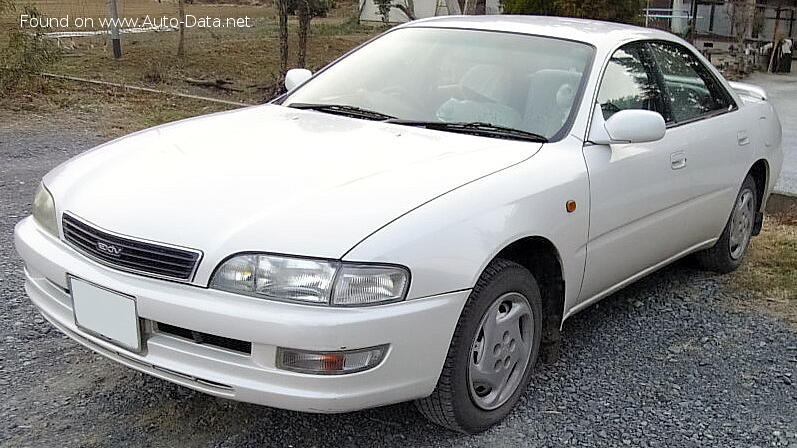
The Toyota Corona EXiV 2.0i (140 Hp) represents a distinctive chapter in Toyota’s history, emerging from Japan’s “bubble economy” period (late 1980s to early 1990s). Launched in 1989 as a sportier, more stylish derivative of the venerable Toyota Corona, the EXiV (an acronym for “Extra Impressive”) was exclusively designed for the Japanese domestic market (JDM). It carved out a niche for buyers seeking the practicality of a sedan combined with the sleek aesthetics of a coupe, thanks to its signature pillarless hardtop design. This first-generation Corona EXiV, produced from 1989 to 1993, specifically the 2.0i variant with 140 horsepower, embodied Toyota’s commitment to offering a diverse range of vehicles tailored to specific consumer desires, often blurring traditional segment lines.
While the standard Toyota Corona was a global workhorse, known for its reliability and utilitarian appeal, the EXiV aimed for a more sophisticated and youthful demographic within Japan. It shared its platform with other popular JDM models like the Carina ED and the sportier Celica, benefiting from Toyota’s advanced engineering of the era. This article delves into the technical prowess, design philosophy, and market impact of this unique Japanese sedan, providing an international automotive expert’s perspective on its significance.
Engine and Performance of the Toyota Corona EXiV 2.0i (140 Hp)
At the heart of the Toyota Corona EXiV 2.0i (140 Hp) was a robust and well-engineered powertrain designed for a balance of spirited performance and everyday usability. This variant featured a 2.0-liter (1998 cm3 or 121.93 cu. in.) inline-four engine, a staple configuration for Toyota during this period. The engine was naturally aspirated, relying on efficient design rather than forced induction to produce its power. It utilized a multi-port manifold injection system, a sophisticated fuel delivery method for its time, ensuring precise fuel metering and improved combustion efficiency.
Key to its performance was the four-valves-per-cylinder design, allowing for better airflow into and out of the combustion chambers, contributing to higher engine speeds and enhanced power delivery. This powerplant generated a respectable 140 horsepower at 6000 rpm, a strong output for a naturally aspirated 2.0-liter engine in 1989. Torque stood at 186 Nm (137.19 lb.-ft.) available at 4400 rpm, providing ample pulling power for urban driving and highway cruising.
Power was sent to the front wheels via a precise 5-speed manual transmission, offering engaging control for the driver. This front-wheel-drive (FWD) architecture, common for sedans in this segment, provided predictable handling and efficient packaging. With a curb weight of 2755.78 lbs. (1250 kg), the Corona EXiV 2.0i achieved a power-to-weight ratio of 8.9 kg/Hp (112 Hp/tonne), indicating a lively performance characteristic for its class. The engine’s bore and stroke were both 86 mm (3.39 in.), suggesting a square engine design, often favored for its balance of torque and high-rpm power potential. The compression ratio of 9.5:1 further optimized efficiency and power output without demanding excessively high-octane fuel.
Design & Features: The Pillarless Hardtop Sedan Aesthetic
The design of the Toyota Corona EXiV was its most striking characteristic, distinguishing it from its more conservative Corona siblings. It adopted the “pillarless hardtop sedan” body type, a popular trend in Japan during the late 1980s and early 1990s, aimed at blending the sleek profile of a two-door coupe with the practicality of a four-door sedan. When all four side windows were lowered, the absence of a B-pillar created an open, airy cabin experience, a significant aesthetic appeal. The car’s low roofline (51.97 in. / 1320 mm) and wide stance (66.54 in. / 1690 mm) further accentuated its sporty aspirations.
Measuring 177.36 inches (4505 mm) in length and riding on a 99.41-inch (2525 mm) wheelbase, the EXiV was dimensionally positioned as a compact to mid-size sedan, offering comfortable seating for five passengers across its two rows. The interior was typical Toyota of the era: well-appointed, ergonomically sound, and built with a focus on durability and user-friendliness. While specific luxury features varied by trim, the EXiV generally offered a higher level of finish and equipment compared to standard Corona models, reflecting its more upscale positioning.
In terms of safety and chassis dynamics, the Corona EXiV was equipped with ventilated disc brakes at the front and drum brakes at the rear, a common setup for the time. A significant safety enhancement for a car of its vintage was the inclusion of ABS (Anti-lock Braking System) as an assisting system, offering improved braking control under hard stops. The car rode on 185/65 R14 tires mounted on 6.0J x 14-inch wheel rims, providing a balance of ride comfort and handling precision. The front track measured 57.68 inches (1465 mm) and the rear track 56.3 inches (1430 mm), contributing to its stable road manners, while a minimum turning circle of 30.84 feet (9.4 m) ensured decent maneuverability in urban environments.
Technical Specifications: Toyota Corona EXiV 2.0i (140 Hp)
| Category | Specification |
|---|---|
| General Information | |
| Brand | Toyota |
| Model | Corona EXiV |
| Type (Engine) | 2.0i (140 Hp) |
| Production Start | 1989 |
| Production End | 199

|