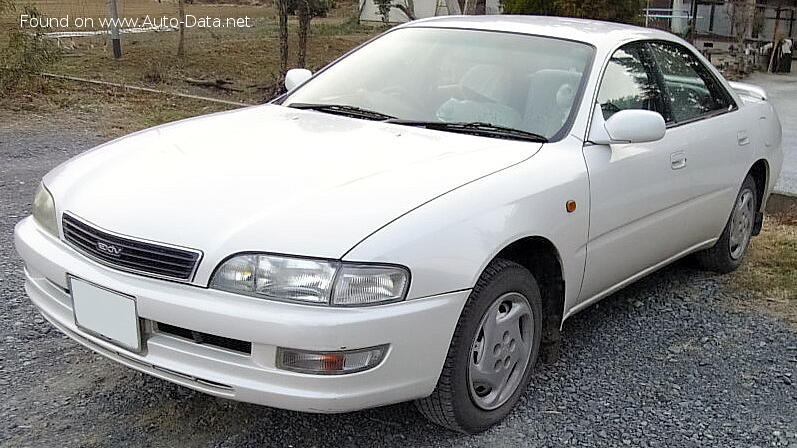
The automotive landscape of the early to mid-1990s in Japan was characterized by an abundance of diverse and often highly specialized vehicles, many of which never officially reached American shores. Among these, the Toyota Corona EXiV 2.0i (140 Hp) Automatic stands out as a prime example of Toyota’s strategy to cater to specific market niches with stylish, refined, and mechanically sound sedans. Produced from 1993 to 1998, the Corona EXiV represented a more upscale and sportier variant of the venerable Toyota Corona, itself a long-running and highly successful model line. This particular generation, often referred to simply as the EXiV, was designed as a four-door hardtop sedan, a popular body style in Japan during that era, blending the practicality of a sedan with the sleek, pillarless aesthetics typically found in coupes.
Positioned within the compact to mid-size segment, the Corona EXiV aimed to attract buyers seeking a vehicle that offered more style and a slightly more premium feel than the standard Corona, without venturing into the larger, more luxurious Crown or Mark II territory. It was a testament to Toyota’s engineering philosophy of reliability, efficiency, and thoughtful design, tailored specifically for the discerning Japanese domestic market (JDM). The 2.0i (140 Hp) Automatic variant, powered by the robust 3S-FE engine, offered a balance of adequate performance and impressive fuel economy, making it a compelling choice for everyday driving and longer journeys alike.
Engineering and Performance of the Toyota Corona EXiV
At the heart of the Toyota Corona EXiV 2.0i (140 Hp) Automatic lies the renowned Toyota 3S-FE engine, a powerplant celebrated for its durability and smooth operation. This 2.0-liter (1998 cm3 or 121.93 cu. in.) inline-four engine was configured with four valves per cylinder, a naturally aspirated design, and a multi-port manifold injection system, providing a reliable and efficient combustion process. With a compression ratio of 9.5:1, the engine produced a respectable 140 horsepower at 6000 rpm and 137.19 lb.-ft. of torque at 4400 rpm. These figures, while not indicative of a high-performance sports car, were more than adequate for a sedan of its class in the mid-1990s, ensuring confident acceleration and comfortable cruising.
The engine’s power output translated to a weight-to-power ratio of 8.3 kg/Hp (120.7 Hp/tonne) and a weight-to-torque ratio of 6.2 kg/Nm (160.3 Nm/tonne), indicating a well-balanced power delivery for its curb weight of 2557.36 lbs. (1160 kg). Power was channeled to the front wheels via a smooth-shifting 4-speed automatic transmission, a common and reliable setup for consumer vehicles of that period. This front-wheel-drive architecture contributed to predictable handling and efficient packaging.
Fuel economy was a strong suit for the EXiV 2.0i. Toyota quoted urban consumption at 8.1 liters per 100 kilometers, which translates to an impressive 29 US mpg. Even more remarkable was its extra-urban (highway) economy, rated at 4.3 liters per 100 kilometers, equivalent to an outstanding 54.7 US mpg. These figures highlight Toyota’s commitment to efficiency, even in a car that prioritized style and comfort, making it an economical choice for daily commutes and long-distance travel on gasoline (petrol) fuel.
Design and Features: The Distinctive Toyota Corona EXiV
The design of the Toyota Corona EXiV was its most distinguishing characteristic. Embracing the popular “pillarless hardtop” aesthetic, the EXiV offered a sleek, coupe-like profile despite being a practical four-door sedan. This design choice, prevalent in Japan during the 1990s, aimed to create a more open and airy cabin when the windows were lowered, enhancing the sense of luxury and sportiness. Its dimensions—177.17 inches in length, 68.5 inches in width, and 52.17 inches in height—gave it a low-slung, athletic stance, further accentuated by a wheelbase of 99.8 inches. The relatively compact turning circle of 34.12 feet made it nimble in urban environments, a crucial attribute for congested Japanese cities.
Inside, the EXiV offered a comfortable and well-appointed cabin for five occupants. While specific luxury features varied by trim level, the focus was on ergonomics, quality materials, and a refined driving experience. Standard amenities typically included air conditioning, power windows, and a well-designed instrument cluster. For safety, the EXiV was equipped with ventilated disc brakes at the front and drum brakes at the rear, complemented by an Anti-lock Braking System (ABS), which was an advanced safety feature for many vehicles in the mid-90s, offering improved control during emergency braking maneuvers. The vehicle rode on 185/70 R14 tires mounted on 6.0J x 14 wheel rims, a practical setup that balanced ride comfort with handling responsiveness.
Technical Specifications
| General Information | |
|---|---|
| Brand | Toyota |
| Model | Corona EXiV |
| Type (Engine) | 2.0i (140 Hp) Automatic |
| Start of Production | 1993 year |
| End of Production | 1998 year |
| Powertrain Architecture | Internal Combustion engine |
| Body type | Sedan (4 Doors, 5 Seats) |
| Performance Specifications | |
| Fuel Consumption (Urban) | 8.1 l/100 km (29 US mpg) |
| Fuel Consumption (Extra Urban) | 4.3 l/100 km (54.7 US mpg) |
| Fuel Type | Petrol (Gasoline) |
| Weight-to-power ratio | 8.3 kg/Hp (120.7 Hp/tonne) |
| Weight-to-torque ratio | 6.2 kg/Nm (160.3 Nm/tonne) |
| Engine Specifications | |
| Power | 140 Hp @ 6000 rpm |
| Power per liter | 70.1 Hp/l |
| Torque | 186 Nm (137.19 lb.-ft.) @ 4400 rpm |
| Engine layout | Front, Transverse |
| Engine Model/Code | 3S-FE |
| Engine Displacement | 1998 cm3 (121.93 cu. in.) |
| Number of cylinders | 4 |
| Engine Configuration | Inline |
| Cylinder Bore | 86 mm (3.39 in.) |
| Piston Stroke | 86 mm (3.39 in.) |
| Compression ratio | 9.5:1 |
| Number of valves per cylinder | 4 |
| Fuel injection system | Multi-port manifold injection |
| Engine aspiration | Naturally aspirated engine |
| Engine oil capacity | 3.9 l (4.12 US qt) |
| Coolant capacity | 6.6 l (6.97 US qt) |
| Space, Volume and Weights | |
| Kerb Weight | 1160 kg (2557.36 lbs.) |
| Fuel tank capacity | 60 l (15.85 US gal) |
| Dimensions | |
| Length | 4500 mm (177.17 in.) |
| Width | 1740 mm (68.5 in.) |
| Height | 1325 mm (52.17 in.) |
| Wheelbase | 2535 mm (99.8 in.) |
| Front track | 1510 mm (59.45 in.) |
| Rear (Back) track | 1490 mm (58.66 in.) |
| Minimum turning circle (turning diameter) | 10.4 m (34.12 ft.) |
| Drivetrain, Brakes and Suspension Specifications | |
| Drivetrain Architecture | The Internal combustion engine (ICE) drives the front wheels of the vehicle. |
| Drive wheel | Front wheel drive |
| Number of gears and type of gearbox | 4 gears, automatic transmission |
| Front brakes | Ventilated discs |
| Rear brakes | Drum |
| Assisting systems | ABS (Anti-lock braking system) |
| Tires size | 185/70 R14 |
| Wheel rims size | 6.0J x 14 |
Legacy and Market Impact in Japan
The Toyota Corona EXiV, particularly the 2.0i (140 Hp) Automatic variant, carved out a significant niche in the highly competitive Japanese market during its production run from 1993 to 1998. It stood as a testament to Toyota’s mastery in creating a diverse product portfolio, offering consumers a blend of style, comfort, and the legendary reliability the brand was known for. While the standard Corona served as a more utilitarian family sedan, the EXiV offered a more youthful and sophisticated alternative, appealing to buyers who desired a car with a distinct visual flair and a slightly upmarket feel without the expense of a full-size luxury vehicle.
In its primary market, the Corona EXiV faced stiff competition from other domestic manufacturers who were also keen on offering stylish, compact-to-mid-size sedans. Key rivals included models like the Honda Ascot, Nissan Primera (known as the Infiniti G20 in North America), Mitsubishi Galant, and Mazda Capella (also marketed as the Mazda 626 internationally). Each of these competitors offered their own blend of performance, features, and design, making the segment a vibrant battleground for consumer preference. The EXiV differentiated itself with its distinctive pillarless hardtop design, which, while offering a unique aesthetic, also contributed to a quieter and more refined cabin experience for its time.
The historical significance of the Corona EXiV lies in its representation of a specific era in Japanese automotive design and marketing. It exemplified the trend of offering multiple variations of a core model to capture different demographic groups within the same market. The EXiV’s success was built on the solid foundation of the Corona’s mechanicals, particularly the robust 3S-FE engine, which contributed to its reputation for longevity and low maintenance. This engine, shared with other Toyota models globally, showcased Toyota’s engineering efficiency and commitment to proven powertrain solutions.
The reason the Corona EXiV was never officially sold in the United States or other major Western markets can be attributed to several factors. Toyota already had a strong presence in these markets with models like the Camry and Corolla, which effectively covered the compact and mid-size sedan segments. The hardtop sedan concept, while popular in Japan, did not resonate as strongly with American buyers, who often preferred more traditional sedan designs or were moving towards SUVs and trucks. Furthermore, the cost of homologation and marketing a niche model like the EXiV for a saturated market likely outweighed the potential returns. Nevertheless, the Toyota Corona EXiV remains a cherished model among JDM enthusiasts, celebrated for its unique styling, reliable engineering, and its distinct place in Toyota’s rich automotive history.