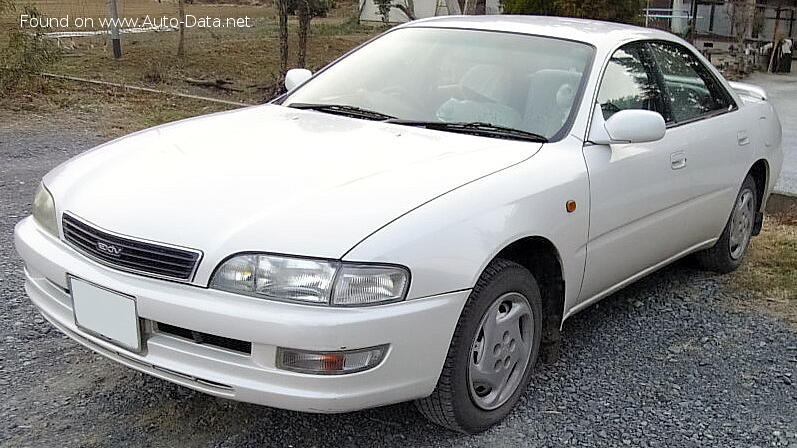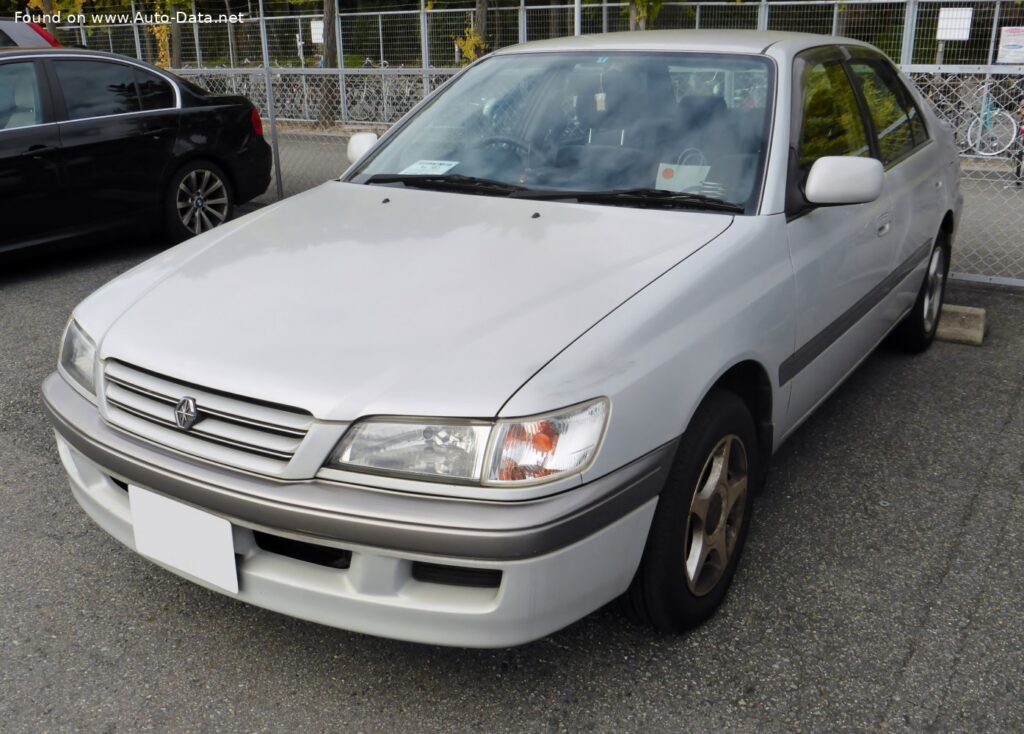
Toyota Corona Premio (T21) 1.6i 16V (105 Hp)
The Toyota Corona Premio (T21) represents a significant chapter in the storied history of Toyota’s long-running Corona lineage. Introduced in 1996 as a successor to the T190 series, this generation aimed to refine the well-established formula of a reliable, practical, and economical compact-to-mid-size sedan. Primarily targeted at the Japanese domestic market (JDM) and select Asian regions, the Corona Premio (T21) was not officially imported or sold in the United States, allowing Toyota to focus its North American efforts on the highly successful Corolla and Camry models. This particular variant, the 1.6i 16V (105 Hp), was a core offering, balancing sufficient power for daily driving with Toyota’s legendary fuel efficiency and durability. It was designed to appeal to families and individuals seeking dependable transportation without unnecessary frills, embodying the pragmatic spirit that defined Toyota’s global success during the late 1990s.
The T21 generation marked a departure in naming, with “Premio” (meaning “premium” or “award” in Spanish and Italian) appended to the Corona nameplate, signifying a slight upscale shift in perceived quality and features for the Japanese market. Production for the Toyota Corona Premio (T21) ran from 1996 until 2001, when it was eventually succeeded by the Toyota Premio and Allion models, which continued to cater to similar market segments with updated designs and technologies.
Engine & Performance: The Heart of the Toyota Corona Premio (T21)
At the core of the Toyota Corona Premio (T21) 1.6i 16V variant was Toyota’s highly regarded 4A-FE engine. This 1.6-Liters (1587 cm³ or 96.84 cu. in.) inline-four powerplant was a testament to Toyota’s engineering philosophy of reliability and efficiency. Featuring a 16-valve, dual overhead camshaft (DOHC) configuration, the naturally aspirated engine utilized a multi-port manifold injection system, which was a standard and effective fuel delivery method for its era, ensuring precise fuel metering and improved combustion.
The 4A-FE engine generated a respectable 105 horsepower at 5600 rpm, providing adequate motivation for a vehicle of its size and class. Torque output stood at 104.73 lb.-ft. (142 Nm) at 4800 rpm, delivering a smooth and linear powerband that was well-suited for urban commuting and highway cruising. While not designed for high-performance thrills, the engine’s characteristics made the Corona Premio a comfortable and predictable car to drive, perfectly aligning with its target demographic.
Power was transmitted to the front wheels via a dependable 5-speed manual transmission, offering direct engagement and maximizing the engine’s efficiency. This powertrain architecture contributed to the vehicle’s impressive fuel economy figures for the time: an estimated 23.5 US mpg in urban driving and an even more commendable 36.8 US mpg on the extra-urban cycle. With a 15.85 US gallon fuel tank, the Corona Premio offered a substantial cruising range, further enhancing its appeal as a practical family sedan. The weight-to-power ratio of 10.6 kg/Hp (or 94.6 Hp/tonne) underscored its sensible performance profile, prioritizing longevity and running costs over outright speed.
Design & Features: Practicality and Comfort
The design of the Toyota Corona Premio (T21) adhered to the conservative yet functional aesthetic prevalent in Japanese sedans of the late 1990s. It presented as a classic 4-door sedan, measuring 181.1 inches in length, 66.73 inches in width, and 55.51 inches in height, with a wheelbase of 101.57 inches. These dimensions placed it squarely in the compact-to-mid-size segment, offering a spacious interior for five occupants while maintaining a manageable footprint for city driving and parking.
The exterior styling was clean and understated, prioritizing aerodynamics and a timeless appeal rather than aggressive lines or flashy adornments. Its smooth contours and sensible proportions ensured good visibility and minimal wind noise, contributing to a comfortable driving experience. The interior was designed with practicality and durability in mind. High-quality, hard-wearing materials were used throughout, capable of withstanding years of family use. The layout of the dashboard was ergonomic, with controls logically placed and easy to reach, reflecting Toyota’s commitment to user-friendliness.
Passenger comfort was a priority, with well-cushioned seats and ample legroom for both front and rear occupants. The trunk (boot) space was generous for its class, offering 17.3 cubic feet (490 Liters) of cargo volume, making it suitable for family trips or substantial grocery runs. In terms of features, the Corona Premio came equipped with essential modern amenities. An Anti-lock Braking System (ABS) was available, enhancing safety by preventing wheel lock-up during hard braking. Hydraulic power steering made maneuvering effortless, a crucial feature for a family car frequently navigating urban environments. The suspension system, featuring a wishbone setup at the front and coil springs at the rear, provided a balanced ride—comfortable enough to absorb road imperfections yet stable at higher speeds. Stopping power came from ventilated disc brakes at the front and reliable drum brakes at the rear, a common and effective setup for the segment. The vehicle rode on 175/70 R14 tires, chosen for their balance of comfort, grip, and longevity.
Technical Specifications
| Category | Specification |
|---|---|
| Brand | Toyota |
| Model | Corona Premio (T21) |
| Type (Engine) | 1.6i 16V (105 Hp) |
| Production Start | 1996 |
| Production End | 2001 |
| Body Type | Sedan, 4 Doors, 5 Seats |
| Performance | |
| Fuel Consumption (Urban) | 23.5 US mpg (10 L/100 km) |
| Fuel Consumption (Extra Urban) | 36.8 US mpg (6.4 L/100 km) |
| Fuel Type | Petrol (Gasoline) |
| Weight-to-Power Ratio | 10.6 kg/Hp (94.6 Hp/tonne) |
| Weight-to-Torque Ratio | 7.8 kg/Nm (127.9 Nm/tonne) |
| Engine Specs | |
| Power | 105 Hp @ 5600 rpm |
| Power per Liter | 66.2 Hp/L |
| Torque | 104.73 lb.-ft. @ 4800 rpm (142 Nm) |
| Engine Layout | Front, Transverse |
| Engine Model/Code | 4A-FE |
| Engine Displacement | 1.6 Liters (1587 cm³ / 96.84 cu. in.) |
| Number of Cylinders | 4, Inline |
| Cylinder Bore | 3.19 in. (81 mm) |
| Piston Stroke | 3.03 in. (77 mm) |
| Compression Ratio | 9.5:1 |
| Valves per Cylinder | 4 |
| Fuel Injection System | Multi-port manifold injection |
| Engine Aspiration | Naturally aspirated |
| Engine Oil Capacity | 3.17 US qt (3 Liters) |
| Engine Oil Specification | Not specified in data |
| Coolant Capacity | 5.6 US qt (5.3 Liters) |
| Dimensions & Weights | |
| Kerb Weight | 2447.13 lbs. (1110 kg) |
| Max. Weight | 3053.4 lbs. (1385 kg) |
| Max Load | 606.27 lbs. (275 kg) |
| Trunk (Boot) Space – Minimum | 17.3 cu. ft. (490 Liters) |
| Fuel Tank Capacity | 15.85 US gal (60 Liters) |
| Length | 181.1 in. (4600 mm) |
| Width | 66.73 in. (1695 mm) |
| Height | 55.51 in. (1410 mm) |
| Wheelbase | 101.57 in. (2580 mm) |
| Front Track | 57.68 in. (1465 mm) |
| Rear Track | 57.09 in. (1450 mm) |
| Drivetrain, Brakes & Suspension | |
| Drivetrain Architecture | Front-wheel drive (ICE drives front wheels) |
| Drive Wheel | Front wheel drive |
| Gearbox Type | 5 gears, manual transmission |
| Front Suspension | Wishbone |
| Rear Suspension | Coil spring |
| Front Brakes | Ventilated discs |
| Rear Brakes | Drum |
| Assisting Systems | ABS (Anti-lock braking system) |
| Steering Type | Steering rack and pinion |
| Power Steering | Hydraulic Steering |
| Tires Size | 175/70 R14 |
Legacy & Market Impact of the Corona Premio (T21)
The Toyota Corona Premio (T21) solidified Toyota’s reputation for building exceptionally reliable, durable, and low-maintenance vehicles. In its primary markets, particularly Japan and parts of Asia, the Corona Premio was a workhorse, often serving as a dependable family car, a fleet vehicle, or even a taxi due to its robust mechanicals and comfortable cabin. Its strong suit was its long-term ownership proposition: minimal breakdowns, readily available parts, and excellent fuel economy translated into low running costs, which was a significant factor for budget-conscious consumers.
Within the Japanese market, the Corona Premio faced stiff competition from other domestic mainstays. Key rivals included the Nissan Primera (known as the Infiniti G20 in North America), the Honda Civic Ferio (the sedan version of the Civic), the Mitsubishi Lancer, and the Mazda Capella (also known as the Mazda 626 in some markets). While these competitors often offered similar practicality and features, the Corona Premio consistently distinguished itself with Toyota’s unparalleled reputation for quality and resale value. Its conservative styling and focus on dependability ensured it maintained a loyal customer base who prioritized peace of mind over cutting-edge design or sporty pretensions.
The historical significance of the Corona Premio (T21) lies in its role as a bridge in Toyota’s sedan strategy. It represented the continued evolution of the Corona nameplate, which had been a staple in Toyota’s lineup for decades, slotting between the smaller Corolla and the larger, more luxurious Camry (or Mark II/Chaser in Japan). The Premio suffix indicated a subtle refinement and a more upscale positioning compared to earlier Corona generations, reflecting evolving consumer expectations in Japan. While it never achieved the global recognition of the Corolla or Camry due to its market-specific focus, the Corona Premio was a vital component of Toyota’s sales success in its intended regions. It laid the groundwork for its successors, the Toyota Allion and Premio models, which further refined the concept of a practical, comfortable, and reliable mid-size sedan for the Japanese market, continuing the legacy of dependable transportation that the T21 generation so effectively upheld. Its absence from the North American market highlights Toyota’s strategic decision to offer tailored lineups for different global regions, ensuring that each market received the models best suited to its specific demands and competitive landscape.