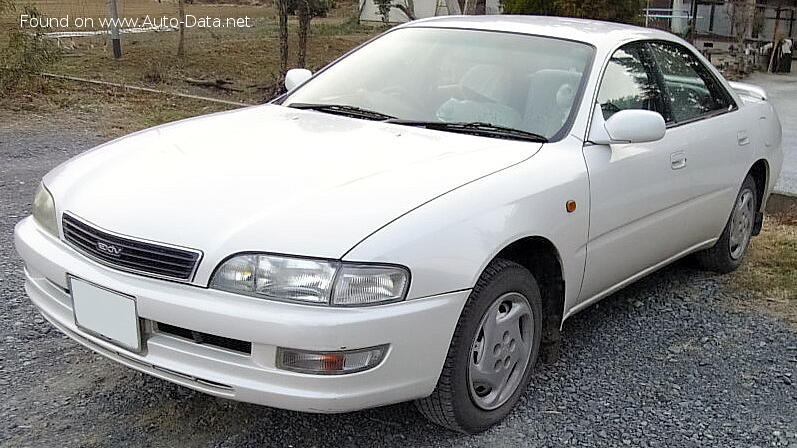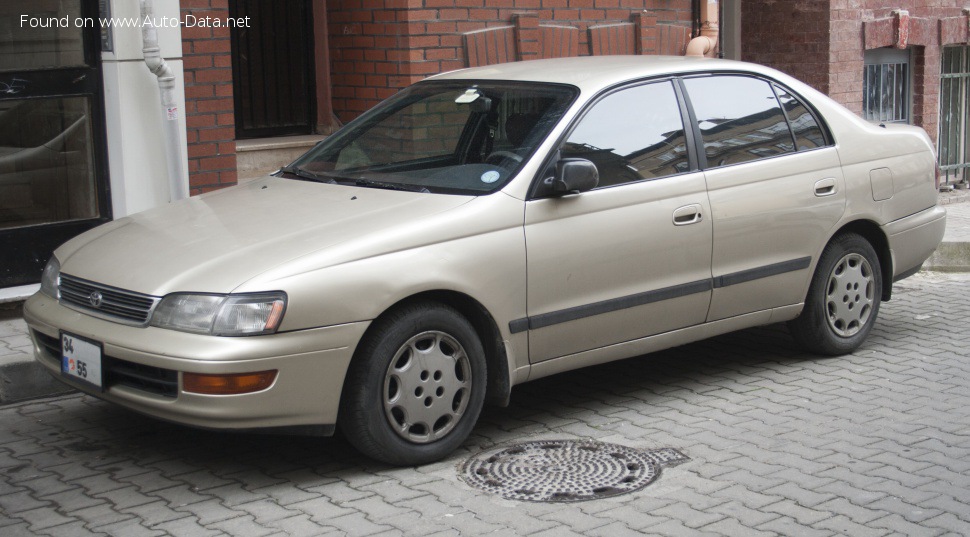
Toyota Corona (T19) 1.6i 16V EX (115 Hp)
The Toyota Corona (T19) represents the tenth generation of Toyota’s long-running Corona nameplate, a venerable series of compact to mid-size sedans first introduced in 1957. Produced from 1992 to 1996, the T19 generation, also known as the Corona Exiv or Corona Premio in some markets, continued the model’s tradition of offering reliable, practical, and efficient transportation. While its larger sibling, the Camry, had largely superseded the Corona in the North American market by this era, the Corona (T19) remained a significant player in Asian, European, and other global markets, upholding Toyota’s reputation for quality and durability. This particular variant, the 1.6i 16V EX (115 Hp), was positioned as an economical yet capable option within the lineup, appealing to buyers seeking a balance of everyday usability and fuel efficiency.
The T19 generation marked a period of refinement for the Corona, building on the success of its predecessors. It featured a more rounded, aerodynamic design compared to earlier boxier models, reflecting the prevailing automotive trends of the early to mid-1990s. Its robust powertrain options, comfortable interior, and reputation for low running costs ensured its continued popularity in the segments it served. The 1.6i 16V EX model, specifically, highlighted Toyota’s commitment to delivering accessible performance coupled with the brand’s hallmark reliability.
Engine and Performance of the Toyota Corona (T19) 1.6i 16V EX
Under the hood, the Toyota Corona (T19) 1.6i 16V EX (115 Hp) was powered by Toyota’s renowned 4A-FE engine. This 1.6-liter (1587 cm³ or 96.84 cu. in.) inline four-cylinder engine was celebrated for its smooth operation, impressive longevity, and fuel efficiency. Utilizing a Double Overhead Camshaft (DOHC) valvetrain with four valves per cylinder, the engine ensured optimal airflow and combustion, contributing to its responsive character. Fuel delivery was handled by a multi-port manifold injection system, a sophisticated setup for its time, providing precise fuel metering for improved performance and reduced emissions.
The 4A-FE engine produced a respectable 115 horsepower at a relatively high 6600 revolutions per minute (rpm), showcasing its free-revving nature. Torque output stood at 99.57 lb.-ft. (135 Nm) delivered at 4800 rpm, providing adequate pulling power for city driving and highway cruising. Power was sent to the front wheels via a crisp-shifting 5-speed manual transmission, offering an engaging driving experience and allowing drivers to extract the most from the engine’s output. This front-wheel-drive architecture, coupled with a transverse engine layout, was a common and efficient setup for compact sedans of the era, maximizing interior space and manufacturing simplicity.
Performance figures for the 1.6i 16V EX were competitive within its class. The vehicle could achieve a maximum speed of approximately 118.06 mph (190 km/h). More impressively, its fuel economy was a significant selling point, with a combined rating of 46.1 US mpg (5.1 l/100 km). This excellent fuel efficiency, combined with a 15.85 US gallon (60 liter) fuel tank, granted the Corona a substantial cruising range, making it an economical choice for commuters and families alike. The car’s weight-to-power ratio was 9.5 kg/Hp (105.5 Hp/tonne), indicating a light and agile feel for a vehicle of its size.
Design and Features
The Toyota Corona (T19) 1.6i 16V EX was designed as a practical and comfortable 4-door sedan, capable of seating five occupants. Its exterior styling was characterized by smooth lines and a somewhat conservative yet timeless aesthetic, typical of Toyota’s design philosophy in the early 1990s. The dimensions of the T19 Corona were well-proportioned for its segment, with a length of 177.95 inches (4520 mm), a width of 66.73 inches (1695 mm), and a height of 55.51 inches (1410 mm). A wheelbase of 101.57 inches (2580 mm) contributed to a stable ride and a surprisingly spacious cabin for its class.
Inside, the Corona (T19) emphasized functionality and durability. The cabin featured logical control layouts, clear instrumentation, and materials chosen for their hard-wearing properties, reflecting Toyota’s focus on long-term reliability and ease of ownership. Comfort was a priority, with supportive seating and ample room for both front and rear passengers.
In terms of chassis and safety, the T19 Corona utilized a robust suspension setup, featuring wishbones at both the front and rear. This independent suspension design provided a comfortable ride while maintaining predictable handling characteristics. Braking duties were handled by ventilated discs at the front, offering strong and consistent stopping power, complemented by drum brakes at the rear. A significant safety feature for the early 1990s was the inclusion of ABS (Anti-lock Braking System), enhancing control during emergency braking maneuvers. The steering system was a responsive rack and pinion setup, augmented by hydraulic power steering, making the car easy to maneuver in urban environments and stable at higher speeds. The vehicle rode on 175/70 R14 tires, providing a good balance of grip, comfort, and rolling resistance for optimal fuel economy.
Technical Specifications
| Category | Specification |
|---|---|
| General Information | |
| Brand | Toyota |
| Model | Corona |
| Generation | Corona (T19) |
| Type (Engine) | 1.6i 16V EX (115 Hp) |
| Production Start | 1992 |
| Production End | 1996 |
| Powertrain Architecture | Internal Combustion Engine |
| Body Type | Sedan |
| Seats | 5 |
| Doors | 4 |
| Performance Specs | |
| Fuel Consumption (Combined) | 5.1 l/100 km (46.1 US mpg) |
| Fuel Type | Petrol (Gasoline) |
| Maximum Speed | 190 km/h (118.06 mph) |
| Weight-to-Power Ratio | 9.5 kg/Hp (105.5 Hp/tonne) |
| Weight-to-Torque Ratio | 8.1 kg/Nm (123.9 Nm/tonne) |
| Engine Specs | |
| Power | 115 Hp @ 6600 rpm |
| Power per Liter | 72.5 Hp/l |
| Torque | 135 Nm @ 4800 rpm (99.57 lb.-ft. @ 4800 rpm) |
| Engine Layout | Front, Transverse |
| Engine Model/Code | 4A-FE |
| Engine Displacement | 1587 cm³ (1.6 liters / 96.84 cu. in.) |
| Number of Cylinders | 4 |
| Engine Configuration | Inline |
| Cylinder Bore | 81 mm (3.19 in.) |
| Piston Stroke | 77 mm (3.03 in.) |
| Compression Ratio | 9.5:1 |
| Valves per Cylinder | 4 |
| Fuel Injection System | Multi-port manifold injection |
| Engine Aspiration | Naturally aspirated |
| Valvetrain | DOHC |
| Engine Oil Capacity | 3 l (3.17 US qt) |
| Engine Oil Specification | Not specified |
| Coolant Capacity | 5.3 l (5.6 US qt) |
| Space, Volume and Weights | |
| Kerb Weight | 1090 kg (2403.04 lbs) |
| Max. Weight | 1365 kg (3009.31 lbs) |
| Max Load | 275 kg (606.27 lbs) |
| Fuel Tank Capacity | 60 l (15.85 US gal) |
| Dimensions | |
| Length | 4520 mm (177.95 in.) |
| Width | 1695 mm (66.73 in.) |
| Height | 1410 mm (55.51 in.) |
| Wheelbase | 2580 mm (101.57 in.) |
| Front Track | 1465 mm (57.68 in.) |
| Rear Track | 1450 mm (57.09 in.) |
| Drivetrain, Brakes and Suspension Specs | |
| Drivetrain Architecture | Front-wheel drive (ICE drives front wheels) |
| Drive Wheel | Front wheel drive |
| Gearbox Type | 5-speed manual transmission |
| Front Suspension | Wishbone |
| Rear Suspension | Wishbone |
| Front Brakes | Ventilated discs |
| Rear Brakes | Drum |
| Assisting Systems | ABS (Anti-lock braking system) |
| Steering Type | Steering rack and pinion |
| Power Steering | Hydraulic Steering |
| Tires Size | 175/70 R14 |
Legacy and Market Impact of the Toyota Corona (T19)
The Toyota Corona (T19), and specifically the 1.6i 16V EX variant, solidified the Corona’s long-standing reputation as a highly dependable and practical family sedan in its primary markets. For decades, the Corona served as a cornerstone of Toyota’s global lineup, bridging the gap between the compact Corolla and the more upmarket Camry. In the early 1990s, while the Camry had become Toyota’s dominant mid-size offering in North America, the Corona continued its legacy in markets across Asia, Europe, and Australia, where it was often positioned as a slightly more premium or larger alternative to the Corolla.
The T19 generation, with its refined styling and proven mechanicals, was well-received for its blend of reliability, fuel efficiency, and low maintenance costs. These attributes were paramount for buyers in many international markets, making the Corona a popular choice among private owners, taxi fleets, and government agencies alike. Its robust construction and the legendary durability of its 4A-FE engine ensured that many T19 Coronas remained on the road for well over a decade, contributing significantly to Toyota’s global image for engineering excellence and vehicle longevity.
In its competitive landscape, the Corona (T19) faced rivals such as the Honda Civic/Domani (depending on market and size segment), Nissan Primera (P10), Mazda 626, and Mitsubishi Lancer/Galant. Against these competitors, the Corona consistently stood out for its unwavering reliability and often superior resale value. While perhaps not always the most exciting car to drive, its practical virtues and peace of mind ownership experience were compelling factors for its target demographic. The inclusion of features like ABS, even on a mid-range 1.6-liter model, demonstrated Toyota’s commitment to offering modern safety technologies to a broader audience.
Ultimately, the Toyota Corona (T19) continued the lineage of a successful nameplate, embodying the core values that Toyota had come to be known for worldwide. It represented a sensible, well-engineered, and enduring vehicle that played a crucial role in expanding Toyota’s global market share and reinforcing its reputation as a leader in automotive manufacturing. Though the Corona nameplate would eventually be phased out in favor of the Camry and Avensis in various markets, the T19 generation remains a testament to its enduring appeal and significant contribution to Toyota’s illustrious history.