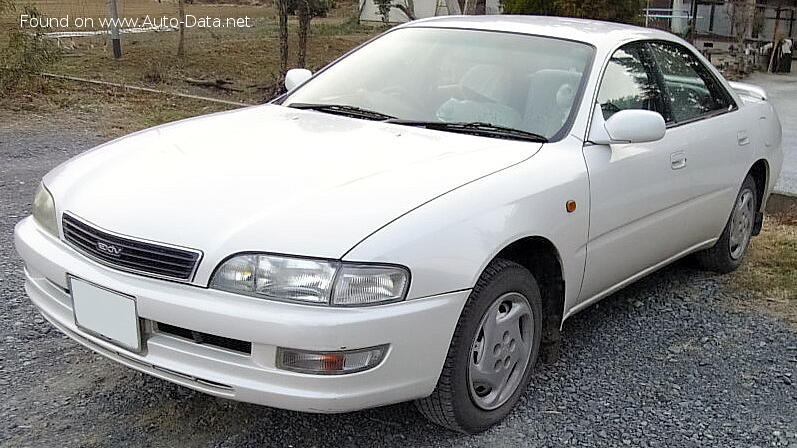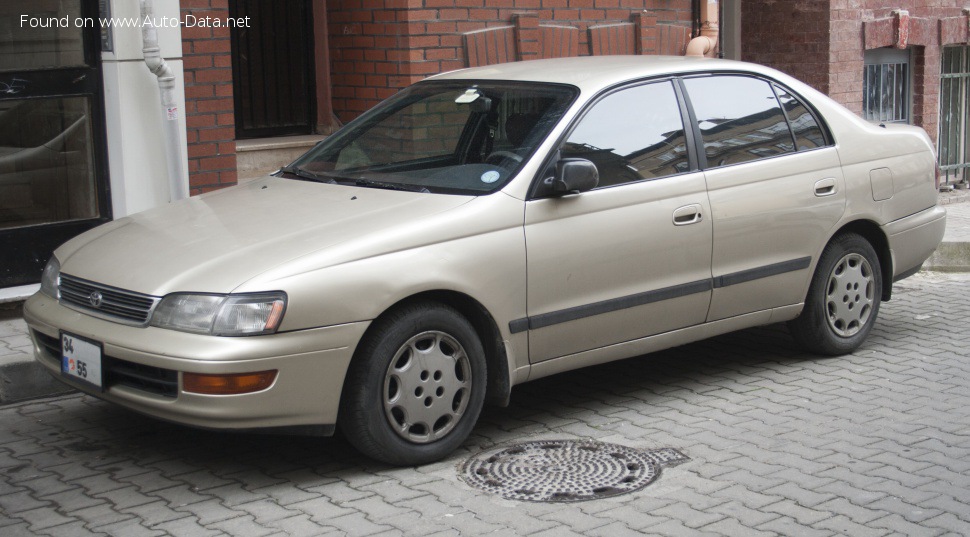
Introduction to the Toyota Corona (T19)
The Toyota Corona has long stood as a pillar in the Japanese automaker’s global lineup, representing a commitment to reliability, efficiency, and practical design. The particular model under examination, the Toyota Corona (T19) 1.6i 16V EX (115 Hp) Automatic, hails from the tenth generation of this esteemed nameplate, produced from 1992 to 1996. While the Corona nameplate might be less familiar to American consumers who predominantly saw the Camry occupying the mid-size segment, the Corona served as a crucial compact-to-mid-size sedan in numerous international markets, including Asia, Europe, and Oceania. It often bridged the gap between the smaller Corolla and the larger Camry, offering a compelling blend of spaciousness, comfort, and Toyota’s renowned durability.
This T19 generation, also known in some markets as the Toyota Carina E, marked a significant evolution for the Corona, incorporating contemporary styling, enhanced safety features for its era, and a range of efficient powertrains. The 1.6i 16V EX variant, equipped with a 115 horsepower engine and an automatic transmission, was positioned as an accessible yet well-appointed option for buyers seeking a dependable daily driver with commendable fuel economy. Its design philosophy emphasized functional elegance and a comfortable ride, making it a popular choice for families and business users alike in its primary markets.
Engine and Performance: The Heart of the Toyota Corona (T19)
At the core of the Toyota Corona (T19) 1.6i 16V EX lies Toyota’s well-regarded 4A-FE engine. This 1.6-liter (1587 cm3 or 96.84 cubic inches) inline-four powertrain is a testament to Toyota’s engineering prowess in creating durable and efficient small-displacement engines. Featuring a Double Overhead Camshaft (DOHC) valvetrain with four valves per cylinder, the 4A-FE was designed for optimal breathing and power delivery throughout the rev range. Its naturally aspirated configuration, coupled with a multi-port manifold injection system, ensured precise fuel delivery and combustion, contributing to both its performance and fuel efficiency.
The engine produced a respectable 115 horsepower at a relatively high 6600 rpm, indicative of its willingness to rev. Peak torque stood at 99.57 lb.-ft. (135 Nm) delivered at 4800 rpm, providing adequate pulling power for city driving and highway cruising. With a compression ratio of 9.5:1, the engine was designed to run on readily available gasoline. The power-to-liter ratio of 72.5 horsepower per liter was competitive for a naturally aspirated engine of its time.
Power was sent to the front wheels via a smooth-shifting 4-speed automatic transmission. This drivetrain architecture, combining a transverse-mounted engine with front-wheel drive, was typical for the segment, offering good traction, packaging efficiency, and a straightforward driving experience. Despite its focus on economy, the Corona (T19) 1.6i 16V EX could achieve a maximum speed of 118.06 mph (190 km/h), demonstrating its capability for sustained highway speeds.
One of the standout features of this specific variant was its remarkable fuel economy. Toyota claimed a combined fuel consumption of 46.1 US mpg (5.1 liters per 100 km), an impressive figure for a sedan from the early 1990s, highlighting Toyota’s early commitment to efficiency. This was achieved through a combination of the engine’s inherent efficiency, the vehicle’s relatively light curb weight of 2403.04 lbs (1090 kg), and the optimized gear ratios of the automatic transmission. The weight-to-power ratio of 9.5 kg/Hp (approximately 20.9 lbs/Hp) further contributed to its nimble feel and economical operation.
Design and Features
The Toyota Corona (T19) adopted a clean, aerodynamic, and understated design language that was characteristic of early 1990s Japanese sedans. As a traditional 4-door sedan, its body type prioritized practicality and interior space. Measuring 177.95 inches in length, 66.73 inches in width, and 55.51 inches in height, with a wheelbase of 101.57 inches, the Corona (T19) offered a well-proportioned silhouette that was neither overtly sporty nor excessively conservative. These dimensions contributed to a comfortable cabin capable of accommodating five occupants, making it an ideal family car.
The exterior styling featured smooth lines and flush-fitting glass, aimed at reducing drag and improving fuel efficiency, a common trend in automotive design during that era. The modest 175/70 R14 tire size underscored its focus on comfort and economy rather than aggressive performance.
Underneath its unassuming exterior, the Corona (T19) featured a robust chassis designed for a balanced ride and predictable handling. Both the front and rear suspensions utilized a wishbone setup, a more sophisticated design compared to simpler strut-based systems, offering improved wheel control and ride comfort. This choice of suspension components contributed to the Corona’s reputation for a smooth and compliant ride, even over varied road surfaces.
For braking, the vehicle was equipped with ventilated discs at the front, providing effective stopping power and resistance to fade, while the rear utilized drum brakes, a common and cost-effective solution for the segment at the time. A significant safety feature for the early 1990s was the inclusion of an Anti-lock Braking System (ABS), which helped prevent wheel lock-up under hard braking, enhancing vehicle control in emergency situations. Steering was managed by a rack and pinion system, assisted by hydraulic power steering, providing a comfortable and responsive steering feel that was well-suited for both city maneuvering and highway stability.
The interior, while not opulent, was designed with typical Toyota ergonomics and durability in mind. Controls were intuitively placed, and materials were chosen for their longevity and ease of maintenance, a key selling point in markets where the car was often used for many years. The 60-liter (15.85 US gallon) fuel tank capacity, combined with its excellent fuel economy, ensured a long cruising range, a practical benefit for long-distance travel.
Technical Specifications
| General Information | |
|---|---|
| Brand | Toyota |
| Model | Corona |
| Generation | Corona (T19) |
| Type (Engine) | 1.6i 16V EX (115 Hp) Automatic |
| Start of Production | 1992 year |
| End of Production | 1996 year |
| Powertrain Architecture | Internal Combustion engine |
| Body type | Sedan |
| Seats | 5 |
| Doors | 4 |
| Performance Specs | |
| Fuel Consumption (combined) | 5.1 l/100 km (46.1 US mpg / 55.4 UK mpg / 19.6 km/l) |
| Fuel Type | Petrol (Gasoline) |
| Maximum Speed | 190 km/h (118.06 mph) |
| Weight-to-Power Ratio | 9.5 kg/Hp (20.94 lbs/Hp) |
| Weight-to-Torque Ratio | 8.1 kg/Nm (123.9 Nm/tonne) |
| Engine Specs | |
| Power | 115 Hp @ 6600 rpm |
| Power per liter | 72.5 Hp/l |
| Torque | 135 Nm @ 4800 rpm (99.57 lb.-ft. @ 4800 rpm) |
| Engine Layout | Front, Transverse |
| Engine Model/Code | 4A-FE |
| Engine Displacement | 1587 cm3 (1.6 liters / 96.84 cu. in.) |
| Number of Cylinders | 4 |
| Engine Configuration | Inline |
| Cylinder Bore | 81 mm (3.19 in) |
| Piston Stroke | 77 mm (3.03 in) |
| Compression Ratio | 9.5:1 |
| Number of Valves per Cylinder | 4 |
| Fuel Injection System | Multi-port manifold injection |
| Engine Aspiration | Naturally aspirated engine |
| Valvetrain | DOHC |
| Engine Oil Capacity | 3 l (3.17 US qt) |
| Coolant Capacity | 5.3 l (5.6 US qt) |
| Space, Volume and Weights | |
| Kerb Weight | 1090 kg (2403.04 lbs) |
| Max. Weight (Gross Vehicle Weight) | 1365 kg (3009.31 lbs) |
| Max Load | 275 kg (606.27 lbs) |
| Fuel Tank Capacity | 60 l (15.85 US gal) |
| Dimensions | |
| Length | 4520 mm (177.95 in) |
| Width | 1695 mm (66.73 in) |
| Height | 1410 mm (55.51 in) |
| Wheelbase | 2580 mm (101.57 in) |
| Front Track | 1465 mm (57.68 in) |
| Rear (Back) Track | 1450 mm (57.09 in) |
| Drivetrain, Brakes and Suspension Specs | |
| Drivetrain Architecture | Front-wheel drive, Internal Combustion Engine (ICE) drives the front wheels. |
| Drive Wheel | Front wheel drive |
| Number of Gears and Type of Gearbox | 4 gears, automatic transmission |
| Front Suspension | Wishbone |
| Rear Suspension | Wishbone |
| Front Brakes | Ventilated discs |
| Rear Brakes | Drum |
| Assisting Systems | ABS (Anti-lock braking system) |
| Steering Type | Steering rack and pinion |
| Power Steering | Hydraulic Steering |
| Tires Size | 175/70 R14 |
Legacy and Market Impact of the Toyota Corona (T19)
The Toyota Corona (T19), particularly in its 1.6i 16V EX Automatic guise, cemented Toyota’s reputation for producing exceptionally reliable, economical, and practical vehicles. Although the Corona nameplate eventually gave way to other models like the Avensis in Europe and the Camry’s expanded global presence, the T19 generation played a vital role in maintaining Toyota’s market share in numerous international regions throughout the mid-1990s.
In markets where it was sold, the Corona (T19) was highly regarded as a workhorse. Its robust 4A-FE engine, known for its longevity and low maintenance requirements, contributed significantly to its appeal. Owners often praised its comfortable ride, spacious interior, and impressive fuel efficiency, making it a favorite for both private individuals and fleet operators. It was a car that simply started every morning and reliably got its occupants from point A to point B with minimal fuss.
Competitors in its segment varied by region but generally included rivals such as the Honda Civic and Accord (depending on market positioning), Nissan Primera/Sunny, Mazda 626, and Mitsubishi Lancer/Galant. The Corona often distinguished itself with a slightly more conservative approach, prioritizing comfort and durability over outright sporty dynamics, which resonated well with a broad base of consumers. Its inclusion of features like ABS, while becoming more common, was a strong selling point for safety-conscious buyers in the early 90s.
The historical significance of the Corona (T19) lies in its embodiment of Toyota’s core values during a period of intense global competition in the automotive industry. It showcased how a well-engineered, no-nonsense sedan could achieve widespread success by consistently delivering on promises of quality, reliability, and value. While not a car that typically garnered headlines for groundbreaking innovation, its steady evolution and consistent performance contributed to the brand’s unwavering image as a producer of dependable vehicles, setting a high standard for future generations of Toyota sedans that would follow. The Corona (T19) remains a testament to an era when automotive design focused heavily on function, efficiency, and long-term ownership satisfaction.