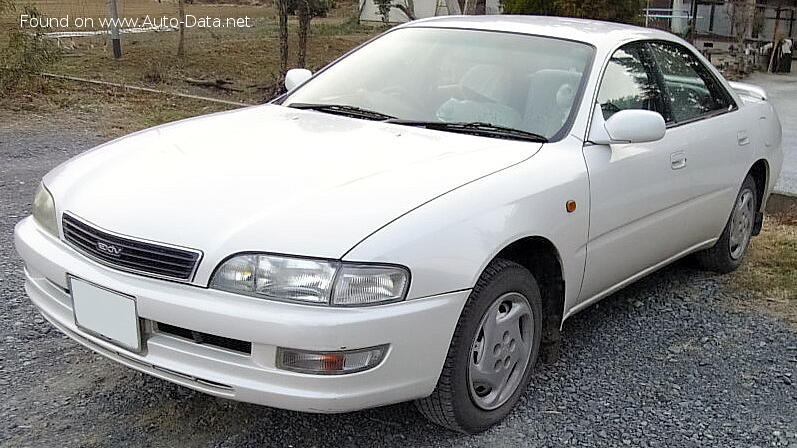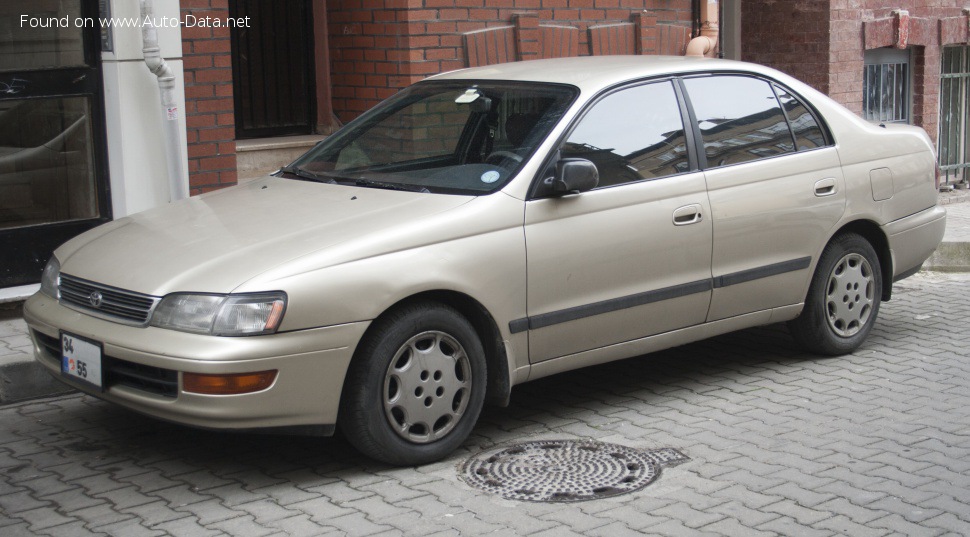
Introduction to the Toyota Corona (T19) 1.8i 16V EX (125 Hp)
The Toyota Corona, a nameplate synonymous with reliability and practicality for decades, saw its tenth generation, the T19 series, introduced in 1992. This iteration continued the Corona’s legacy as a robust and dependable compact to mid-size family sedan, primarily targeting markets outside of North America, where the Camry had largely taken over its role. The Toyota Corona (T19) 1.8i 16V EX (125 Hp) variant, specifically, represented a well-balanced offering within the lineup, combining Toyota’s renowned engineering prowess with a focus on fuel efficiency and comfortable daily driving. Produced from 1992 to 1996, the T19 Corona was a testament to Toyota’s philosophy of building durable, low-maintenance vehicles that appealed to a broad demographic seeking sensible transportation.
While the Corona name may not resonate as strongly with American consumers as some other Toyota models, its global impact, particularly in Asian and European markets, was significant. It served as a workhorse for families and businesses alike, praised for its straightforward design, build quality, and impressive longevity. The 1.8i 16V EX model, equipped with a four-cylinder gasoline engine and a manual transmission, was a popular choice, embodying the era’s blend of emerging safety features and established mechanical simplicity. This article delves into the specifics of this particular model, evaluating its mechanical attributes, design philosophy, and its enduring legacy in the global automotive landscape.
Engine and Performance: The Heart of the Toyota Corona (T19)
Under the hood of the Toyota Corona (T19) 1.8i 16V EX (125 Hp) lay Toyota’s venerable 4S-FE engine, an inline four-cylinder powerplant designed for efficiency and durability. With an engine displacement of 1.8 liters (1839 cubic centimeters or 112.22 cubic inches), this naturally aspirated engine featured a Dual Overhead Camshaft (DOHC) valvetrain with four valves per cylinder, a configuration that was becoming standard for optimizing airflow and combustion efficiency in the early 1990s. Fuel was delivered via a multi-port manifold injection system, ensuring precise fuel metering for improved economy and reduced emissions.
The 4S-FE engine produced a respectable 125 horsepower at 6000 rpm, translating to a power output of approximately 68 horsepower per liter. Torque figures stood at 119.49 lb.-ft. (162 Nm) delivered at 4600 rpm. This power output, coupled with a relatively light curb weight of 2491.22 pounds (1130 kg), resulted in a weight-to-power ratio of 9 kg/Hp, or 110.6 Hp per tonne, providing adequate acceleration and cruising capability for its class. The power was channeled to the front wheels via a smooth-shifting 5-speed manual transmission, a common and preferred choice for many drivers in its target markets, offering direct engagement and maximizing fuel efficiency.
Performance figures for the 1.8i 16V EX were competitive for the segment, with a top speed of 118.06 mph (190 km/h). However, where this powertrain truly shone was in its fuel economy. Toyota claimed an impressive combined fuel consumption of 43.6 US mpg (5.4 liters per 100 km), making it a highly economical choice for daily commuting and long-distance travel. This balance of dependable power and excellent fuel efficiency underscored the T19 Corona’s appeal as a practical and cost-effective family vehicle. The engine’s robust design, with a compression ratio of 9.5:1, contributed to its reputation for long-term reliability and relatively low maintenance demands, requiring 4.12 US quarts of engine oil and 6.97 US quarts of coolant.
Design and Features of the Toyota Corona (T19)
The Toyota Corona (T19) adopted a clean, contemporary design that reflected the automotive aesthetic of the early 1990s. As a traditional 4-door sedan with seating for five, its styling prioritized aerodynamics and interior space over flamboyant lines. The exterior dimensions were practical for urban environments, with a length of 177.95 inches (4520 mm), a width of 66.73 inches (1695 mm), and a height of 55.51 inches (1410 mm). A wheelbase of 101.57 inches (2580 mm) contributed to a stable ride and a reasonably spacious cabin for its class. The front track measured 57.68 inches (1465 mm) and the rear track 57.09 inches (1450 mm), providing a solid stance on the road.
Inside, the T19 Corona was characterized by a functional and ergonomic layout. Materials were chosen for durability and ease of cleaning, consistent with its role as a family car. While not overtly luxurious, the interior offered comfortable seating and intuitive controls. Storage compartments were thoughtfully integrated throughout the cabin, enhancing its practicality. The 60-liter (15.85 US gallon) fuel tank provided an excellent cruising range, further cementing its long-distance capabilities.
In terms of features, the T19 Corona was equipped with some important advancements for its time. A key safety feature was the inclusion of an Anti-lock Braking System (ABS), which significantly improved braking performance and control during emergency stops, a notable addition for a car in this segment in the early 90s. The braking system itself consisted of ventilated discs at the front for improved heat dissipation and traditional drum brakes at the rear, a cost-effective and reliable setup. The suspension system utilized a wishbone design at the front and coil springs at the rear, a configuration aimed at balancing ride comfort with predictable handling. Steering was managed by a rack and pinion system, aided by hydraulic power steering, providing a smooth and responsive feel. The car rode on 175/70 R14 tires, offering a good balance of grip and ride comfort. With a maximum load capacity of 606.27 pounds (275 kg) and a maximum permissible weight of 3097.49 pounds (1405 kg), the Corona was well-suited for carrying passengers and luggage.
Technical Specifications
| Category | Specification |
|---|---|
| Brand | Toyota |
| Model | Corona |
| Generation | Corona (T19) |
| Type (Engine) | 1.8i 16V EX (125 Hp) |
| Production Start | 1992 |
| Production End | 1996 |
| Body Type | Sedan |
| Seats | 5 |
| Doors | 4 |
| Performance Specs | |
| Fuel Consumption (Combined) | 43.6 US mpg (5.4 l/100 km) |
| Fuel Type | Petrol (Gasoline) |
| Maximum Speed | 118.06 mph (190 km/h) |
| Weight-to-Power Ratio | 9 kg/Hp (110.6 Hp/tonne) |
| Weight-to-Torque Ratio | 7 kg/Nm (143.4 Nm/tonne) |
| Engine Specs | |
| Power | 125 Hp @ 6000 rpm |
| Power per Liter | 68 Hp/l |
| Torque | 119.49 lb.-ft. (162 Nm) @ 4600 rpm |
| Engine Layout | Front, Transverse |
| Engine Model/Code | 4S-FE |
| Engine Displacement | 1.8 Liters (1839 cm³, 112.22 cu. in.) |
| Number of Cylinders | 4 |
| Engine Configuration | Inline |
| Cylinder Bore | 3.25 in. (82.5 mm) |
| Piston Stroke | 3.39 in. (86 mm) |
| Compression Ratio | 9.5:1 |
| Valves per Cylinder | 4 |
| Fuel Injection System | Multi-port manifold injection |
| Engine Aspiration | Naturally aspirated |
| Valvetrain | DOHC |
| Engine Oil Capacity | 4.12 US qt (3.9 l) |
| Coolant Capacity | 6.97 US qt (6.6 l) |
| Dimensions, Volume, and Weights | |
| Kerb Weight | 2491.22 lbs. (1130 kg) |
| Max. Weight | 3097.49 lbs. (1405 kg) |
| Max Load | 606.27 lbs. (275 kg) |
| Fuel Tank Capacity | 15.85 US gal (60 l) |
| Length | 177.95 in. (4520 mm) |
| Width | 66.73 in. (1695 mm) |
| Height | 55.51 in. (1410 mm) |
| Wheelbase | 101.57 in. (2580 mm) |
| Front Track | 57.68 in. (1465 mm) |
| Rear Track | 57.09 in. (1450 mm) |
| Drivetrain, Brakes, and Suspension | |
| Drivetrain Architecture | Front-wheel drive (ICE drives front wheels) |
| Drive Wheel | Front-wheel drive |
| Number of Gears | 5, manual transmission |
| Front Suspension | Wishbone |
| Rear Suspension | Coil spring |
| Front Brakes | Ventilated discs |
| Rear Brakes | Drum |
| Assisting Systems | ABS (Anti-lock braking system) |
| Steering Type | Steering rack and pinion |
| Power Steering | Hydraulic Steering |
| Tires Size | 175/70 R14 |
Legacy and Market Impact of the Toyota Corona (T19)
The Toyota Corona (T19) 1.8i 16V EX (125 Hp) played a crucial role in cementing Toyota’s reputation for building exceptionally reliable and durable vehicles during the early to mid-1990s. While the Corona nameplate had a long history, dating back to 1957, the T19 generation continued its tradition as a no-nonsense, dependable family car. Its primary markets were Japan, Southeast Asia, Australasia, and parts of Europe, where it competed fiercely with other popular mid-size sedans of the era.
In its home market of Japan, the Corona was a staple, often seen as a slightly more upscale alternative to the Corolla, bridging the gap to the larger Camry. Its competitors included well-established models like the Honda Civic (in larger iterations) and Accord, Nissan Primera (Bluebird in some markets), Mazda 626, and Mitsubishi Galant. In Europe, it faced off against local favorites such as the Opel Vectra/Vauxhall Cavalier, Ford Mondeo, and Volkswagen Passat. The Corona’s key differentiators were its perceived superior long-term reliability, lower running costs, and strong resale value, attributes that consistently positioned Toyota as a leader in customer satisfaction.
The T19 generation, with its emphasis on efficiency (highlighted by the 1.8i 16V EX’s excellent fuel economy) and safety features like available ABS, showcased Toyota’s commitment to continuous improvement. It was not a car designed to excite with radical styling or blistering performance; rather, its appeal lay in its unwavering dependability and practical utility. This steadfast approach endeared it to millions of owners who valued peace of mind and minimal hassle.
The legacy of the Toyota Corona (T19) is primarily one of understated success. It was a car that consistently delivered on its promise of reliable transportation, contributing significantly to Toyota’s global dominance. Although the Corona name was eventually phased out in many markets, giving way to models like the Avensis (which inherited much of the Corona’s core philosophy for European markets) or being overshadowed by the globally successful Camry, the T19 remains an important chapter in Toyota’s history. It represents an era when Japanese manufacturers perfected the art of building robust, efficient, and affordable vehicles that became the benchmark for quality and longevity worldwide. Its mechanical simplicity, coupled with advanced features for its time, ensured that many examples of the T19 Corona continued to serve their owners faithfully for decades after leaving the production line, a true testament to its enduring engineering and market impact.