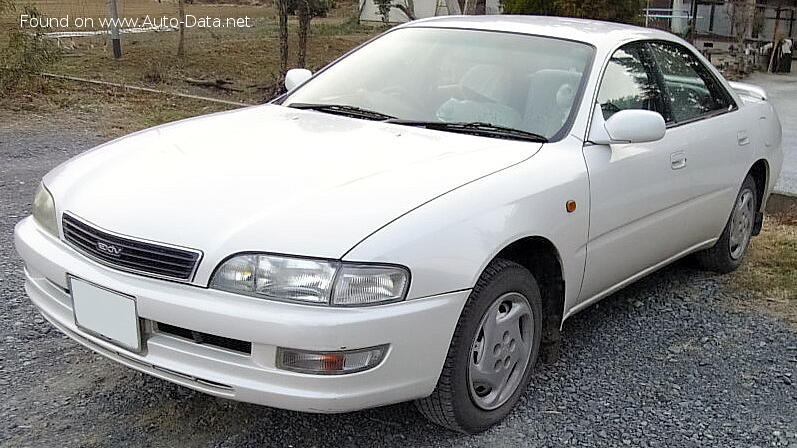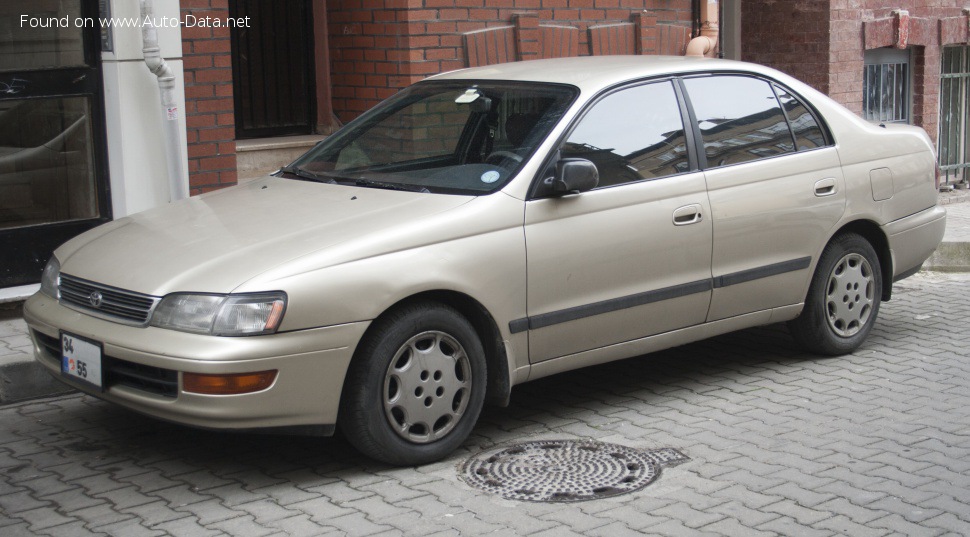
The Toyota Corona (T19) 2.0 D EX (73 Hp) 4WD: A Reliable Workhorse
The Toyota Corona, a nameplate synonymous with reliability and practicality for decades, saw its tenth generation, the T190 series, introduced in 1992. This iteration continued the Corona’s legacy as a robust and dependable compact to mid-size sedan, primarily targeting markets outside of North America where its blend of efficiency, durability, and often, more diverse powertrain options, resonated with consumers. Among the many configurations offered, the Toyota Corona (T19) 2.0 D EX (73 Hp) 4WD stands out as a particularly interesting variant, highlighting Toyota’s commitment to offering specialized models tailored to specific regional needs, such as the demand for diesel engines and all-wheel-drive capability in certain European and Asian markets.
Produced from 1992 to 1996, the T19 Corona represented a significant evolution in design and engineering from its predecessors. While the North American market received the functionally similar, though distinct, Toyota Carina E (and later the Corolla-based Corona Exiv/Premio), the core Corona (T19) served as a practical, family-oriented vehicle in its primary territories. The 2.0 D EX (73 Hp) 4WD model, specifically, was engineered for a blend of fuel economy, low-end torque, and enhanced traction, making it a compelling choice for regions with varied climates or those requiring greater utility from a sedan. This specific configuration, featuring a naturally aspirated diesel engine and a full-time all-wheel-drive system, was a testament to Toyota’s engineering versatility during an era when such powertrains were gaining traction globally, even if they were less common in sedans within the US market.
Engine and Performance of the Toyota Corona (T19)
At the heart of the Toyota Corona (T19) 2.0 D EX (73 Hp) 4WD was the venerable Toyota 2C diesel engine. This 1,974 cubic inch (120.46 cu. in.) inline four-cylinder unit was an example of Toyota’s robust, naturally aspirated diesel technology from the early 1990s. While its output of 73 horsepower at 4,600 rpm and 97.36 lb-ft of torque at a low 2,800 rpm might appear modest by modern standards, it was perfectly adequate for the vehicle’s intended purpose. The engine’s design emphasized durability and fuel efficiency over outright speed, characteristics highly valued in its target markets.
The 2C engine featured an Overhead Camshaft (OHC) valvetrain with two valves per cylinder, a common and reliable setup for diesel engines of its time. Its fuel injection system utilized a precombustion chamber design, known for its smoother operation and reduced noise compared to direct injection systems of the era, albeit with a slight compromise in efficiency. With a high compression ratio of 23:1, typical for a naturally aspirated diesel, the engine delivered consistent, usable torque across its operating range. Power was sent to all four wheels via a 5-speed manual transmission, providing the driver with full control and leveraging the engine’s torque for effective traction, especially in adverse weather conditions or on unpaved roads. The all-wheel-drive (4×4) powertrain architecture was a significant differentiator for a sedan in this class, offering enhanced stability and grip that front-wheel-drive variants could not match.
Design and Features of the Toyota Corona (T19)
The Toyota Corona (T19) adopted a clean, aerodynamic, and somewhat understated design that was typical of early 1990s Japanese sedans. Its four-door sedan body style offered a practical and spacious cabin for five occupants, making it an ideal family car. With a length of 177.95 inches, a width of 66.73 inches, and a height of 56.1 inches, the T19 Corona struck a balance between exterior compactness and interior roominess. The 101.57-inch wheelbase contributed to a comfortable ride and stable handling, characteristics that were important for long-distance travel.
Underneath its conventional exterior, the T19 Corona featured a sophisticated chassis for its class. Both the front and rear suspensions employed a wishbone setup, which provided a good balance of ride comfort and handling precision. Braking duties were handled by ventilated discs at the front and solid discs at the rear, complemented by an Anti-lock Braking System (ABS), a significant safety feature for the early 1990s. Steering was managed by a rack and pinion system with hydraulic power steering, offering direct feedback and ease of maneuverability. The vehicle rode on 185/65 R14 S tires, a common size for compact sedans of the period, designed to offer a balance of grip, comfort, and longevity. The curb weight of 2,888.06 lbs (1,310 kg) and a maximum permissible weight of 3,494.33 lbs (1,585 kg) underscored its solid build quality and capacity for carrying passengers and cargo.
Technical Specifications
| Category | Specification |
|---|---|
| General Information | |
| Brand | Toyota |
| Model | Corona |
| Generation | Corona (T19) |
| Type (Engine) | 2.0 D EX (73 Hp) 4WD |
| Start of Production | 1992 year |
| End of Production | 1996 year |
| Powertrain Architecture | Internal Combustion Engine |
| Body Type | Sedan |
| Seats | 5 |
| Doors | 4 |
| Performance Specs | |
| Fuel Type | Diesel |
| Power | 73 Hp @ 4600 rpm |
| Power per liter | 37 Hp/l |
| Torque | 132 Nm (97.36 lb-ft) @ 2800 rpm |
| Weight-to-power ratio | 17.9 kg/Hp, 55.7 Hp/tonne |
| Weight-to-torque ratio | 9.9 kg/Nm, 100.8 Nm/tonne |
| Engine Specs | |
| Engine Layout | Front, Transverse |
| Engine Model/Code | 2C |
| Engine Displacement | 1974 cm3 (120.46 cu. in.) |
| Number of Cylinders | 4 |
| Engine Configuration | Inline |
| Cylinder Bore | 86 mm (3.39 in.) |
| Piston Stroke | 85 mm (3.35 in.) |
| Compression Ratio | 23:1 |
| Number of Valves per Cylinder | 2 |
| Fuel Injection System | Precombustion chamber injection |
| Engine Aspiration | Naturally aspirated engine |
| Valvetrain | OHC |
| Engine Oil Capacity | 4.3 l (4.54 US qt) |
| Engine Oil Specification | Not specified |
| Coolant Capacity | 7 l (7.4 US qt) |
| Space, Volume and Weights | |
| Kerb Weight | 1310 kg (2888.06 lbs) |
| Max. Weight | 1585 kg (3494.33 lbs) |
| Max Load | 275 kg (606.27 lbs) |
| Fuel Tank Capacity | 60 l (15.85 US gal) |
| Dimensions | |
| Length | 4520 mm (177.95 in.) |
| Width | 1695 mm (66.73 in.) |
| Height | 1425 mm (56.1 in.) |
| Wheelbase | 2580 mm (101.57 in.) |
| Front Track | 1465 mm (57.68 in.) |
| Rear (Back) Track | 1435 mm (56.5 in.) |
| Drivetrain, Brakes and Suspension Specs | |
| Drive Wheel | All-wheel drive (4×4) |
| Number of Gears and Type of Gearbox | 5 gears, manual transmission |
| Front Suspension | Wishbone |
| Rear Suspension | Wishbone |
| Front Brakes | Ventilated discs |
| Rear Brakes | Disc |
| Assisting Systems | ABS (Anti-lock Braking System) |
| Steering Type | Steering rack and pinion |
| Power Steering | Hydraulic Steering |
| Tires Size | 185/65 R14 S |
Legacy and Market Impact
The Toyota Corona, particularly the T19 generation, played a crucial role in Toyota’s global strategy as a reliable, no-nonsense family sedan. While this specific 2.0 D EX (73 Hp) 4WD variant was not offered in the United States, its presence in markets like Europe, parts of Asia, and Australia underscored Toyota’s ability to adapt its core models to diverse consumer preferences and environmental conditions. In these regions, the combination of a fuel-efficient diesel engine and an all-wheel-drive system in a sedan body offered a unique proposition. It appealed to buyers looking for the practicality and comfort of a sedan with the added traction and potentially better fuel economy (especially during the oil price fluctuations of the early 90s) that a diesel 4WD system could provide.
Competitors to the Toyota Corona (T19) in its primary markets included other mainstream sedans of the era such as the Nissan Primera, Honda Accord (though often with different powertrain offerings), Mazda 626, and various European offerings like the Volkswagen Passat or Opel Vectra. The Corona differentiated itself through Toyota’s legendary reputation for bulletproof reliability and low running costs. The 2C diesel engine, in particular, was known for its longevity and ease of maintenance, making it a favorite among taxi operators and private owners who covered high mileage.
The T19 Corona’s legacy is one of quiet competence. It wasn’t a car that broke new ground in terms of styling or performance, but it excelled at its primary mission: providing dependable, comfortable, and economical transportation. The 2.0 D EX (73 Hp) 4WD variant further solidified this reputation by offering enhanced capability without compromising the Corona’s core values. Today, surviving examples of the T19 Corona, especially the diesel 4WD models, are cherished by enthusiasts and practical drivers alike for their enduring quality and mechanical simplicity, serving as a testament to Toyota’s engineering philosophy of building vehicles that last.