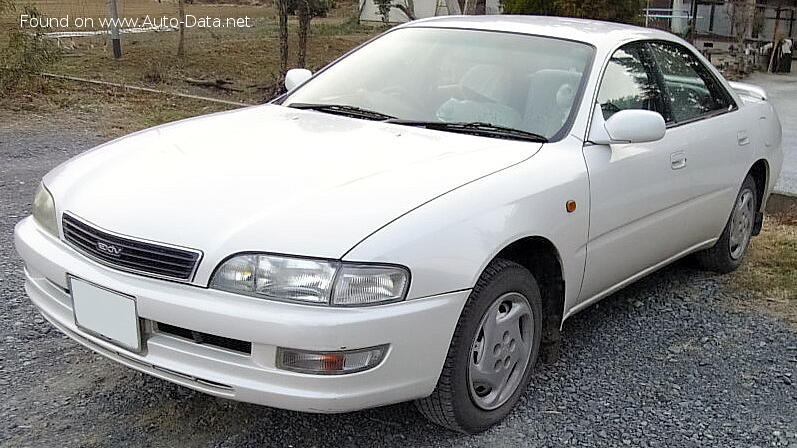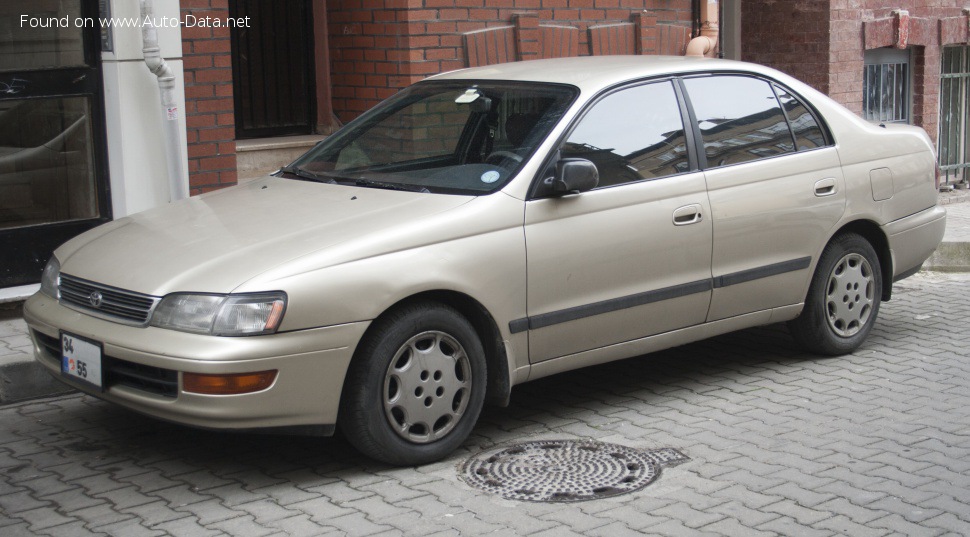
The Toyota Corona (T19) 2.0i 16V 4WS TR-R (133 Hp) Automatic: A Global Sedan with Advanced Dynamics
The Toyota Corona holds a significant place in automotive history, representing a long-running and highly successful nameplate for the Japanese automaker. The T19 generation, produced from 1992 to 1998, continued this legacy, offering a blend of reliability, practicality, and, in some variants, surprising technological sophistication. This article focuses on the specific Toyota Corona (T19) 2.0i 16V 4WS TR-R (133 Hp) Automatic variant, a model that showcased Toyota’s engineering prowess, particularly its innovative four-wheel steering system, during its production run from 1993 to 1996.
While the Corona nameplate had a presence in the United States until the early 1980s, by the T19 generation, Toyota had largely transitioned its mid-size sedan offerings in North America to the more upscale Camry. Consequently, the T19 Toyota Corona was primarily marketed in Japan, various Asian markets, and some European countries, where it served as a robust and efficient family sedan. The 2.0i 16V 4WS TR-R variant, with its advanced features and capable powertrain, positioned itself as a more dynamic and premium offering within the Corona lineup, appealing to drivers seeking a blend of comfort and enhanced handling.
Engine & Performance: The Robust 3S-FE in the Toyota Corona (T19)
At the heart of the Toyota Corona (T19) 2.0i 16V 4WS TR-R (133 Hp) Automatic was Toyota’s well-regarded 3S-FE engine. This 2.0-liter (1998 cm3 or 121.93 cu. in.) inline-four cylinder engine was a staple across many Toyota models of the era, known for its exceptional reliability, smooth operation, and respectable power output for a naturally aspirated unit. Featuring a Double Overhead Camshaft (DOHC) valvetrain with four valves per cylinder, the 3S-FE was designed for efficiency and durability.
The engine produced a healthy 133 horsepower at 5800 rpm, providing ample power for daily driving and highway cruising. Torque was rated at 134.97 lb.-ft. (183 Nm) at 4400 rpm, delivered smoothly across the rev range thanks to its multi-port manifold injection system and natural aspiration. This powertrain architecture, with the engine mounted transversely at the front and driving the front wheels, contributed to efficient packaging and predictable handling characteristics.
Paired with a 4-speed automatic transmission, the Corona 2.0i 16V 4WS TR-R offered a refined and comfortable driving experience, particularly suited for urban environments and longer journeys where ease of operation was paramount. The transmission was designed to maximize fuel efficiency while providing seamless shifts. Despite its automatic gearbox, the car maintained a respectable weight-to-power ratio of 8.9 kg/Hp (112.7 Hp/tonne), indicating a balanced performance for its class. Fuel economy was a strong point, with a combined rating of approximately 39.2 US mpg (6 liters/100 km), making it an economical choice for its time.
Design & Features: Innovation Beyond the Conventional Sedan
The T19 generation of the Toyota Corona maintained the brand’s reputation for understated yet functional design. As a four-door, five-seat sedan, it offered practical interior space and a comfortable ride, making it an ideal family vehicle. The exterior styling was clean and aerodynamic, characterized by smooth lines and a conservative profile that appealed to a broad demographic. Measuring 177.17 inches in length, 68.5 inches in width, and 52.17 inches in height, the Corona (T19) was a well-proportioned mid-size sedan.
However, what truly set the 2.0i 16V 4WS TR-R variant apart was its Four-Wheel Steering (4WS) system. This cutting-edge technology, particularly for a mainstream sedan in the early to mid-1990s, allowed the rear wheels to turn slightly in conjunction with the front wheels. At lower speeds, the rear wheels would turn in the opposite direction to the front, significantly reducing the turning radius and enhancing maneuverability in tight spaces. At higher speeds, the rear wheels would turn in the same direction, improving stability during lane changes and cornering. This system elevated the handling dynamics of the Corona (T19) beyond its competitors, offering a more engaging and confident driving experience.
Other notable features included a robust suspension setup, with wishbones at both the front and rear, designed to provide a compliant ride while maintaining control. Braking was handled by ventilated discs at the front and solid discs at the rear, augmented by an Anti-lock Braking System (ABS), a significant safety feature for the era. The hydraulic power steering, combined with the rack and pinion setup, offered precise and responsive feedback to the driver. The car rode on 195/65 R14 tires, fitted on 14-inch wheel rims, providing a good balance between comfort and grip.
Technical Specifications: Toyota Corona (T19) 2.0i 16V 4WS TR-R (133 Hp) Automatic
| Category | Specification |
|---|---|
| Brand | Toyota |
| Model | Corona |
| Generation | Corona (T19) |
| Type (Engine) | 2.0i 16V 4WS TR-R (133 Hp) Automatic |
| Production Start | 1993 year |
| Production End | 1996 year |
| Powertrain Architecture | Internal Combustion engine |
| Body type | Sedan |
| Seats | 5 |
| Doors | 4 |
| Performance Specs | |
| Fuel consumption (combined) | 6 l/100 km (39.2 US mpg) |
| Fuel Type | Petrol (Gasoline) |
| Weight-to-power ratio | 8.9 kg/Hp (112.7 Hp/tonne) |
| Weight-to-torque ratio | 6.4 kg/Nm (155.1 Nm/tonne) |
| Engine Specs | |
| Power | 133 Hp @ 5800 rpm |
| Power per liter | 66.6 Hp/l |
| Torque | 183 Nm (134.97 lb.-ft.) @ 4400 rpm |
| Engine layout | Front, Transverse |
| Engine Model/Code | 3S-FE |
| Engine displacement | 1998 cm3 (121.93 cu. in.) |
| Number of cylinders | 4 |
| Engine configuration | Inline |
| Cylinder Bore | 86 mm (3.39 in.) |
| Piston Stroke | 86 mm (3.39 in.) |
| Compression ratio | 9.5:1 |
| Number of valves per cylinder | 4 |
| Fuel injection system | Multi-port manifold injection |
| Engine aspiration | Naturally aspirated engine |
| Valvetrain | DOHC |
| Engine oil capacity | 3.9 l (4.12 US qt) |
| Coolant capacity | 6.9 l (7.29 US qt) |
| Space, Volume and Weights | |
| Kerb Weight | 1180 kg (2601.45 lbs) |
| Max. weight | 1455 kg (3207.73 lbs) |
| Max load | 275 kg (606.27 lbs) |
| Fuel tank capacity | 60 l (15.85 US gal) |
| Dimensions | |
| Length | 4500 mm (177.17 in.) |
| Width | 1740 mm (68.5 in.) |
| Height | 1325 mm (52.17 in.) |
| Wheelbase | 2535 mm (99.8 in.) |
| Front track | 1510 mm (59.45 in.) |
| Rear (Back) track | 1480 mm (58.27 in.) |
| Drivetrain, Brakes and Suspension Specs | |
| Drivetrain Architecture | Internal combustion engine drives the front wheels |
| Drive wheel | Front wheel drive |
| Number of gears and type of gearbox | 4 gears, automatic transmission |
| Front suspension | Wishbone |
| Rear suspension | Wishbone |
| Front brakes | Ventilated discs |
| Rear brakes | Disc |
| Assisting systems | ABS (Anti-lock braking system) |
| Steering type | Steering rack and pinion |
| Power steering | Hydraulic Steering |
| Tires size | 195/65 R14 |
| Wheel rims size | 14 |
Legacy & Market Impact of the Toyota Corona (T19)
The Toyota Corona nameplate, in its various generations, cultivated a reputation for being an unpretentious, reliable, and economical workhorse. The T19 generation, including the 2.0i 16V 4WS TR-R (133 Hp) Automatic, continued this tradition, solidifying Toyota’s standing as a producer of dependable vehicles globally. While it was overshadowed by the Camry in the crucial North American market, the Corona (T19) remained a strong seller in its primary markets, particularly in Japan and parts of Asia, where its blend of practicality, comfort, and low running costs was highly valued.
In its segment, the Corona (T19) competed against formidable rivals such as the Honda Accord (Ascot Innova in some markets), Nissan Primera (Bluebird in Japan), and Mazda Capella (626). What distinguished the TR-R variant, especially with its 4WS system, was its attempt to inject a dose of dynamic sophistication into a fundamentally reliable platform. This technological ambition demonstrated Toyota’s willingness to experiment with advanced features, even on its more mainstream models, to cater to a segment of buyers looking for something beyond basic transportation.
The 4WS system, though not universally adopted by the industry due to its complexity and cost, was a testament to Toyota’s engineering capabilities and commitment to innovation. It provided a tangible benefit in terms of handling and maneuverability, setting the TR-R apart from its more conventional siblings and many of its competitors. While the Corona nameplate eventually gave way to other models like the Allion and Premio in Japan, and the Camry continued its global ascent, the T19 generation, and especially variants like the 4WS TR-R, represent a period where Toyota was expertly balancing its core values of reliability and efficiency with a drive towards technological advancement. The legacy of the Toyota Corona (T19) is one of solid engineering, enduring dependability, and a quiet, yet significant, contribution to the evolution of the modern family sedan.