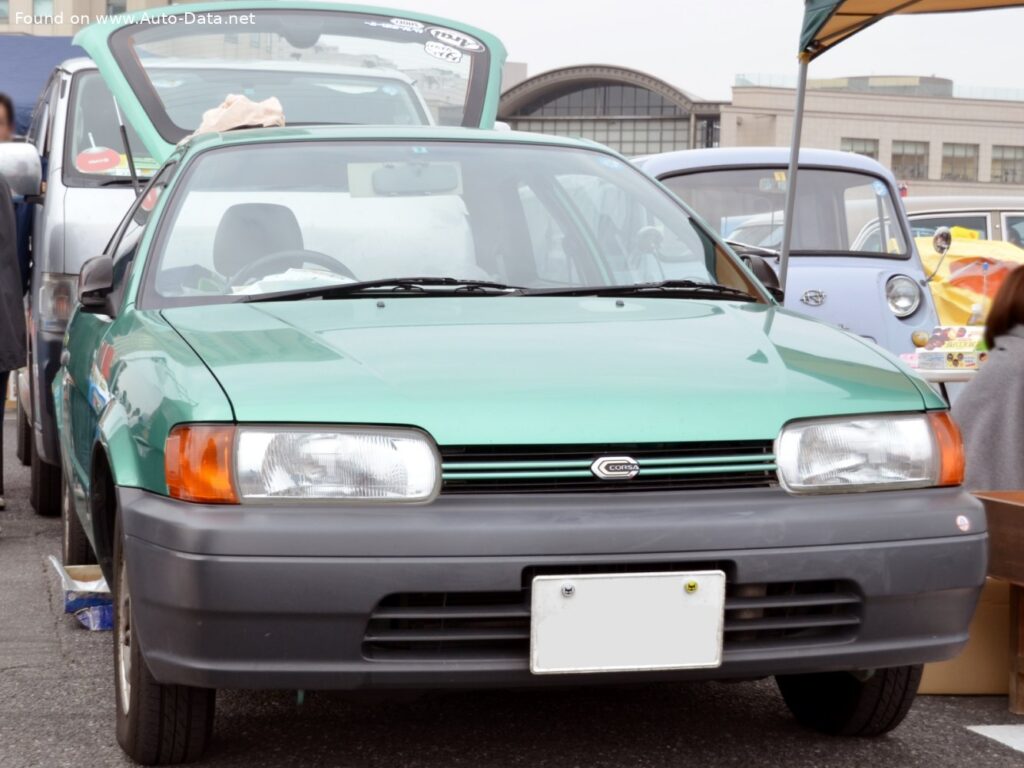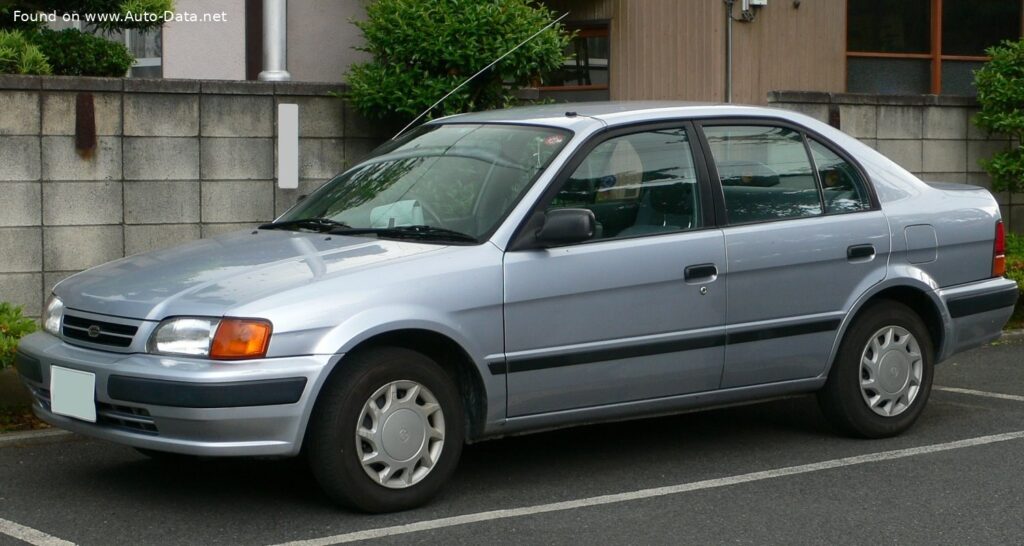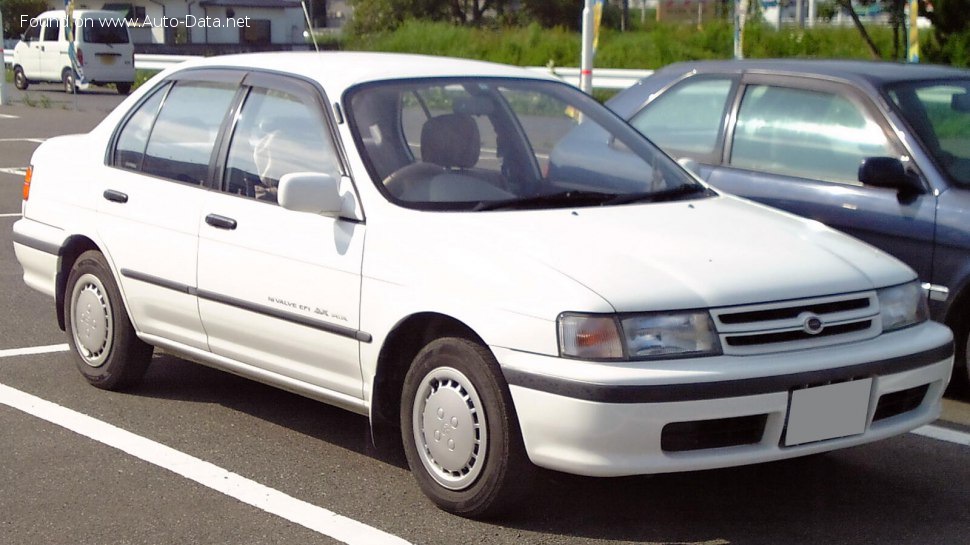
The Toyota Corsa (L40) 1.5 d (67 Hp): An Economical Compact Sedan of the Early 90s
The Toyota Corsa (L40) represents the fourth generation of Toyota’s compact car, produced from 1990 to 1994. While not officially sold in the United States, the Corsa played a significant role in Toyota’s lineup in Japan and various export markets, often twinned with the Toyota Tercel (known as the Corsa in Japan) and the Corolla II. This generation continued the Corsa’s legacy as a reliable, economical, and practical vehicle designed primarily for urban commuting and family use. The specific variant, the 1.5 d (67 Hp) sedan, was a testament to Toyota’s commitment to offering fuel-efficient diesel options for markets where diesel powertrains were popular, providing a robust and thrifty alternative to its gasoline counterparts. The L40 series built upon the established reputation of its predecessors, offering incremental improvements in design, safety, and powertrain technology, solidifying its position in the highly competitive compact car segment of the early 1990s.
Powertrain and Performance of the Toyota Corsa (L40) 1.5 d
At the heart of the Toyota Corsa (L40) 1.5 d was the robust 1N-T engine, a 1.5-liter (1453 cm3 or 88.67 cu. in.) inline-four diesel unit. This particular engine configuration featured a DOHC (Double Overhead Camshaft) valvetrain, which was somewhat advanced for a small diesel engine of its era, contributing to better efficiency and power delivery. Equipped with a turbocharger and a Diesel Commonrail fuel injection system, the engine produced a modest but highly effective 67 horsepower at 4500 rpm. More importantly for a diesel, it delivered a healthy 101.05 lb.-ft. of torque at a low 2600 rpm. This ample torque at lower revs made the Corsa 1.5 d feel responsive in city traffic and capable of maintaining speed on highways, despite its relatively low horsepower figure.
The engine’s front, transverse layout, coupled with front-wheel drive, was typical for compact cars of the period, optimizing interior space and manufacturing efficiency. With a high compression ratio of 22:1, characteristic of diesel engines, the 1N-T was designed for maximum fuel efficiency. Its fuel consumption figures were particularly impressive: an urban economy of 31.4 US mpg (7.5 l/100 km) and an outstanding extra-urban economy of 56 US mpg (4.2 l/100 km). These numbers underscored the vehicle’s primary purpose as an economical daily driver. The vehicle’s lightweight kerb weight of 1851.88 lbs (840 kg) contributed significantly to its efficiency, resulting in a weight-to-power ratio of 12.5 kg/Hp (79.8 Hp/tonne) and a weight-to-torque ratio of 6.1 kg/Nm (163.1 Nm/tonne), indicating a well-balanced package for its intended use. The 3.8 liters (4.02 US qt) engine oil capacity and 5.3 liters (5.6 US qt) coolant capacity further highlight the compact and efficient design of this powertrain.
Design Philosophy and Interior Amenities
The design of the Toyota Corsa (L40) sedan was characteristic of early 1990s Japanese compact cars: functional, conservative, and built for durability. Measuring 162.01 inches in length, 65.35 inches in width, and 53.94 inches in height, with a wheelbase of 93.7 inches, the Corsa was a compact vehicle that offered surprising interior space for its class. The four-door sedan body style provided easy access for up to five occupants, making it a practical choice for small families or commuters. The exterior styling was clean and aerodynamic for its time, eschewing flashy elements in favor of a timeless and unobtrusive aesthetic that appealed to a broad range of buyers prioritizing utility.
Inside, the Corsa’s cabin was designed with practicality and ergonomics in mind. While luxury was not its focus, the interior materials were durable, and the controls were intuitively placed. Standard features for the era would have included basic climate control, an AM/FM radio, and comfortable cloth seating. For safety, the L40 generation saw the inclusion of ABS (Anti-lock braking system) as an assisting system, a significant advancement for a compact car in the early 1990s, enhancing braking performance and driver control in adverse conditions. The vehicle featured disc brakes at the front and drum brakes at the rear, a common and cost-effective setup for FWD compacts. The 155/80 SR13 tires provided a comfortable ride and adequate grip for everyday driving, further emphasizing its role as a reliable and accessible mode of transport. Its minimum turning circle of 29.53 feet (9 meters) also highlighted its maneuverability in urban environments.
Technical Specifications of the Toyota Corsa (L40) 1.5 d (67 Hp)
| Category | Specification |
|---|---|
| General Information | |
| Brand | Toyota |
| Model | Corsa |
| Generation | Corsa (L40) |
| Type (Engine) | 1.5 d (67 Hp) |
| Start of Production | 1990 year |
| End of Production | 1994 year |
| Powertrain Architecture | Internal Combustion engine |
| Body Type | Sedan |
| Seats | 5 |
| Doors | 4 |
| Performance Specs | |
| Fuel Consumption (Urban) | 7.5 l/100 km (31.4 US mpg) |
| Fuel Consumption (Extra Urban) | 4.2 l/100 km (56 US mpg) |
| Fuel Type | Diesel |
| Weight-to-Power Ratio | 12.5 kg/Hp (79.8 Hp/tonne) |
| Weight-to-Torque Ratio | 6.1 kg/Nm (163.1 Nm/tonne) |
| Engine Specs | |
| Power | 67 Hp @ 4500 rpm |
| Power per Liter | 46.1 Hp/l |
| Torque | 137 Nm @ 2600 rpm (101.05 lb.-ft. @ 2600 rpm) |
| Engine Layout | Front, Transverse |
| Engine Model/Code | 1N-T |
| Engine Displacement | 1453 cm3 (88.67 cu. in.) |
| Number of Cylinders | 4 |
| Engine Configuration | Inline |
| Cylinder Bore | 74 mm (2.91 in.) |
| Piston Stroke | 84.5 mm (3.33 in.) |
| Compression Ratio | 22:1 |
| Fuel Injection System | Diesel Commonrail |
| Engine Aspiration | Turbocharger |
| Valvetrain | DOHC |
| Engine Oil Capacity | 3.8 l (4.02 US qt) |
| Coolant Capacity | 5.3 l (5.6 US qt) |
| Space, Volume and Weights | |
| Kerb Weight | 840 kg (1851.88 lbs) |
| Fuel Tank Capacity | 45 l (11.89 US gal) |
| Dimensions | |
| Length | 4115 mm (162.01 in.) |
| Width | 1660 mm (65.35 in.) |
| Height | 1370 mm (53.94 in.) |
| Wheelbase | 2380 mm (93.7 in.) |
| Front Track | 1400 mm (55.12 in.) |
| Rear (Back) Track | 1430 mm (56.3 in.) |
| Minimum Turning Circle | 9 m (29.53 ft) |
| Drivetrain, Brakes and Suspension Specs | |
| Drivetrain Architecture | Front wheel drive (ICE drives front wheels) |
| Drive Wheel | Front wheel drive |
| Front Brakes | Disc |
| Rear Brakes | Drum |
| Assisting Systems | ABS (Anti-lock braking system) |
| Tires Size | 155/80 SR13 |
Legacy and Market Placement
The Toyota Corsa (L40) 1.5 d (67 Hp) solidified its reputation as a highly reliable, economical, and practical vehicle, characteristics synonymous with the Toyota brand. While it never officially graced American showrooms, its impact was keenly felt in its primary markets, particularly Japan and parts of Europe and Asia. In these regions, it catered to a segment of buyers who valued low running costs, dependable transportation, and a no-frills approach to motoring. Its diesel variant, in particular, offered an attractive proposition in markets with favorable diesel fuel pricing or taxation structures.
In its home market, Japan, the Corsa competed directly with other compact sedans and hatchbacks from rival manufacturers, including the Nissan Sunny (known as Sentra in some markets), the Mazda Familia (323), and the Honda Civic. Within Toyota’s own extensive lineup, it occupied a space alongside the more upscale Corolla, often serving as a slightly more budget-conscious alternative or a specific-purpose model like a commercial vehicle. The Corsa’s availability with an efficient diesel engine allowed Toyota to capture a niche market that sought maximum fuel economy and torque for utility purposes.
The L40 generation, including the 1.5 d variant, is historically significant for demonstrating Toyota’s global strategy of offering a diverse range of powertrains to meet specific regional demands. It showcased the brand’s engineering prowess in developing durable and efficient diesel engines, a segment that was crucial outside North America. The Corsa’s understated design and robust mechanicals contributed to Toyota’s overall image of quality and longevity, reinforcing customer loyalty and expanding its global footprint. Even today, these vehicles are remembered for their extraordinary durability and low cost of ownership, making them sought-after classics in regions where they were originally sold, embodying the practical and dependable spirit of early 1990s Japanese automotive engineering.