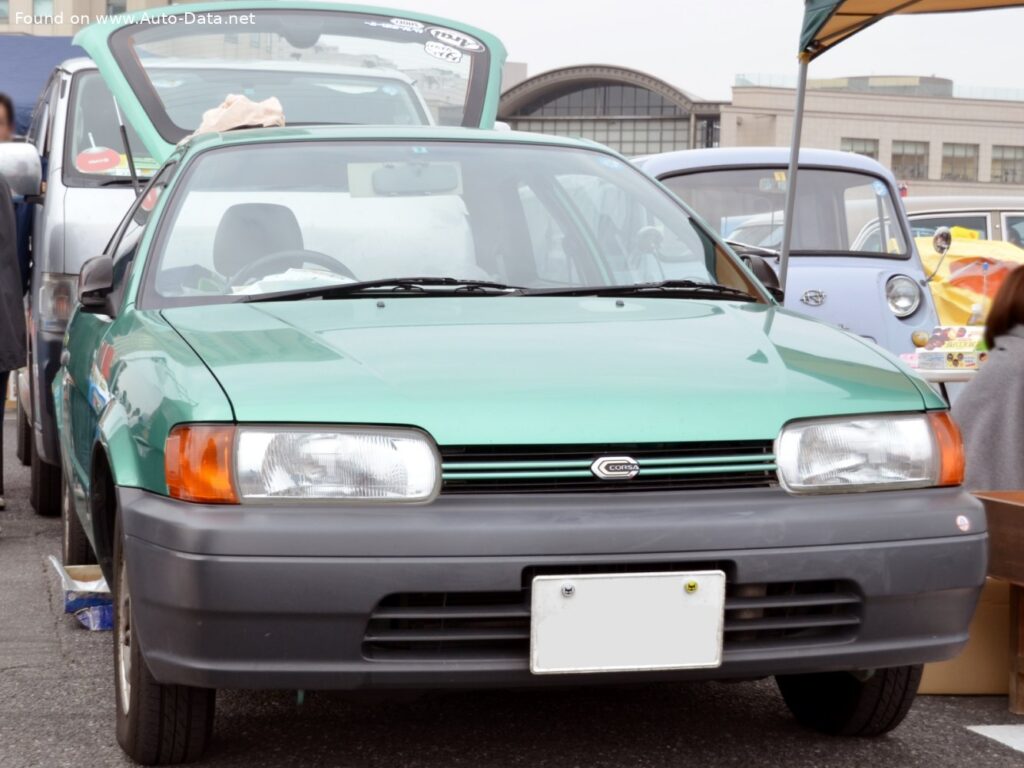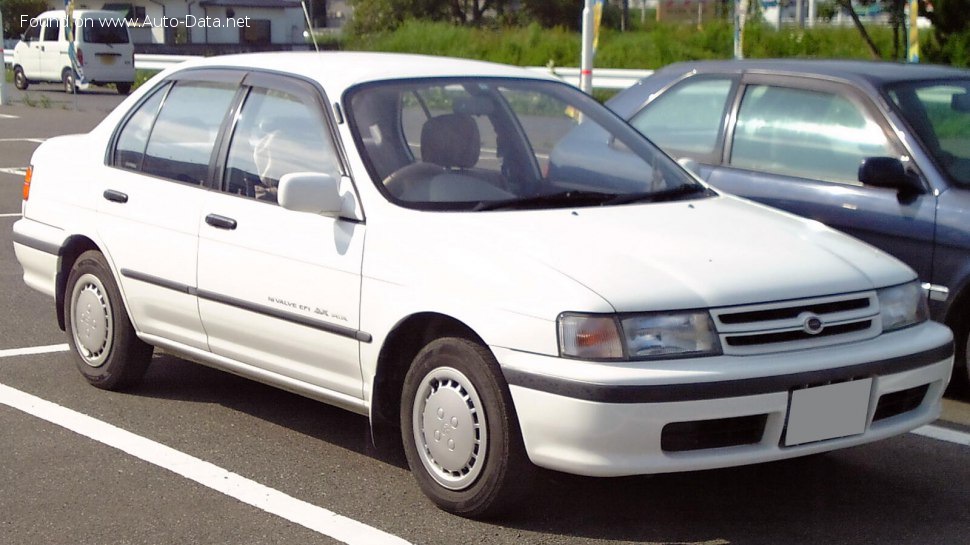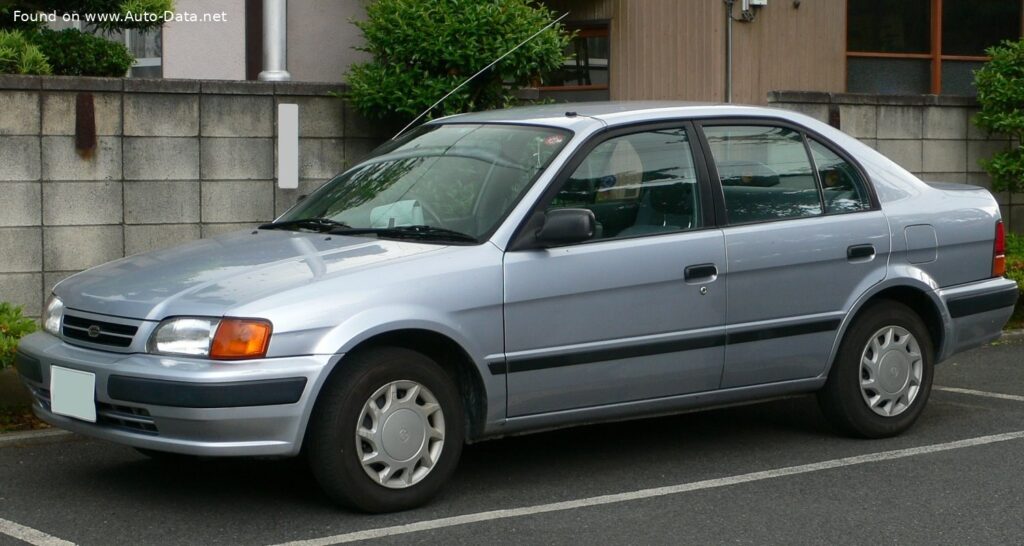
Toyota Corsa (L50) 1.5 d (67 Hp) Overview
The Toyota Corsa (L50) represents the fifth generation of Toyota’s long-running compact sedan and hatchback line, primarily designed for the Japanese domestic market (JDM) and select international markets. Produced between 1994 and 1998, this iteration of the Corsa, often twinned with the Toyota Tercel and Toyota Corolla II, was engineered as a practical, economical, and reliable vehicle tailored for urban environments and efficient daily commuting. While not officially sold in the United States, the Corsa L50 series played a significant role in Toyota’s global strategy, particularly in offering a diverse range of powertrains, including a notably efficient 1.5-liter turbodiesel variant, the focus of this expert analysis. This specific model, the 1.5 d (67 Hp) sedan, exemplifies Toyota’s commitment to fuel efficiency and durability in a compact package during the mid-1990s.
Engine and Performance: The Toyota Corsa (L50) Diesel Powertrain
Under the hood, the Toyota Corsa (L50) 1.5 d (67 Hp) featured a robust and highly efficient 1.5-liter (1453 cm3 or 88.67 cubic inches) inline-four diesel engine, designated as the 1N-T. This powerplant was a testament to Toyota’s engineering prowess in developing compact, economical diesel engines. Featuring a DOHC (Double Overhead Camshaft) valvetrain and a turbocharger, it was advanced for its time, especially for a vehicle in this segment. The engine produced a modest but highly usable 67 horsepower at 4500 rpm, which, when combined with its impressive torque output, provided ample motivation for its lightweight chassis.
The torque figures were particularly noteworthy for a small diesel engine of the era: 137 Newton-meters (approximately 101.05 lb.-ft.) delivered at a low 2600 rpm. This low-end torque characteristic made the Corsa 1.5 d feel sprightly in city traffic and allowed for relaxed cruising on highways, minimizing the need for frequent gear changes. The engine’s high compression ratio of 22:1, coupled with a Commonrail diesel fuel injection system, contributed significantly to its excellent fuel economy. Drivers could expect exceptional mileage, with an urban consumption rate of around 31.4 US miles per gallon and an even more impressive extra-urban (highway) figure of 56 US miles per gallon. These figures underscored the Corsa’s appeal as a cost-effective vehicle to operate, particularly in markets where diesel fuel was prevalent and economically advantageous. The engine’s front, transverse layout and front-wheel-drive architecture were standard for compact cars of this period, optimizing interior space and manufacturing efficiency.
Design and Features of the Toyota Corsa (L50) Sedan
The fifth-generation Toyota Corsa (L50) sedan adopted a conservative yet functional design philosophy typical of Toyota vehicles of the mid-1990s. Its four-door, five-seat sedan body type emphasized practicality and affordability. With a length of 162.2 inches, a width of 65.35 inches, and a height of 53.94 inches, the Corsa was dimensionally compact, making it highly maneuverable in congested urban environments and easy to park. The wheelbase measured 93.7 inches, providing a stable ride while maintaining a tight turning circle of 29.53 feet, a definite advantage for city driving.
Inside, the Corsa L50 offered a straightforward and ergonomic cabin. While not luxurious, the interior was built with Toyota’s renowned attention to durability and user-friendliness. Controls were intuitively placed, and materials were chosen for their longevity. The five-seat configuration provided adequate space for occupants, making it a suitable family car for its segment. For its time, the inclusion of an Anti-lock Braking System (ABS) as an assisting system was a significant safety feature, enhancing braking performance and control, especially under emergency conditions. The vehicle rode on 155/80 SR13 tires, a common size for compact cars that balanced ride comfort with efficiency. The braking system comprised disc brakes at the front and drum brakes at the rear, a conventional setup for an economical vehicle of its class, offering reliable stopping power. The Corsa L50 was designed with a focus on delivering dependable transportation without unnecessary frills, a characteristic that resonated well with its target demographic.
Technical Specifications
| Category | Specification |
|---|---|
| Brand | Toyota |
| Model | Corsa (L50) |
| Generation | Corsa (L50) |
| Engine Type | 1.5 d (67 Hp) |
| Production Start | 1994 year |
| Production End | 1998 year |
| Powertrain Architecture | Internal Combustion engine |
| Body Type | Sedan |
| Seats | 5 |
| Doors | 4 |
| Performance Specifications | |
| Fuel Consumption (Urban) | 7.5 l/100 km (31.4 US mpg) |
| Fuel Consumption (Extra Urban) | 4.2 l/100 km (56 US mpg) |
| Fuel Type | Diesel |
| Weight-to-Power Ratio | 12.5 kg/Hp (79.8 Hp/tonne) |
| Weight-to-Torque Ratio | 6.1 kg/Nm (163.1 Nm/tonne) |
| Engine Specifications | |
| Power | 67 Hp @ 4500 rpm |
| Power per Liter | 46.1 Hp/l |
| Torque | 137 Nm @ 2600 rpm (101.05 lb.-ft. @ 2600 rpm) |
| Engine Layout | Front, Transverse |
| Engine Model/Code | 1N-T |
| Engine Displacement | 1453 cm3 (1.5 L / 88.67 cu. in.) |
| Number of Cylinders | 4 |
| Engine Configuration | Inline |
| Cylinder Bore | 74 mm (2.91 in.) |
| Piston Stroke | 84.5 mm (3.33 in.) |
| Compression Ratio | 22:1 |
| Fuel Injection System | Diesel Commonrail |
| Engine Aspiration | Turbocharger |
| Valvetrain | DOHC |
| Engine Oil Capacity | 3.8 L (4.02 US qt) |
| Coolant Capacity | 5.3 L (5.6 US qt) |
| Dimensions, Volume, and Weights | |
| Kerb Weight | 840 kg (1851.88 lbs.) |
| Fuel Tank Capacity | 45 L (11.89 US gal) |
| Length | 4120 mm (162.2 in.) |
| Width | 1660 mm (65.35 in.) |
| Height | 1370 mm (53.94 in.) |
| Wheelbase | 2380 mm (93.7 in.) |
| Front Track | 1400 mm (55.12 in.) |
| Rear Track | 1430 mm (56.3 in.) |
| Minimum Turning Circle | 9 m (29.53 ft.) |
| Drivetrain, Brakes, and Suspension | |
| Drivetrain Architecture | Front-wheel drive (Internal Combustion engine drives front wheels) |
| Drive Wheel | Front wheel drive |
| Front Brakes | Disc |
| Rear Brakes | Drum |
| Assisting Systems | ABS (Anti-lock braking system) |
| Tires Size | 155/80 SR13 |
Legacy and Market Impact of the Toyota Corsa (L50)
The Toyota Corsa (L50), particularly in its diesel iteration, carved out a significant niche in the Japanese and other Asian markets where fuel efficiency and low operating costs were paramount. As a compact sedan, it competed in a highly contested segment against domestic rivals such as the Nissan Sunny (known as Sentra in North America), Honda Civic (in its more utilitarian trims), and the Mazda Familia (323). What distinguished the Corsa was Toyota’s unwavering reputation for reliability and the L50’s exceptional fuel economy, especially with the 1.5-liter turbodiesel engine.
Its market impact was largely defined by its role as a practical, no-nonsense vehicle for daily transportation. The Corsa was often chosen by individuals and small families seeking dependable transport that wouldn’t break the bank at the pump or require frequent maintenance. Its straightforward engineering and robust build quality ensured a long service life, contributing to Toyota’s overall brand image of durability. While the L50 generation did not officially reach the North American market—where the larger Corolla and Tercel lines served similar market segments—its design principles and powertrain technology influenced Toyota’s global compact car development. The Corsa’s success in its primary markets underscored the demand for efficient diesel options in regions where fuel prices and emissions regulations encouraged such powertrains.
The 1.5 d (67 Hp) variant, with its advanced Commonrail injection and turbocharging, was a precursor to the sophisticated diesel engines that would become more common in compact cars globally in the following decades. It demonstrated that even a small, economical sedan could offer impressive performance, efficiency, and modern safety features like ABS. Today, the Toyota Corsa (L50) is remembered as a resilient and economical workhorse, embodying Toyota’s core values of quality, reliability, and value in the competitive compact car segment of the mid-1990s. Its legacy is one of quiet competence and enduring practicality, a testament to Toyota’s engineering philosophy.