The Toyota Corsa (L50) 1.5 i (94 Hp): A Pillar of Japanese Subcompact Engineering
The Toyota Corsa (L50) represents the fifth generation of Toyota’s long-running subcompact car, produced from 1994 to 1999. While largely unfamiliar to the American market, where Toyota offered the mechanically similar Tercel, the Corsa was a foundational model in its primary markets, particularly Japan and parts of Asia. As a practical and economical sedan, the Toyota Corsa (L50) was designed to offer reliable transportation, impressive fuel efficiency, and a comfortable ride within a compact footprint. This article delves into the specifics of the 1.5 i (94 Hp) variant, a popular engine choice that embodied the Corsa’s core attributes of dependability and cost-effectiveness. It highlights Toyota’s engineering philosophy of the mid-to-late 1990s, focusing on durability and sensible design over flamboyant styling or high-performance aspirations, cementing its status as a ubiquitous sight on Japanese roads during its production run.
Engine and Performance Characteristics of the Toyota Corsa (L50)
At the heart of the Toyota Corsa (L50) 1.5 i (94 Hp) model was the venerable 5E-FE engine, a 1.5-liter (1496 cm3 or 91.29 cu. in.) inline-four gasoline powerplant. This engine, known for its robustness and smooth operation, featured a Dual Overhead Camshaft (DOHC) valvetrain with four valves per cylinder, a configuration that was becoming standard for efficient, responsive engines of the era. Fuel delivery was handled by a multi-port manifold injection system, ensuring precise fuel metering and contributing to both performance and fuel economy. As a naturally aspirated engine, it delivered its power linearly and predictably, a characteristic highly valued in urban driving conditions.
The 5E-FE engine produced a respectable 94 horsepower at 5400 rpm, which, for a vehicle of its size and intended purpose, provided ample motivation. Torque output stood at 132 Newton-meters (97.36 lb.-ft.) at 4400 rpm, providing sufficient pulling power for daily commutes and light highway cruising. With a compression ratio of 9.8:1, the engine was designed for optimal efficiency using regular unleaded gasoline. The power-to-liter ratio of 62.8 Hp/L underscored its balanced design, offering a good blend of power for its displacement.
Driving the front wheels, the Corsa’s powertrain architecture was typical for a subcompact of its generation, prioritizing interior space and manufacturing simplicity. Its kerb weight of 840 kg (1851.88 lbs) resulted in a favorable weight-to-power ratio of 8.9 kg/Hp (111.9 Hp/tonne), allowing the 94-horsepower engine to feel sprightly enough for its urban environment. Fuel economy was a major selling point for the Corsa. It achieved an impressive 7.5 L/100 km (31.4 US mpg) in urban settings and an even more remarkable 4.2 L/100 km (56 US mpg) on extra-urban cycles, making it an incredibly economical choice for Japanese consumers facing high fuel costs. The 45-liter (11.89 US gal) fuel tank provided a substantial cruising range, further enhancing its practicality for daily use.
Design and Features
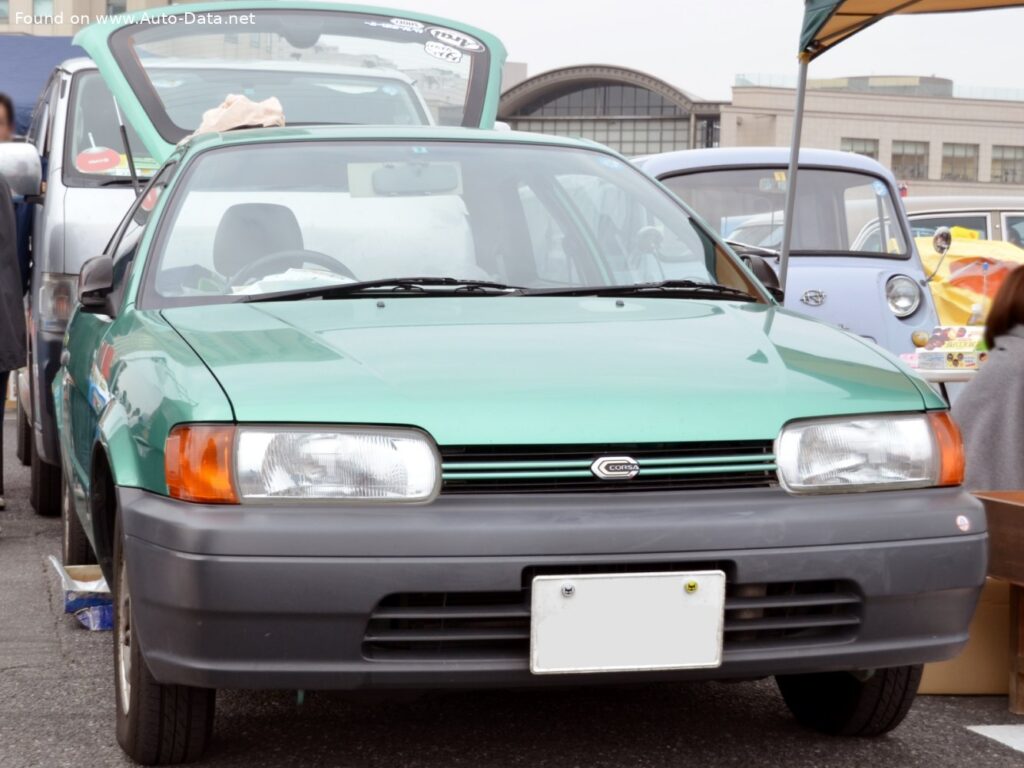
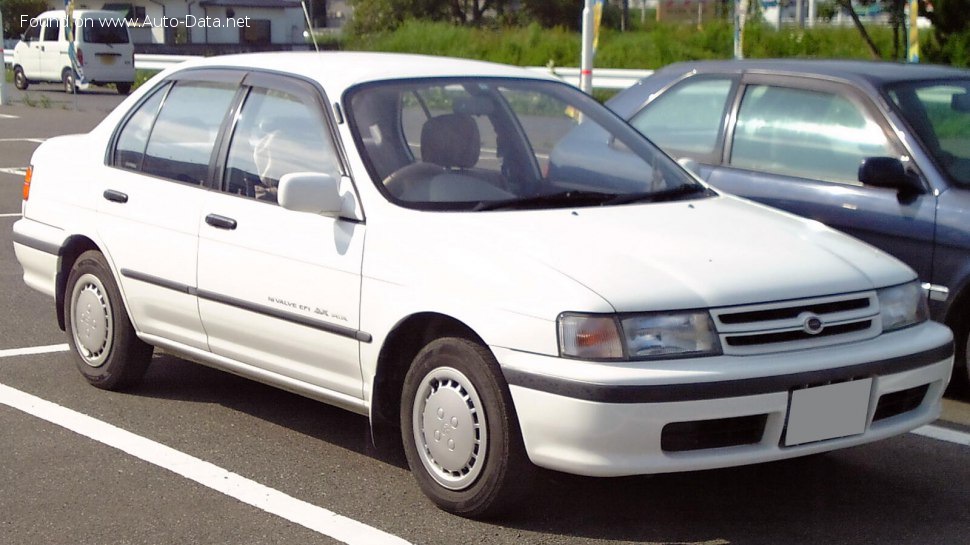
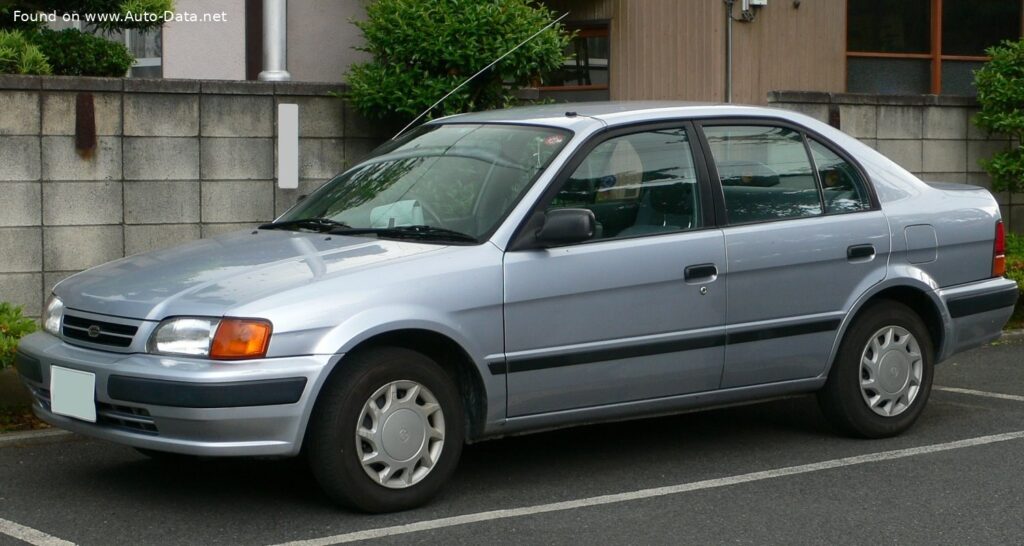
The Toyota Corsa (L50) was offered as a four-door sedan, a popular body style in its target markets for its perceived formality and secure trunk space compared to hatchbacks. Its design language was unmistakably Toyota of the mid-1990s: clean, unpretentious, and functional. With a length of 4120 mm (162.2 in.), a width of 1660 mm (65.35 in.), and a height of 1370 mm (53.94 in.), the Corsa was compact yet thoughtfully proportioned. The wheelbase measured 2380 mm (93.7 in.), contributing to a stable ride and a surprisingly roomy interior for five occupants, a key consideration for family buyers.
The exterior styling was characterized by smooth lines and a rounded aesthetic, a departure from the boxier designs of earlier generations, reflecting the prevailing aerodynamic trends of the decade. Large glass areas ensured good visibility, an important safety and convenience feature in congested urban environments. The minimum turning circle of 9 meters (29.53 ft.) highlighted its maneuverability, making it adept at navigating tight city streets and parking spaces.
Inside, the Corsa emphasized practicality and durability. The dashboard layout was straightforward, with controls placed intuitively for ease of use. While not luxurious, the materials were hard-wearing, designed to withstand years of daily use. Seating for five was standard, with comfortable if not overly plush upholstery. For its time, the inclusion of ABS (Anti-lock Braking System) as an assisting system was a significant safety feature, providing enhanced control during emergency braking. The braking system itself comprised disc brakes at the front and reliable drum brakes at the rear. The vehicle rode on 155/80 SR13 tires, a common size for subcompacts, balancing grip with ride comfort and fuel efficiency.
Technical Specifications
| Category | Specification |
|---|---|
| Brand | Toyota |
| Model | Corsa (L50) |
| Type (Engine) | 1.5 i (94 Hp) |
| Production Start | 1994 |
| Production End | 1999 |
| Body Type | Sedan |
| Seats | 5 |
| Doors | 4 |
| Performance | |
| Fuel Consumption (Urban) | 7.5 L/100 km (31.4 US mpg) |
| Fuel Consumption (Extra Urban) | 4.2 L/100 km (56 US mpg) |
| Fuel Type | Petrol (Gasoline) |
| Weight-to-Power Ratio | 8.9 kg/Hp (111.9 Hp/tonne) |
| Weight-to-Torque Ratio | 6.4 kg/Nm (157.1 Nm/tonne) |
| Engine | |
| Power | 94 Hp @ 5400 rpm |
| Power per Liter | 62.8 Hp/L |
| Torque | 132 Nm (97.36 lb.-ft.) @ 4400 rpm |
| Engine Layout | Front, Transverse |
| Engine Model/Code | 5E-FE |
| Engine Displacement | 1496 cm3 (1.5 L / 91.29 cu. in.) |
| Number of Cylinders | 4, Inline |
| Cylinder Bore | 74 mm (2.91 in.) |
| Piston Stroke | 87 mm (3.43 in.) |
| Compression Ratio | 9.8:1 |
| Valves per Cylinder | 4 |
| Fuel Injection System | Multi-port manifold injection |
| Engine Aspiration | Naturally aspirated |
| Valvetrain | DOHC |
| Engine Oil Capacity | 2.8 L (2.96 US qt) |
| Coolant Capacity | 4.9 L (5.18 US qt) |
| Dimensions & Weights | |
| Kerb Weight | 840 kg (1851.88 lbs) |
| Fuel Tank Capacity | 45 L (11.89 US gal) |
| Length | 4120 mm (162.2 in.) |
| Width | 1660 mm (65.35 in.) |
| Height | 1370 mm (53.94 in.) |
| Wheelbase | 2380 mm (93.7 in.) |
| Front Track | 1400 mm (55.12 in.) |
| Rear Track | 1430 mm (56.3 in.) |
| Minimum Turning Circle | 9 m (29.53 ft.) |
| Drivetrain, Brakes & Suspension | |
| Drivetrain Architecture | Front-wheel drive (ICE drives front wheels) |
| Drive Wheel | Front-wheel drive |
| Front Brakes | Disc |
| Rear Brakes | Drum |
| Assisting Systems | ABS (Anti-lock braking system) |
| Tires Size | 155/80 SR13 |
Legacy and Market Impact
The Toyota Corsa (L50), particularly the 1.5 i (94 Hp) variant, played a crucial role in Toyota’s strategy for the Japanese and select Asian markets during the mid to late 1990s. It was positioned as an accessible, economical, and utterly dependable subcompact sedan, a segment that formed the backbone of personal transportation in many of these regions. Its primary competitors included domestic rivals such as the Honda Civic (in its more basic trims), Nissan Sunny (known as Sentra in some markets), Mitsubishi Lancer, and the Mazda Familia (323). Against these, the Corsa consistently stood out for its legendary reliability and low running costs, attributes that resonated deeply with value-conscious buyers.
The Corsa’s reputation for being virtually bulletproof contributed significantly to Toyota’s overall brand image for quality and durability, which by the 1990s was already globally recognized. It was the kind of car that owners could buy, drive for years with minimal fuss, and then sell on the used market with strong resale value. This consistent performance and hassle-free ownership experience solidified its place as a practical choice for urban commuters, small families, and even first-time car buyers.
While the Corsa itself was not directly offered in the United States, its mechanical underpinnings and design philosophy were closely shared with the Toyota Tercel, which served a similar entry-level segment in North America. This strategy allowed Toyota to efficiently cater to diverse market needs with region-specific branding and slight adaptations, while leveraging common platforms and powertrains. The Corsa (L50) embodies a period when Japanese automakers perfected the art of the reliable, efficient, and affordable small car, setting benchmarks that many global manufacturers would strive to meet. Its legacy is not one of groundbreaking innovation or high performance, but rather of quiet competence, unwavering dependability, and a profound understanding of what the everyday driver truly needs in a personal vehicle.