Introduction to the Toyota Harrier I (XU10, Facelift 2000)
The Toyota Harrier I (XU10, facelift 2000) represents a significant milestone in the evolution of the modern sport utility vehicle (SUV) and crossover segment. Launched in 1997, the first-generation Harrier, internally designated XU10, pioneered the concept of a car-based luxury SUV, blending the practicality and elevated driving position of an SUV with the comfort and handling characteristics of a sedan. The model under review here is the facelifted iteration, produced from 2000 to 2002, specifically the 2.2i 16V (140 Hp) 4×4 Automatic variant. While the Toyota Harrier was primarily marketed in Japan and select Asian markets, it gained international recognition and immense success as the Lexus RX 300 in North America and other global luxury markets, effectively establishing the premium crossover segment. This particular configuration, with its 2.2-liter inline-four engine and all-wheel-drive system, offered a compelling blend of efficiency, capability, and refined driving dynamics for its time.
During its production run, the facelifted XU10 Harrier continued to build on its reputation for reliability, comfort, and innovative design. It appealed to a demographic seeking a versatile family vehicle that eschewed the rugged, truck-like demeanor of traditional SUVs in favor of a more sophisticated and urban-friendly aesthetic. The 2000 facelift brought subtle but important updates, refreshing its appearance and enhancing its feature set to maintain competitiveness in a rapidly evolving market.
Powertrain and Performance of the Toyota Harrier I (XU10, Facelift 2000)
Engine Specifications and Output
At the heart of the Toyota Harrier I (XU10, facelift 2000) 2.2i 16V variant is Toyota’s venerable 5S-FE engine. This 2.2-liter (2163 cm³ or 131.99 cu. in.) inline-four powerplant is a naturally aspirated, multi-port manifold injected unit featuring a Double Overhead Camshaft (DOHC) valvetrain with four valves per cylinder. Known for its robust design and smooth operation, the 5S-FE delivered a respectable 140 horsepower at 5600 rpm. Its power-per-liter rating stood at 64.7 Hp/l, a solid figure for a non-turbocharged engine of its era.
Torque output for this engine was 143.82 lb.-ft. (195 Nm) available at 4400 rpm. This torque curve, peaking in the mid-range, provided adequate responsiveness for daily driving and highway cruising. The engine’s front, transverse layout was typical for a car-based platform, optimizing interior space and weight distribution. With a compression ratio of 9.8:1, the engine was designed for efficient combustion using regular gasoline. Its oil capacity was 3.8 US quarts, and the cooling system held 8.77 US quarts of coolant.
Drivetrain and Driving Dynamics
Power was transmitted to all four wheels via a conventional 4-speed automatic transmission. This automatic gearbox, while not as sophisticated as modern multi-speed units, was praised for its smooth shifts and reliability, contributing to the Harrier’s comfortable driving experience. The permanent all-wheel-drive (4×4) architecture ensured consistent traction and enhanced stability, especially in adverse weather conditions or on unpaved roads, a key selling point for SUV buyers.
In terms of performance, the 2.2i 16V 4×4 Automatic Harrier could accelerate from 0 to 60 mph in a calculated 11.8 seconds, with a 0-100 km/h sprint taking 12.4 seconds. Its maximum speed was approximately 99.42 mph (160 km/h). While not a performance-oriented vehicle, these figures were competitive for a mid-size crossover of its time, emphasizing comfort and practicality over outright speed. The vehicle’s weight-to-power ratio was 12.1 kg/Hp (82.4 Hp/tonne), indicating a balanced approach to its powertrain design.
Fuel Economy
Fuel efficiency was a strong suit for the Harrier, especially considering its all-wheel-drive system and automatic transmission. The official combined fuel consumption was 7.1 liters per 100 kilometers, translating to an impressive 33.1 US mpg. Urban driving yielded about 23.5 US mpg, while extra-urban conditions saw figures up to 38.6 US mpg. This efficiency, coupled with a generous 19.81 US gallon fuel tank capacity, provided a substantial driving range, making it suitable for long journeys.
Design, Features, and Ergonomics
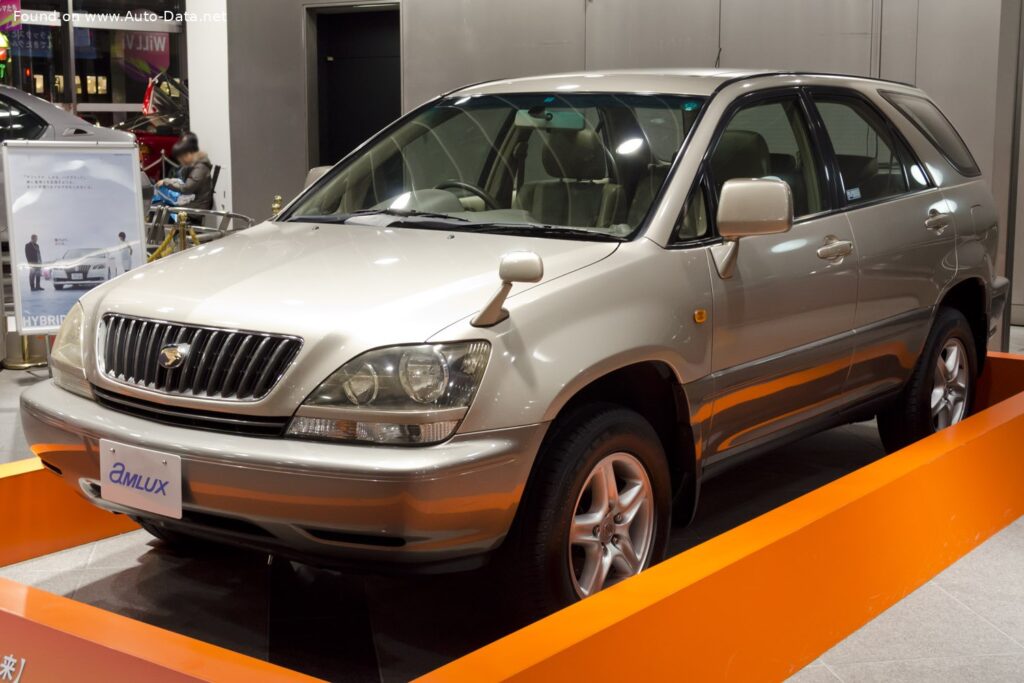
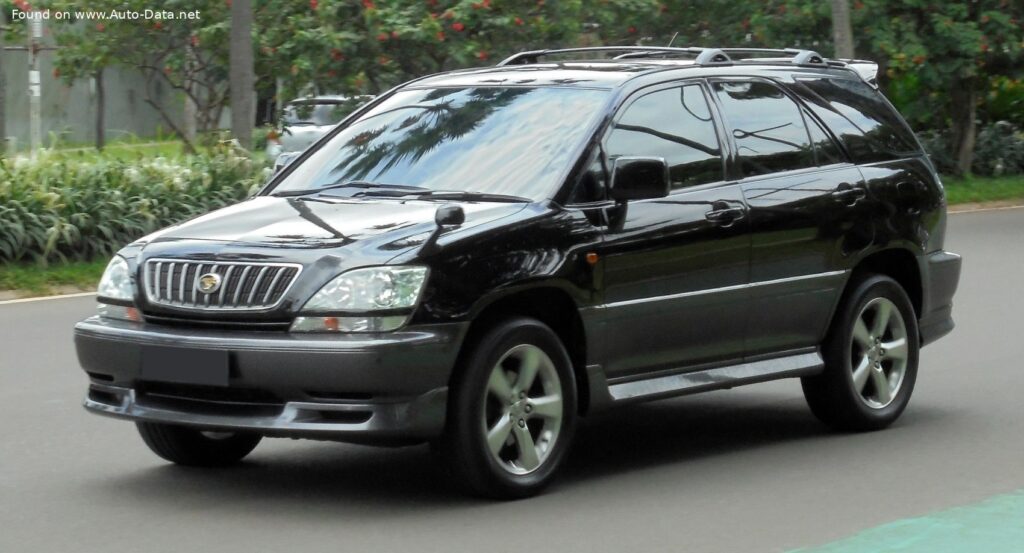
The Toyota Harrier I (XU10, facelift 2000) was a pioneer in its design philosophy, blending the ruggedness typically associated with SUVs with the sleek lines and comfortable interior of a passenger car. Its body type is classified as an SUV/Crossover, featuring five doors and seating for five occupants. The facelift in 2000 brought subtle exterior revisions, including updated headlamps, taillamps, and minor trim changes, keeping its appearance fresh and contemporary.
Dimensionally, the Harrier measured 180.12 inches in length, 71.46 inches in width, and 65.55 inches in height. Its 102.95-inch wheelbase contributed to a stable ride and generous interior volume. With a ground clearance of 7.09 inches, it offered a commanding view of the road and reasonable capability over light obstacles. The design prioritized occupant comfort and cargo versatility. The trunk space was highly flexible, ranging from 30.37 cubic feet (860 liters) with the rear seats up to a cavernous 75.22 cubic feet (2130 liters) with the rear seats folded down, making it highly practical for families and active lifestyles.
The interior was designed with an emphasis on ergonomics and quality materials, typical of Toyota’s attention to detail. Features included hydraulic power steering with a rack and pinion system, providing a predictable and comfortable steering feel. For safety, the Harrier came equipped with an Anti-lock Braking System (ABS), which was becoming standard on more premium vehicles of this era. Braking was handled by ventilated discs at the front and disc brakes at the rear, ensuring effective stopping power.
The suspension system comprised spring struts at the front and a trailing arm setup at the rear. This independent suspension architecture, unlike the more rudimentary leaf springs or solid axles found on truck-based SUVs, greatly contributed to the Harrier’s car-like ride comfort and handling prowess. It rode on 215/70 R16 99S tires mounted on 6.5J x 16 ET35 wheel rims, a practical size that balanced ride comfort, grip, and aesthetic appeal. The overall design language, both inside and out, foreshadowed the direction many automotive manufacturers would take in the burgeoning crossover market.
Comprehensive Technical Specifications
| Category | Specification | Value |
|---|---|---|
| General Information | ||
| Brand | Toyota | |
| Model | Harrier | |
| Generation | Harrier I (XU10, facelift 2000) | |
| Type (Engine) | 2.2i 16V (140 Hp) 4×4 Automatic | |
| Start of Production | 2000 year | |
| End of Production | 2002 year | |
| Powertrain Architecture | Internal Combustion Engine | |
| Body Type | SUV, Crossover | |
| Seats | 5 | |
| Doors | 5 | |
| Performance Specs | ||
| Fuel Consumption (Economy) – Urban | 10 l/100 km | 23.5 US mpg |
| Fuel Consumption (Economy) – Extra Urban | 6.1 l/100 km | 38.6 US mpg |
| Fuel Consumption (Economy) – Combined | 7.1 l/100 km | 33.1 US mpg |
| Fuel Type | Petrol (Gasoline) | |
| Acceleration 0 – 60 mph | 11.8 sec | |
| Acceleration 0 – 100 km/h | 12.4 sec | |
| Maximum Speed | 160 km/h | 99.42 mph |
| Weight-to-Power Ratio | 12.1 kg/Hp | 82.4 Hp/tonne |
| Weight-to-Torque Ratio | 8.7 kg/Nm | 114.7 Nm/tonne |
| Engine Specs | ||
| Power | 140 Hp @ 5600 rpm | |
| Power per Liter | 64.7 Hp/l | |
| Torque | 195 Nm @ 4400 rpm | 143.82 lb.-ft. @ 4400 rpm |
| Engine Layout | Front, Transverse | |
| Engine Model/Code | 5S-FE | |
| Engine Displacement | 2163 cm³ | 2.2 liters (131.99 cu. in.) |
| Number of Cylinders | 4 | |
| Engine Configuration | Inline | |
| Cylinder Bore | 87 mm | 3.43 in. |
| Piston Stroke | 91 mm | 3.58 in. |
| Compression Ratio | 9.8:1 | |
| Number of Valves per Cylinder | 4 | |
| Fuel Injection System | Multi-port manifold injection | |
| Engine Aspiration | Naturally aspirated engine | |
| Valvetrain | DOHC | |
| Engine Oil Capacity | 3.6 l | 3.8 US qt |
| Coolant Capacity | 8.3 l | 8.77 US qt |
| Space, Volume and Weights | ||
| Kerb Weight (Curb Weight) | 1700 kg | 3747.86 lbs. |
| Trunk (Boot) Space – Minimum | 860 l | 30.37 cu. ft. |
| Trunk (Boot) Space – Maximum | 2130 l | 75.22 cu. ft. |
| Fuel Tank Capacity | 75 l | 19.81 US gal |
| Dimensions | ||
| Length | 4575 mm | 180.12 in. |
| Width | 1815 mm | 71.46 in. |
| Height | 1665 mm | 65.55 in. |
| Wheelbase | 2615 mm | 102.95 in. |
| Front Track | 1565 mm | 61.61 in. |
| Rear (Back) Track | 1550 mm | 61.02 in. |
| Ride Height (Ground Clearance) | 180 mm | 7.09 in. |
| Drivetrain, Brakes and Suspension Specs | ||
| Drivetrain Architecture | The Internal Combustion Engine (ICE) drives permanently the four wheels of the vehicle. | |
| Drive Wheel | All-wheel drive (4×4) | |
| Number of Gears and Type of Gearbox | 4 gears, automatic transmission | |
| Front Suspension | Spring Strut | |
| Rear Suspension | Trailing arm | |
| Front Brakes | Ventilated discs | |
| Rear Brakes | Disc | |
| Assisting Systems | ABS (Anti-lock braking system) | |
| Steering Type | Steering rack and pinion | |
| Power Steering | Hydraulic Steering | |
| Tires Size | 215/70 R16 99S | |
| Wheel Rims Size | 6.5J x 16 ET35 | |
Legacy and Market Impact of the Toyota Harrier
The Toyota Harrier I (XU10, facelift 2000), and indeed the entire first generation, holds a significant place in automotive history, particularly in defining the modern crossover segment. Its primary market impact was in Japan and other Asian countries, where it was sold under the Toyota brand as a premium SUV. However, its true global legacy was forged as the Lexus RX 300, a vehicle that effectively created and dominated the luxury crossover category in North America and beyond. This dual identity allowed Toyota to offer a sophisticated, car-based SUV in its home market while simultaneously launching its luxury division, Lexus, into a highly profitable new segment internationally.
The Harrier’s reputation was built on several pillars: exceptional Toyota reliability, a comfortable and quiet ride, a refined interior, and surprisingly car-like handling for an SUV. Unlike the truck-derived SUVs prevalent at the time, the Harrier utilized a unibody construction and independent suspension, largely based on the Toyota Camry platform. This engineering choice provided a significant advantage in ride quality and on-road dynamics, making it far more appealing to buyers who didn’t need serious off-road capability but desired the elevated seating position, cargo space, and perceived safety of an SUV.
In its home market, the Harrier faced competition from other burgeoning crossovers like the Honda CR-V and Nissan X-Trail, although the Harrier positioned itself as a more upscale offering. Globally, as the Lexus RX 300, it competed with traditional luxury sedans and helped shift consumer preferences away from large, body-on-frame SUVs like the Mercedes-Benz M-Class and BMW X5, which often came with a higher price tag and a more rugged, less refined driving experience. The Harrier/RX proved that luxury, practicality, and efficiency could coexist in a single, car-based package.
The success of the XU10 Harrier and RX 300 sent shockwaves through the automotive industry, prompting virtually every major manufacturer to develop their own car-based crossovers. Its pioneering spirit paved the way for the proliferation of models that now dominate the automotive landscape. Even two decades later, the influence of the first-generation Harrier is evident in the design and engineering philosophies of countless modern crossovers. It remains a testament to Toyota’s foresight in recognizing and capitalizing on a fundamental shift in consumer demand for versatile, comfortable, and efficient family vehicles. The 2.2i 16V (140 Hp) 4×4 Automatic variant, in particular, showcased how a well-engineered four-cylinder engine combined with all-wheel drive could deliver a balanced and satisfying driving experience in a groundbreaking vehicle.