Introduction to the Toyota Harrier III (XU60)
The Toyota Harrier III (XU60) represents the third generation of Toyota’s mid-size luxury crossover SUV, produced from 2013 to 2017. Marketed primarily in Japan and select Asian regions, the Harrier holds a distinct position within Toyota’s vehicle lineup, offering a blend of sophisticated design, comfortable driving dynamics, and premium features. While its predecessors shared a platform and branding with the Lexus RX in North America and other international markets, the XU60 generation marked a clearer differentiation, with the Harrier maintaining its unique identity and design language tailored for its specific target demographic. This particular variant, the Toyota Harrier III (XU60) 2.0 (151 Hp) CVT-i, highlights Toyota’s commitment to efficiency and refined performance within the popular SUV segment, catering to drivers seeking a versatile and elegant urban vehicle.
Engine & Performance of the Toyota Harrier III (XU60)
The powertrain for the Toyota Harrier III (XU60) 2.0 (151 Hp) CVT-i is centered around a naturally aspirated 2.0-liter (1986 cm3 or 121.19 cu. in.) 3ZR-FAE inline-four gasoline engine. This powerplant is engineered for a balance of smooth operation and economical fuel consumption, making it well-suited for daily driving and urban environments. It features a Double Overhead Camshaft (DOHC) valvetrain with four valves per cylinder, optimizing airflow and combustion efficiency. Fuel is delivered via a multi-port manifold injection system, a reliable and well-proven technology for consistent performance.
The engine delivers a peak power output of 151 horsepower (Hp) at 6100 rpm, providing ample acceleration for most driving scenarios. Torque is rated at 142.35 lb.-ft. (193 Nm) at 3800 rpm, ensuring responsive throttle input and sufficient pulling power at lower engine speeds. The engine’s layout is front, transverse, which is typical for front-wheel-drive vehicles, contributing to efficient packaging and interior space. With a power-to-liter ratio of 76 Hp/l, the 3ZR-FAE engine demonstrates efficient power generation for its displacement.
Power is transmitted to the front wheels through Toyota’s advanced Super CVT-i (Continuously Variable Transmission with intelligence) automatic gearbox. This transmission is designed to provide seamless acceleration and optimize fuel efficiency by continuously varying gear ratios. The drivetrain architecture is front-wheel drive, with the internal combustion engine directly driving the front wheels. This configuration contributes to the vehicle’s commendable combined fuel economy of 37.6 US mpg (6.25 l/100 km), an impressive figure for an SUV of its size. The vehicle’s weight-to-power ratio stands at 10.3 kg/Hp (96.8 Hp/tonne), while the weight-to-torque ratio is 8.1 kg/Nm (123.7 Nm/tonne), indicating a well-balanced performance profile for its segment.
Design & Features
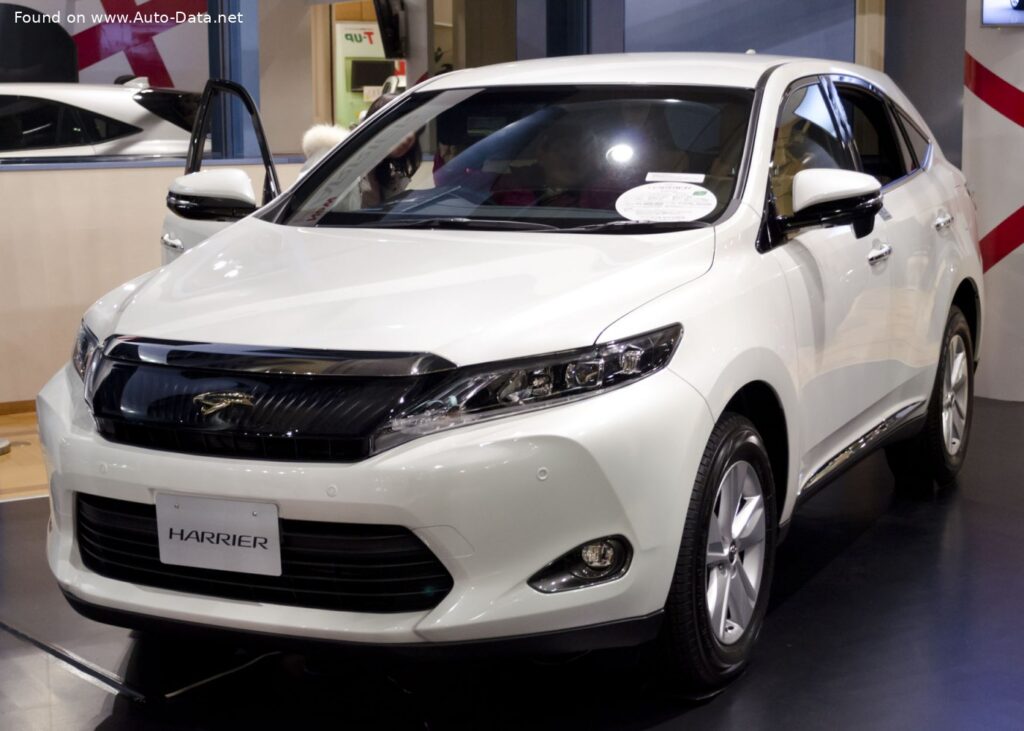
The Toyota Harrier III (XU60) sports a sophisticated and dynamic SUV body type, designed to appeal to buyers seeking a vehicle that combines practicality with a strong aesthetic presence. Its exterior design features sleek lines, a prominent front grille, and distinctive lighting elements that give it a premium and modern look. The XU60 generation moved towards a more coupe-like profile compared to its predecessors, enhancing its visual appeal and differentiating it from more traditional SUVs.
Inside, the Harrier offers a spacious and comfortable cabin, designed to accommodate five occupants across two rows of seating. The vehicle comes with five doors, ensuring easy access for all passengers and cargo. Interior appointments typically include high-quality materials and finishes, reflecting its luxury-oriented positioning within the Toyota lineup. For its production era (2013-2017), the Harrier was equipped with contemporary features such as advanced infotainment systems, automatic climate control, and various convenience options tailored for its target markets.
Underneath its stylish exterior, the Harrier III (XU60) is built on a robust platform designed for both comfort and stability. The front suspension utilizes an independent McPherson strut setup, known for its ability to provide a smooth ride and precise handling. At the rear, a double wishbone suspension system further enhances ride quality and vehicle control. Braking performance is handled by ventilated discs at the front and solid discs at the rear, complemented by an Anti-lock Braking System (ABS) for enhanced safety during emergency stops. Steering is managed by an electric power-assisted rack and pinion system, offering light and precise control, particularly beneficial in urban driving and parking maneuvers. The vehicle is equipped with tire sizes ranging from 225/65 R17 to 235/55 R18, mounted on 6.5J x 17 or 7.5J x 18 wheel rims, respectively, contributing to its stable stance and comfortable ride height of 7.48 inches (190 mm).
Technical Specifications
| General Information | |
| Brand | Toyota |
| Model | Harrier |
| Generation | Harrier III (XU60) |
| Type (Engine) | 2.0 (151 Hp) CVT-i |
| Start of Production | 2013 year |
| End of Production | 2017 year |
| Powertrain Architecture | Internal Combustion engine |
| Body type | SUV |
| Seats | 5 |
| Doors | 5 |
| Performance Specs | |
| Fuel consumption (economy) – combined | 37.6 US mpg (6.25 l/100 km) |
| Fuel Type | Petrol (Gasoline) |
| Weight-to-power ratio | 10.3 kg/Hp (96.8 Hp/tonne) |
| Weight-to-torque ratio | 8.1 kg/Nm (123.7 Nm/tonne) |
| Engine Specs | |
| Power | 151 Hp @ 6100 rpm |
| Power per liter | 76 Hp/l |
| Torque | 142.35 lb.-ft. (193 Nm) @ 3800 rpm |
| Engine layout | Front, Transverse |
| Engine Model/Code | 3ZR-FAE |
| Engine displacement | 2.0 liters (1986 cm3 / 121.19 cu. in.) |
| Number of cylinders | 4 |
| Engine configuration | Inline |
| Cylinder Bore | 3.17 in. (80.5 mm) |
| Piston Stroke | 3.84 in. (97.6 mm) |
| Number of valves per cylinder | 4 |
| Fuel injection system | Multi-port manifold injection |
| Engine aspiration | Naturally aspirated engine |
| Valvetrain | DOHC |
| Engine oil capacity | 4.44 US qt (4.2 l) |
| Coolant | 6.23 US qt (5.9 l) |
| Space, Volume and Weights | |
| Kerb Weight | 3439.21 – 3593.53 lbs. (1560-1630 kg) |
| Max. weight | 4089.57 lbs. (1855 kg) |
| Max load | 496.04 – 650.36 lbs. (225-295 kg) |
| Fuel tank capacity | 15.85 US gal (60 l) |
| Dimensions | |
| Length | 185.83 in. (4720 mm) |
| Width | 72.24 in. (1835 mm) |
| Height | 66.54 in. (1690 mm) |
| Wheelbase | 104.72 in. (2660 mm) |
| Front track | 61.42 – 61.81 in. (1560-1570 mm) |
| Rear (Back) track | 61.42 – 61.81 in. (1560-1570 mm) |
| Ride height (ground clearance) | 7.48 in. (190 mm) |
| Minimum turning circle (turning diameter) | 36.75 ft. (11.2 m) |
| Drivetrain, Brakes and Suspension Specs | |
| Drivetrain Architecture | The Internal combustion engine (ICE) drives the front wheels of the vehicle. |
| Drive wheel | Front wheel drive |
| Number of gears and type of gearbox | automatic transmission Super CVT-i |
| Front suspension | Independent type McPherson |
| Rear suspension | Double wishbone |
| Front brakes | Ventilated discs |
| Rear brakes | Disc |
| Assisting systems | ABS (Anti-lock braking system) |
| Steering type | Steering rack and pinion |
| Power steering | Electric Steering |
| Tires size | 225/65 R17; 235/55 R18 |
| Wheel rims size | 6.5J x 17; 7.5J x 18 |
Legacy & Market Impact
The Toyota Harrier III (XU60) continued the legacy of the Harrier nameplate as a sophisticated and desirable mid-size SUV in its primary markets of Japan and various Asian countries. During its production run from 2013 to 2017, it maintained a strong reputation for Toyota’s hallmark reliability, exceptional build quality, and a comfortable, refined driving experience. Its premium positioning, often seen as a near-luxury offering without the full Lexus branding, allowed it to appeal to a broad demographic looking for an upscale SUV with strong practicality.
In the competitive Japanese and Asian SUV markets, the Harrier III faced rivals from both domestic and international brands. Key competitors included models such as the Honda CR-V, Nissan X-Trail (known as the Rogue in North America), Mazda CX-5, and Subaru Forester, all of which offered compelling packages in terms of size, features, and efficiency. However, the Harrier distinguished itself with its more overtly luxurious styling, a quieter cabin, and a perceived higher level of refinement, often bridging the gap between mainstream and entry-level luxury SUVs.
The 2.0-liter (151 Hp) CVT-i variant, in particular, was significant for its focus on fuel efficiency. Achieving a combined 37.6 US mpg, it offered an economical choice for consumers, aligning with global trends towards more fuel-conscious vehicles. This efficiency, combined with its comfortable ride and spacious interior, made it a popular choice for urban families and individuals who valued practicality without compromising on style or comfort.
Historically, the Harrier’s lineage is intertwined with the Lexus RX, particularly in its first two generations where the Harrier was essentially the Japanese-market RX. The XU60 generation, however, saw the Harrier develop a more distinct identity, with unique styling cues that set it apart from the contemporary Lexus RX. This strategic divergence allowed Toyota to cater specifically to the preferences of its domestic and regional markets, reinforcing the Harrier’s status as a standalone premium model. Its success solidified its position as a cornerstone of Toyota’s SUV offerings in Asia, contributing to the brand’s overall dominance in the segment and continuing its reputation for delivering high-quality, dependable, and desirable vehicles.