The Toyota Harrier III (XU60, Facelift 2017): A Premium Crossover for the Asian Market
The Toyota Harrier III (XU60, facelift 2017) represents a significant iteration of Toyota’s mid-size luxury crossover SUV, a vehicle primarily tailored for the Japanese domestic market (JDM) and other Asian regions. While its lineage shares a historical connection with the Lexus RX, the Harrier carved out its own distinct identity as a more accessible, yet still premium, offering within Toyota’s extensive lineup. The XU60 generation, launched in 2013, received a notable facelift in 2017, bringing refreshed styling, enhanced technology, and updated powertrains, including the potent 2.0-liter turbocharged variant detailed here. Produced from 2017 to 2020, this particular model, equipped with the 2.0 T (231 Hp) ECT engine, aimed to deliver a compelling blend of performance, sophistication, and everyday usability to discerning buyers who sought SUV practicality without compromising on a refined driving experience.
Engine & Performance: The 2.0-liter Turbocharged Heart
At the core of the Toyota Harrier III (XU60, facelift 2017) 2.0 T model lies Toyota’s advanced 8AR-FTS engine. This 2.0-liter (1998 cm³ or 121.93 cu. in.) inline-four gasoline unit is a testament to modern engine design, featuring direct injection, a twin-scroll turbocharger, and an intercooler. The sophisticated valvetrain, a DOHC (Double Overhead Camshaft) setup with 4 valves per cylinder, ensures optimal airflow and combustion efficiency. This engineering prowess culminates in a robust power output of 231 horsepower, delivered between 5200 and 5600 rpm. Equally impressive is the torque figure of 258.15 lb.-ft. (350 Nm), which is available across a broad rev range from a low 1650 rpm up to 4000 rpm. This wide torque band contributes significantly to the vehicle’s responsive acceleration and effortless cruising capabilities.
The engine’s front, transverse layout efficiently packages the powertrain, contributing to a balanced weight distribution. Power is channeled to the front wheels via a smooth and reliable 6-speed Super ECT (Electronically Controlled Transmission) automatic gearbox. This transmission is engineered for seamless shifts, optimizing both performance and fuel economy. The combined fuel consumption for this setup is rated at an impressive 30.5 US mpg (7.7 l/100 km), showcasing the efficiency gains achieved through turbocharging and advanced transmission technology. With a weight-to-power ratio of 7.2 kg/Hp (139.2 Hp/tonne) and a weight-to-torque ratio of 4.7 kg/Nm (210.8 Nm/tonne), the Harrier 2.0 T offers a lively and engaging driving dynamic for its segment.
Design & Features: Sophistication Meets Utility
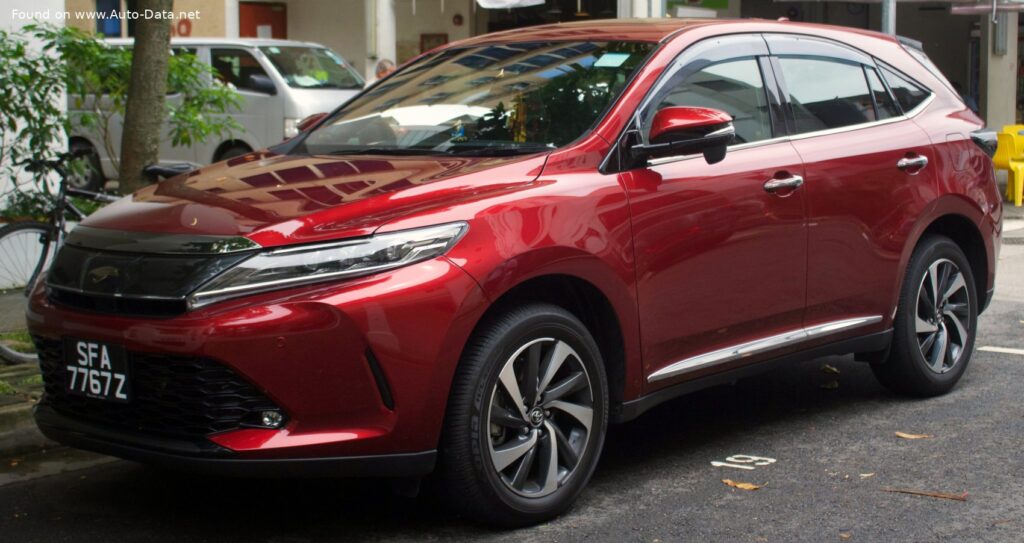
The Toyota Harrier III (XU60, facelift 2017) embodies a distinctive blend of elegance and athleticism. As a 5-door SUV, it skillfully balances a commanding road presence with a sleek, coupe-like profile, a design language that has become a hallmark of the Harrier nameplate. The facelift brought subtle but impactful changes, including updated front and rear fascias, revised lighting signatures, and new wheel designs, enhancing its contemporary appeal. The vehicle’s dimensions—186.02 inches (4725 mm) in length, 72.24 inches (1835 mm) in width, and 66.54 inches (1690 mm) in height—position it squarely in the mid-size SUV category, offering ample interior space without being overly cumbersome for urban driving.
Inside, the Harrier provides a comfortable and upscale environment for five occupants. The cabin is characterized by high-quality materials, meticulous craftsmanship, and a user-friendly layout. Features common in this segment include advanced infotainment systems, automatic climate control, and a range of convenience options designed to enhance the driving and passenger experience. Safety is paramount, and the Harrier III comes equipped with standard features such as ABS (Anti-lock Braking System), a critical component for maintaining control during emergency braking. The suspension system, featuring an independent MacPherson strut setup at the front and a double wishbone at the rear, is tuned to provide a smooth ride quality while maintaining confident handling. Braking is handled by ventilated discs at the front and solid discs at the rear, ensuring strong stopping power. The vehicle rides on either 235/55 R18 or 235/50 R19 tires, paired with stylish alloy wheels, contributing to both its aesthetic and dynamic capabilities. An electric power steering system with a rack and pinion setup provides precise and effortless steering, making maneuvers in tight spaces easier with a minimum turning circle of 36.75 feet (11.2 meters).
Technical Specifications: Toyota Harrier III (XU60, Facelift 2017) 2.0 T (231 Hp) ECT
| Category | Specification | Value |
|---|---|---|
| General Information | ||
| Brand | Toyota | |
| Model | Harrier | |
| Generation | Harrier III (XU60, facelift 2017) | |
| Type (Engine) | 2.0 T (231 Hp) ECT | |
| Start of Production | 2017 year | |
| End of Production | 2020 year | |
| Powertrain Architecture | Internal Combustion engine | |
| Body Type | SUV | |
| Seats | 5 | |
| Doors | 5 | |
| Performance Specifications | ||
| Fuel Consumption (Combined) | 7.7 l/100 km (30.5 US mpg, 36.7 UK mpg, 13 km/l) | |
| Fuel Type | Petrol (Gasoline) | |
| Weight-to-Power Ratio | 7.2 kg/Hp (139.2 Hp/tonne) | |
| Weight-to-Torque Ratio | 4.7 kg/Nm (210.8 Nm/tonne) | |
| Engine Specifications | ||
| Power | 231 Hp @ 5200-5600 rpm | |
| Power per Liter | 115.6 Hp/l | |
| Torque | 350 Nm (258.15 lb.-ft.) @ 1650-4000 rpm | |
| Engine Layout | Front, Transverse | |
| Engine Model/Code | 8AR-FTS | |
| Engine Displacement | 1998 cm³ (121.93 cu. in.) | |
| Number of Cylinders | 4 | |
| Engine Configuration | Inline | |
| Cylinder Bore | 86 mm (3.39 in.) | |
| Piston Stroke | 86 mm (3.39 in.) | |
| Number of Valves per Cylinder | 4 | |
| Fuel Injection System | Direct injection | |
| Engine Aspiration | Turbocharger, Intercooler | |
| Valvetrain | DOHC | |
| Engine Oil Capacity | 4.9 l (5.18 US qt) | |
| Engine Oil Specification | Not specified | |
| Coolant Capacity | 7.9 l (8.35 US qt) | |
| Space, Volume and Weights | ||
| Kerb Weight | 1660-1700 kg (3659.67 – 3747.86 lbs.) | |
| Max. Weight (Gross Vehicle Weight) | 1975 kg (4354.13 lbs.) | |
| Max Load | 275-315 kg (606.27 – 694.46 lbs.) | |
| Fuel Tank Capacity | 60 l (15.85 US gal) | |
| Dimensions | ||
| Length | 4725 mm (186.02 in.) | |
| Width | 1835 mm (72.24 in.) | |
| Height | 1690 mm (66.54 in.) | |
| Wheelbase | 2660 mm (104.72 in.) | |
| Front Track | 1560 mm (61.42 in.) | |
| Rear (Back) Track | 1560 mm (61.42 in.) | |
| Ride Height (Ground Clearance) | 160 mm (6.3 in.) | |
| Minimum Turning Circle | 11.2 m (36.75 ft.) | |
| Drivetrain, Brakes and Suspension Specifications | ||
| Drivetrain Architecture | Internal combustion engine (ICE) drives the front wheels | |
| Drive Wheel | Front wheel drive | |
| Number of Gears & Type of Gearbox | 6 gears, automatic transmission Super ECT | |
| Front Suspension | Independent type McPherson | |
| Rear Suspension | Double wishbone | |
| Front Brakes | Ventilated discs | |
| Rear Brakes | Disc | |
| Assisting Systems | ABS (Anti-lock braking system) | |
| Steering Type | Steering rack and pinion | |
| Power Steering | Electric Steering | |
| Tires Size | 235/55 R18 100H; 235/50 R19 99V | |
| Wheel Rims Size | 7.5J x 18 ET45; 8J x 19 ET40 | |
Legacy & Market Impact of the Toyota Harrier III (XU60)
The Toyota Harrier has consistently held a unique and respected position within its primary markets, particularly in Japan and other parts of Asia. The XU60 generation, especially after its 2017 facelift, reinforced the Harrier’s reputation as a sophisticated and reliable premium crossover. Unlike its Lexus RX counterpart, which is globally marketed as a luxury vehicle, the Harrier offered a slightly more understated yet equally refined package under the Toyota badge, appealing to buyers who valued brand familiarity and strong resale values without needing the full luxury brand caché.
In its segment, the Toyota Harrier III (XU60, facelift 2017) faced competition from a range of domestic and international rivals. In Japan, it contended with other popular mid-size SUVs such as the Nissan Murano (though the Murano’s presence waned later in the Harrier’s lifecycle), Honda CR-V, and Mazda CX-5, as well as premium offerings like the Subaru Forester and the aforementioned Lexus RX. Its distinct styling, comfortable ride, and the reliability inherent to the Toyota brand allowed it to maintain a strong market share. The introduction of the 2.0-liter turbocharged engine in the facelifted model was a strategic move, offering a more powerful and engaging driving experience compared to the naturally aspirated options, catering to consumers seeking higher performance without sacrificing fuel efficiency.
Historically, the Harrier nameplate has been pivotal in establishing the premium crossover segment in Asia. Its influence can be seen in the subsequent development of other sophisticated SUVs from various manufacturers. The XU60 generation, with its refined aesthetics and advanced technology, further solidified this legacy. While not officially sold in the United States or many European markets under the Harrier name, its design language and engineering principles often foreshadowed trends seen in global Toyota and Lexus products. The Harrier remains a symbol of aspirational yet practical motoring in its home region, bridging the gap between mainstream and luxury, and the 2017 facelift with its potent 2.0 T engine represented a high point in its evolution.