Toyota Highlander I 2.4 16V (157 Hp): A Pioneer in the American Crossover Segment
The Toyota Highlander I, introduced in 2000, marked a significant pivot in the automotive landscape, particularly within the burgeoning SUV market. As an international automotive expert, I can attest that this first-generation Highlander, specifically the Toyota Highlander I 2.4 16V (157 Hp) variant, was a groundbreaking vehicle designed primarily for the North American market. It offered a compelling alternative to traditional, truck-based sport utility vehicles by leveraging a car-like unibody construction, shared with the popular Camry sedan and RX 300 luxury crossover. This approach emphasized passenger comfort, on-road handling, and fuel efficiency over rugged off-road capability or heavy towing, defining what would become known as the “crossover SUV” segment.
Positioned above the compact RAV4 but below the more rugged 4Runner and Land Cruiser, the Highlander I provided a mid-size option that perfectly met the demands of suburban families seeking practicality, versatility, and Toyota’s renowned reliability. Its production spanned from 2000 to 2007, during which it solidified its reputation as a sensible and dependable family hauler. The 2.4 16V (157 Hp) model, featuring a four-cylinder engine, represented the entry point into the Highlander lineup, offering a balanced blend of performance and economy for everyday driving.
Engine and Performance: The Heart of the Toyota Highlander I 2.4 16V (157 Hp)
Powertrain Overview
The powertrain architecture of the Toyota Highlander I 2.4 16V (157 Hp) was centered around an internal combustion engine driving the front wheels, with an all-wheel-drive option also available for the Highlander I generation, though not specified for this particular FWD variant. The 2.4-liter (2362 cm3 or 144.14 cu. in.) 2AZ-FE inline-four engine was a workhorse for Toyota, widely used across several models of the era. This naturally aspirated unit featured a Double Overhead Camshaft (DOHC) valvetrain with 16 valves (four per cylinder), ensuring efficient air intake and exhaust. With a compression ratio of 9.6:1 and multi-port manifold fuel injection, the engine was designed for smooth operation and respectable fuel economy.
This specific variant delivered a peak power output of 157 horsepower at 5600 rpm, translating to a power per liter figure of 66.5 Hp/l. Torque was rated at 221 Nm, or 163 lb.-ft., available at a practical 4000 rpm. This power delivery, while not exhilarating, was more than adequate for daily commuting, highway cruising, and light family duties. The engine was paired with a 4-speed automatic transmission, a common setup for SUVs of its time, prioritizing smooth shifts and durability over outright performance or numerous gear ratios.
Driving Dynamics
In terms of raw performance, the Toyota Highlander I 2.4 16V (157 Hp) achieved a 0-60 mph acceleration in a respectable 10.3 seconds, with a top speed electronically limited to approximately 105.63 mph (170 km/h). These figures underscored its role as a practical family vehicle rather than a performance-oriented SUV. Fuel economy was a strong suit for its class, with urban consumption rated at 22 US mpg and extra-urban cruising reaching an impressive 30.2 US mpg. This efficiency, combined with a generous 19.81 US gallon (75-liter) fuel tank, provided a substantial driving range, appealing to budget-conscious buyers and those embarking on longer journeys. The vehicle’s curb weight of 3483.3 lbs (1580 kg) contributed to a weight-to-power ratio of 10.1 kg/Hp, indicating a balanced approach to its overall engineering.
Design and Features: Practicality Meets Suburban Elegance
Exterior and Interior Design
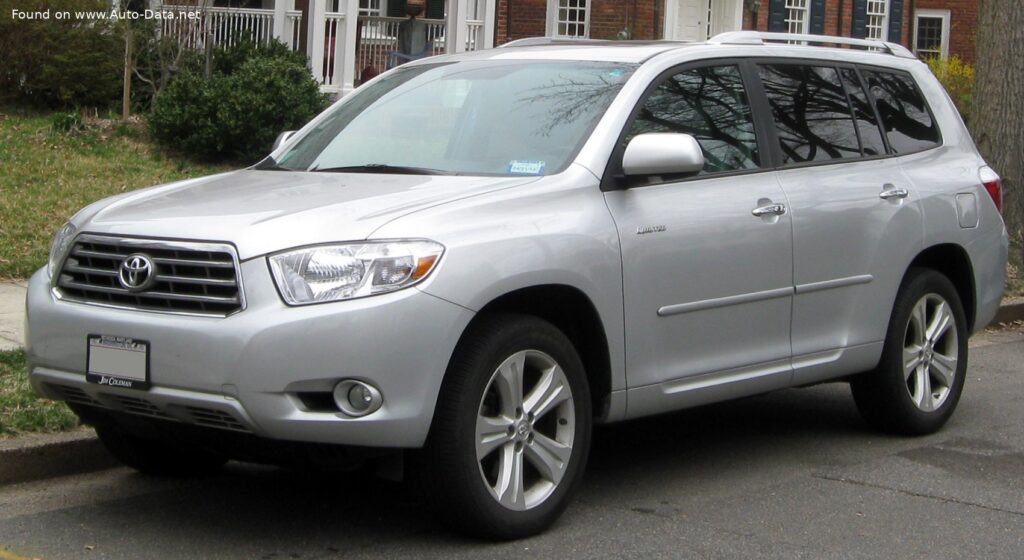
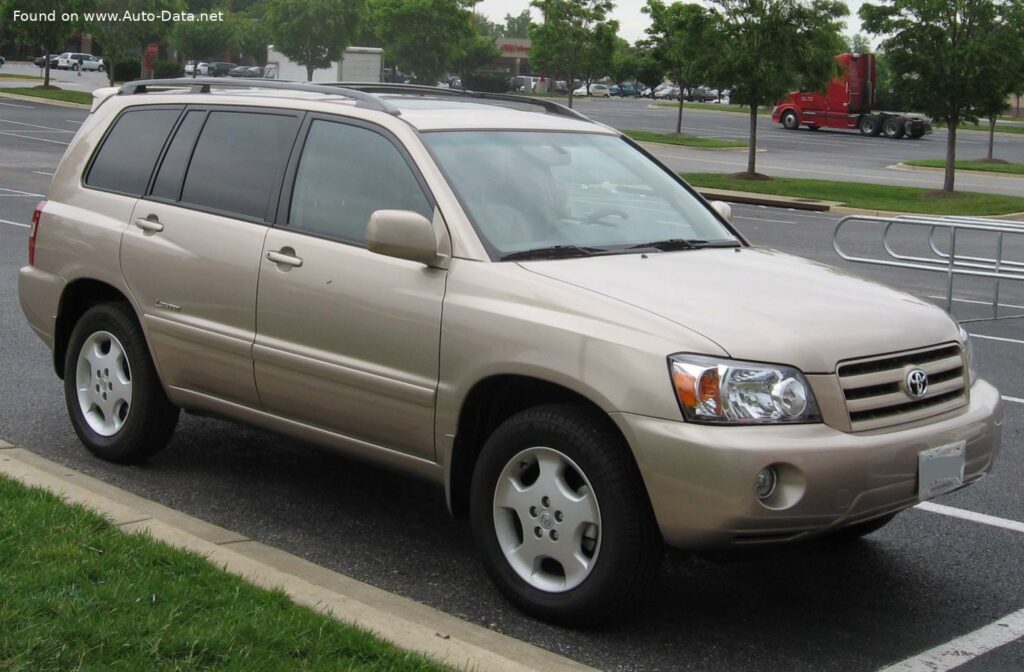
The first-generation Highlander boasted a clean, unpretentious design that projected an image of capability and refinement without being overly aggressive. Its SUV body type featured five doors and seating for five passengers, though later models offered an optional third row. With a length of 184.45 inches (4685 mm), a width of 71.85 inches (1825 mm), and a height of 68.31 inches (1735 mm), it struck a comfortable balance between maneuverability in urban environments and interior spaciousness. The wheelbase of 106.89 inches (2715 mm) contributed to a stable ride. The exterior was characterized by smooth lines, a modest grille, and practical roof rails, typical of early 2000s SUV styling.
Inside, the Highlander prioritized ergonomics and functionality. The cabin was well-appointed with durable materials, and controls were intuitively placed. Visibility was excellent, a hallmark of Toyota’s design philosophy. The focus was on creating a comfortable and user-friendly environment for families.
Comfort and Utility
One of the Highlander’s most significant advantages was its interior versatility. The rear seats offered ample legroom and could be folded down to expand cargo capacity dramatically. Minimum trunk space started at 38.49 cu. ft. (1090 liters), which was generous for groceries or daily errands. When the rear seats were folded, the cargo volume swelled to an impressive 113.18 cu. ft. (3205 liters), allowing for the transport of larger items, making it a highly practical choice for active families or those needing utility. The suspension system, featuring Spring Struts at the front and Coil Springs at the rear, provided a comfortable and compliant ride, absorbing road imperfections effectively. Hydraulic power steering, combined with a rack and pinion setup, offered predictable and easy maneuverability, further enhancing its car-like driving experience.
Safety and Technology
In terms of safety, the Toyota Highlander I 2.4 16V (157 Hp) came equipped with essential features for its era. Anti-lock Braking System (ABS) was standard, providing improved control during emergency braking. The braking system itself comprised ventilated discs at the front and solid discs at the rear, ensuring reliable stopping power. Standard safety equipment for the early 2000s also typically included front airbags, and potentially side airbags depending on trim and year. The 225/70 R16 tires provided a good balance of grip and ride comfort. While lacking the advanced driver-assistance systems found in modern vehicles, the Highlander offered a solid foundation of passive and active safety features designed to protect its occupants.
Technical Specifications
| Category | Specification |
|---|---|
| General Information | |
| Brand | Toyota |
| Model | Highlander |
| Generation | Highlander I |
| Type (Engine) | 2.4 16V (157 Hp) |
| Start of Production | 2000 year |
| End of Production | 2007 year |
| Powertrain Architecture | Internal Combustion engine |
| Body Type | SUV |
| Seats | 5 |
| Doors | 5 |
| Performance Specs | |
| Fuel Consumption (Urban) | 22 US mpg (10.7 l/100 km) |
| Fuel Consumption (Extra Urban) | 30.2 US mpg (7.8 l/100 km) |
| Fuel Type | Petrol (Gasoline) |
| Acceleration 0 – 60 mph | 10.3 sec |
| Maximum Speed | 105.63 mph (170 km/h) |
| Weight-to-Power Ratio | 10.1 kg/Hp |
| Weight-to-Torque Ratio | 7.1 kg/Nm |
| Engine Specs | |
| Power | 157 Hp @ 5600 rpm |
| Power per Litre | 66.5 Hp/l |
| Torque | 163 lb.-ft. @ 4000 rpm (221 Nm) |
| Engine Layout | Front, Transverse |
| Engine Model/Code | 2AZ-FE |
| Engine Displacement | 2362 cm3 (144.14 cu. in.) |
| Number of Cylinders | 4 |
| Engine Configuration | Inline |
| Cylinder Bore | 3.48 in. (88.5 mm) |
| Piston Stroke | 3.78 in. (96 mm) |
| Compression Ratio | 9.6:1 |
| Number of Valves per Cylinder | 4 |
| Fuel Injection System | Multi-port manifold injection |
| Engine Aspiration | Naturally aspirated engine |
| Valvetrain | DOHC |
| Engine Oil Capacity | 4.02 US qt (3.8 l) |
| Coolant Capacity | 6.76 US qt (6.4 l) |
| Space, Volume and Weights | |
| Kerb Weight | 3483.3 lbs (1580 kg) |
| Trunk Space (minimum) | 38.49 cu. ft. (1090 l) |
| Trunk Space (maximum) | 113.18 cu. ft. (3205 l) |
| Fuel Tank Capacity | 19.81 US gal (75 l) |
| Dimensions | |
| Length | 184.45 in. (4685 mm) |
| Width | 71.85 in. (1825 mm) |
| Height | 68.31 in. (1735 mm) |
| Wheelbase | 106.89 in. (2715 mm) |
| Front Track | 62.2 in. (1580 mm) |
| Rear Track | 61.61 in. (1565 mm) |
| Drivetrain, Brakes and Suspension Specs | |
| Drivetrain Architecture | The Internal combustion engine (ICE) drives the front wheels of the vehicle. |
| Drive Wheel | Front wheel drive |
| Number of Gears and Type of Gearbox | 4 gears, automatic transmission |
| Front Suspension | Spring Strut |
| Rear Suspension | Coil spring |
| Front Brakes | Ventilated discs |
| Rear Brakes | Disc |
| Assisting Systems | ABS (Anti-lock braking system) |
| Steering Type | Steering rack and pinion |
| Power Steering | Hydraulic Steering |
| Tires Size | 225/70 R16 |
Legacy and Market Impact
The Toyota Highlander I 2.4 16V (157 Hp), and the first-generation Highlander as a whole, carved out a crucial niche in the North American automotive market. It arrived at a time when consumers were increasingly seeking the commanding driving position and spaciousness of an SUV, but without the truck-like ride quality, poor fuel economy, and challenging maneuverability often associated with traditional body-on-frame SUVs. By offering a car-based platform, the Highlander delivered a smoother, quieter, and more refined driving experience that resonated deeply with urban and suburban families.
Competitors and Market Positioning
In its competitive landscape, the Highlander I stood out. While smaller crossovers like the Honda CR-V and Ford Escape were gaining traction, and larger, more rugged SUVs such as the Ford Explorer and Toyota 4Runner dominated their respective segments, the Highlander positioned itself as a mid-size, comfort-oriented alternative. It was essentially a pioneer in what would become the immensely popular mid-size crossover segment. Later competitors, like the Nissan Murano (introduced in 2002), would follow its lead, but the Highlander had already established a strong foothold. Its success demonstrated that a significant portion of the SUV market valued practicality, comfort, and efficiency above extreme off-road prowess.
Enduring Reputation
The first-generation Highlander, particularly models equipped with the dependable 2.4-liter engine, quickly earned a reputation for Toyota’s hallmark reliability and low ownership costs. These vehicles were known for their longevity, often reaching well over 200,000 miles with proper maintenance. This durability, combined with its practical design and respectable fuel economy, ensured strong resale values and a loyal customer base. The Toyota Highlander I 2.4 16V (157 Hp) played a pivotal role in popularizing the crossover concept, demonstrating that a family-friendly SUV could drive much like a sedan. Its legacy is evident in the current automotive market, which is now dominated by a vast array of crossovers, many of which owe their existence to the path paved by early innovators like the Toyota Highlander. It remains a testament to Toyota’s foresight in identifying and successfully catering to evolving consumer preferences.