The Toyota Highlander II 3.5 V6 (280 Hp) Hybrid 4WD-i e-CVT: A Pioneer in Family-Sized Efficiency
The Toyota Highlander, a stalwart in the mid-size SUV segment, received its second-generation update for the 2008 model year, bringing with it a significant evolution in design, capability, and powertrain options. Among these, the Toyota Highlander II 3.5 V6 (280 Hp) Hybrid 4WD-i e-CVT, produced from 2011 to 2013, stood out as a particularly compelling offering. This specific variant represented the pinnacle of Toyota’s hybrid technology applied to a family-oriented, three-row SUV, combining the practicality and versatility expected of the Highlander nameplate with an impressive blend of power and fuel efficiency. Positioned as a smart choice for consumers seeking reduced environmental impact without compromising on space or performance, the Highlander Hybrid solidified Toyota’s leadership in the burgeoning hybrid market.
The second-generation Highlander was larger and more refined than its predecessor, aiming to appeal to a broader audience seeking a comfortable and capable family vehicle. The hybrid model, in particular, leveraged Toyota’s proven Hybrid Synergy Drive system, adapting it for a larger, all-wheel-drive platform. This iteration of the Highlander Hybrid was not just an eco-friendly option; it was a technologically advanced SUV that offered a smooth driving experience, ample power for daily duties, and the peace of mind associated with Toyota’s reputation for reliability. Its tenure from 2011 to 2013 represented a mature phase of the second-generation, incorporating subtle refinements before the introduction of the third generation.
Engine & Performance: The Hybrid Synergy Drive in the Toyota Highlander II 3.5 V6 (280 Hp) Hybrid 4WD-i e-CVT
At the heart of the Toyota Highlander II 3.5 V6 (280 Hp) Hybrid 4WD-i e-CVT lies a sophisticated Full Hybrid Electric Vehicle (FHEV) powertrain architecture, meticulously engineered to deliver both robust performance and remarkable fuel economy for its class. The internal combustion engine (ICE) component is a naturally aspirated 3.5-liter V6, designated by the code 2GR-FXE. This V-engine configuration, featuring DOHC (Dual Overhead Camshafts) and VVT-i (Variable Valve Timing with intelligence), produces a commendable 245 horsepower at 6000 rpm and 248.56 lb.-ft. of torque at 4700 rpm. Its multi-port manifold injection system ensures efficient fuel delivery, contributing to its overall refinement.
Complementing the powerful V6 are two synchronous electric motors, integral to Toyota’s renowned Hybrid Synergy Drive system. The primary electric motor (Electric Motor 1), integrated into the transaxle, contributes a substantial 167 horsepower at 4500 rpm and an impressive 247.08 lb.-ft. of torque available from 0-1500 rpm. A second electric motor (Electric Motor 2), rated at 68 horsepower and 102.52 lb.-ft. of torque, is transversely mounted on the rear axle. This innovative setup allows for an electronic on-demand all-wheel-drive system (4WD-i), where the rear wheels are driven solely by the electric motor, eliminating the need for a traditional mechanical driveshaft and improving packaging and efficiency.
The combined efforts of the V6 engine and both electric motors result in a robust total system output of 280 horsepower. Power is seamlessly managed and delivered to the wheels via an electronic continuously variable transmission (e-CVT), which optimizes power delivery for efficiency and smooth acceleration. This sophisticated powertrain enables the Highlander Hybrid to accelerate from 0 to 60 mph in a brisk 7.8 seconds, an impressive figure for a vehicle of its size and weight. The top speed is electronically limited to 111.85 mph (180 km/h).
Fuel efficiency was a key selling point, with the Highlander Hybrid achieving an estimated 25 US mpg in urban driving, 27 US mpg on the highway, and a combined rating of 26.1 US mpg. These figures were highly competitive for a three-row SUV of its era. The vehicle also boasted a Super Ultra Low Emission Vehicle (SULEV) rating, underscoring Toyota’s commitment to environmental responsibility. The hybrid system is powered by a durable 288-volt Nickel-metal hydride (NiMH) battery, strategically located below the floor, under the rear seats, to preserve cargo and passenger space.
Design & Features: Practicality Meets Modernity
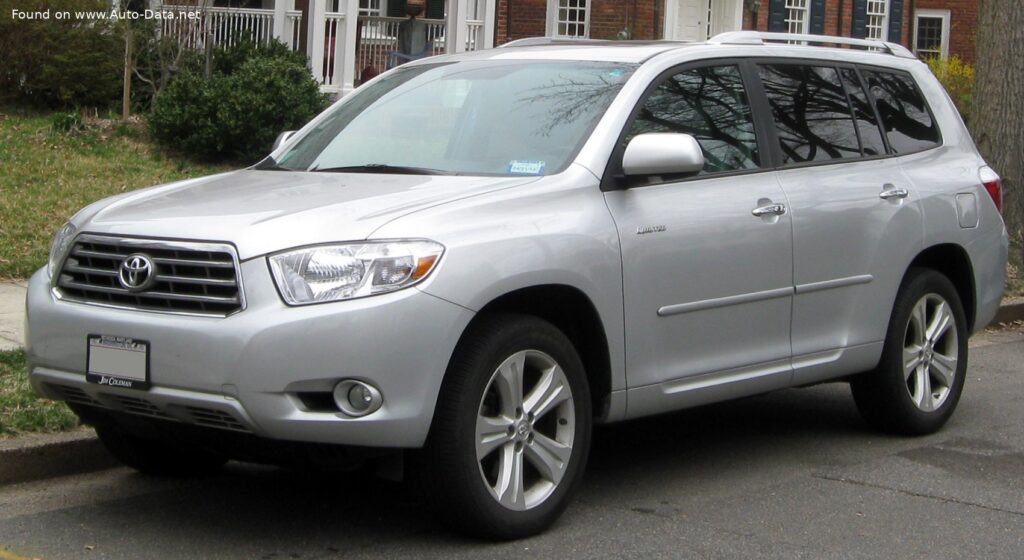
The second-generation Toyota Highlander, including its hybrid variant, presented a design that was both contemporary and functional, perfectly suiting its role as a versatile family SUV. With a length of 188.39 inches (4785 mm), a width of 75.2 inches (1910 mm), and a height of 69.29 inches (1760 mm), it offered a substantial road presence without being overly cumbersome. The 109.84-inch (2790 mm) wheelbase contributed to a stable ride and generous interior volume.
As a 5-door SUV with seating for up to seven occupants, the Highlander Hybrid prioritized interior space and flexibility. The cabin was designed with family needs in mind, offering comfortable seating across three rows. Cargo versatility was a notable strength, with a minimum trunk space of 10.31 cubic feet (292 liters) behind the third row, expanding significantly to a cavernous 80.59 cubic feet (2282 liters) with the second and third rows folded down. This adaptability made it ideal for everything from grocery runs to hauling sports equipment or luggage for a long trip.
Key features for the 2011-2013 model years included a focus on safety and convenience. Standard equipment typically comprised an Anti-lock Braking System (ABS) with ventilated discs at the front (327.66 mm) and disc brakes at the rear (309.88 mm). The independent suspension system, featuring McPherson struts with coil springs and an anti-roll bar at the front, and independent coil springs at the rear, provided a comfortable and composed ride. Electric power steering (rack and pinion) offered light and responsive handling, especially at lower speeds. The Highlander Hybrid rode on 245/55 R19 tires mounted on 7.5J x 19-inch wheel rims, contributing to both its aesthetic and handling characteristics. With a ground clearance of 8.11 inches (206 mm) and a drag coefficient (Cd) of 0.34, it balanced practicality with aerodynamic efficiency.
Technical Specifications: Toyota Highlander II 3.5 V6 (280 Hp) Hybrid 4WD-i e-CVT
| Category | Specification |
|---|---|
| Brand | Toyota |
| Model | Highlander |
| Generation | Highlander II |
| Type (Engine) | 3.5 V6 (280 Hp) Hybrid 4WD-i e-CVT |
| Start of production | 2011 year |
| End of production | 2013 year |
| Powertrain Architecture | FHEV (Full Hybrid Electric Vehicle) |
| Body type | SUV |
| Seats | 7 |
| Doors | 5 |
| Performance Specs | |
| Fuel consumption (economy) – urban | 25 US mpg (9.4 l/100 km) |
| Fuel consumption (economy) – extra urban | 27 US mpg (8.7 l/100 km) |
| Fuel consumption (economy) – combined | 26.1 US mpg (9 l/100 km) |
| Fuel Type | Petrol (Gasoline) |
| Acceleration 0 – 60 mph | 7.8 sec |
| Maximum speed | 111.85 mph (180 km/h) |
| Emission standard | SULEV |
| Kerb Weight | 4508.45 lbs. (2045 kg) |
| Weight-to-power ratio | 7.3 kg/Hp (136.9 Hp/tonne) |
| Electric Cars and Hybrids Specs | |
| Battery voltage | 288 V |
| Battery technology | Nickel-metal hydride (NiMH) |
| Battery location | Below the floor, under the rear seats |
| Electric motor 1 power | 167 Hp @ 4500 rpm. |
| Electric motor 1 Torque | 247.08 lb.-ft. @ 0-1500 rpm. (335 Nm) |
| Electric motor 1 location | Integrated into the transmission |
| Electric motor 1 type | Synchronous |
| Electric motor 2 power | 68 Hp |
| Electric motor 2 Torque | 102.52 lb.-ft. (139 Nm) |
| Electric motor 2 location | Rear axle, Transverse |
| Electric motor 2 type | Synchronous |
| System power | 280 Hp |
| Internal Combustion Engine Specs | |
| Power | 245 Hp @ 6000 rpm. |
| Power per liter | 70.9 Hp/l |
| Torque | 248.56 lb.-ft. @ 4700 rpm. (337 Nm) |
| Engine layout | Front, Transverse |
| Engine Model/Code | 2GR-FXE |
| Engine displacement | 210.9 cu. in. (3456 cm3) |
| Number of cylinders | 6 |
| Engine configuration | V-engine |
| Cylinder Bore | 3.7 in. (94 mm) |
| Piston Stroke | 3.27 in. (83 mm) |
| Compression ratio | 10.8:1 |
| Number of valves per cylinder | 4 |
| Fuel injection system | Multi-port manifold injection |
| Engine aspiration | Naturally aspirated engine |
| Valvetrain | DOHC, VVT-i |
| Engine oil capacity | 6.45 US qt (6.1 l) |
| Coolant | 14.27 US qt (13.5 l) |
| Space, Volume and Weights | |
| Max. weight | 5996.57 lbs. (2720 kg) |
| Max load | 1488.12 lbs. (675 kg) |
| Trunk (boot) space – minimum | 10.31 cu. ft. (292 l) |
| Trunk (boot) space – maximum | 80.59 cu. ft. (2282 l) |
| Fuel tank capacity | 17.17 US gal (65 l) |
| Dimensions | |
| Length | 188.39 in. (4785 mm) |
| Width | 75.2 in. (1910 mm) |
| Height | 69.29 in. (1760 mm) |
| Wheelbase | 109.84 in. (2790 mm) |
| Front track | 63.98 in. (1625 mm) |
| Rear (Back) track | 63.98 in. (1625 mm) |
| Ride height (ground clearance) | 8.11 in. (206 mm) |
| Drag coefficient (Cd) | 0.34 |
| Minimum turning circle (turning diameter) | 38.71 ft. (11.8 m) |
| Drivetrain, Brakes and Suspension Specs | |
| Drivetrain Architecture | An Internal combustion engine (ICE) drives the front wheels, one electric motor drives the front wheels, one electric motor drives the rear wheels. There is an ability for running in full electric or mixed mode. |
| Drive wheel | All wheel drive (4×4) |
| Number of gears and type of gearbox | automatic transmission e-CVT |
| Front suspension | Independent, type McPherson with coil spring and anti-roll bar |
| Rear suspension | Independent coil spring |
| Front brakes | Ventilated discs, 12.9 in. (327.66 mm) |
| Rear brakes | Disc, 12.2 in. (309.88 mm) |
| Assisting systems | ABS (Anti-lock braking system) |
| Steering type | Steering rack and pinion |
| Power steering | Electric Steering |
| Tires size | 245/55 R19 |
| Wheel rims size | 7.5J x 19 |
Legacy & Market Impact
The Toyota Highlander Hybrid, particularly the second-generation model from 2011 to 2013, carved out a significant niche in the North American automotive market. It reinforced Toyota’s reputation as a leader in hybrid technology and demonstrated that fuel efficiency could be successfully integrated into a large, family-friendly SUV without sacrificing performance or utility. At a time when gasoline prices were often volatile and environmental consciousness was growing, the Highlander Hybrid offered a compelling alternative to traditional V6-powered SUVs.
Its primary competitors in the mid-size SUV segment included popular models such as the Ford Explorer, Honda Pilot, Chevrolet Traverse, and Nissan Pathfinder. While many of these rivals offered V6 engines and optional all-wheel drive, none could match the Highlander Hybrid’s impressive fuel economy figures. This unique selling proposition allowed it to attract buyers who desired the practicality of a three-row SUV but were also looking for a more eco-conscious and economical daily driver. The Highlander Hybrid’s SULEV (Super Ultra Low Emission Vehicle) rating was also a testament to its advanced powertrain and helped cement its image as an environmentally responsible choice.
The success of the Toyota Highlander II 3.5 V6 (280 Hp) Hybrid 4WD-i e-CVT contributed significantly to the broader acceptance of hybrid technology in larger vehicles. Before its introduction, hybrids were largely associated with smaller, more niche vehicles like the Prius. The Highlander Hybrid proved that the technology could be scaled up effectively for mainstream SUVs, paving the way for a wider array of hybrid and electrified SUVs from Toyota and other manufacturers in subsequent years. Its robust system power, combined with the seamless operation of the e-CVT and the electronic all-wheel-drive, offered a refined driving experience that was both powerful and surprisingly frugal.
Ultimately, the second-generation Highlander Hybrid played a crucial role in Toyota’s long-term electrification strategy. It served as a bridge, demonstrating the viability and benefits of hybrid powertrains in larger vehicle segments. Its legacy is one of innovation, reliability, and a commitment to efficiency, making it a noteworthy chapter in the evolution of modern SUVs and hybrid vehicles alike. Even today, these models remain desirable on the used car market, a testament to their enduring quality and the appeal of their well-balanced blend of attributes.