Introduction to the Toyota Highlander IV 3.5 V6 (295 Hp) AWD Direct Shift
The Toyota Highlander, a stalwart in the competitive mid-size SUV segment, entered its fourth generation (Highlander IV) for the 2020 model year, further solidifying its reputation as a reliable and versatile family vehicle. Among its powertrain offerings, the Toyota Highlander IV 3.5 V6 (295 Hp) AWD Direct Shift variant stands out for its blend of robust performance, all-weather capability, and sophisticated engineering. Designed primarily for the North American market, where it enjoys significant popularity, this generation of the Highlander continued Toyota’s commitment to safety, efficiency, and comfort, evolving the platform with a sharper design and an array of advanced technologies.
This iteration of the Highlander, produced from 2020 to 2022 in this specific V6 configuration, represented a significant step forward in terms of styling, interior refinement, and dynamic capability. It maintained its core identity as a spacious, three-row SUV, appealing to families seeking a practical yet comfortable daily driver capable of handling a variety of tasks, from school runs to long-distance road trips. The 3.5-liter V6 engine, paired with an advanced Direct Shift automatic transmission and an intelligent All-Wheel Drive system, provided a compelling package for consumers prioritizing power and traction.
The Fourth Generation Toyota Highlander IV 3.5 V6 (295 Hp) AWD Direct Shift: A Comprehensive Overview
Engine & Performance
At the heart of the Toyota Highlander IV 3.5 V6 (295 Hp) AWD Direct Shift lies the formidable 2GR-FKS engine, a 3.5-liter naturally aspirated V6. This powerplant is renowned for its smooth operation and impressive output, generating a robust 295 horsepower at 6600 rpm. Torque figures are equally compelling, with 357 Newton-meters (263.31 lb.-ft.) available at 4700 rpm, ensuring confident acceleration and ample power for merging onto highways or tackling inclines. The engine’s architecture features a V-engine configuration with six cylinders, a bore of 94 mm (3.7 in.) and a stroke of 83 mm (3.27 in.), contributing to its balanced performance characteristics. With a compression ratio of 11.8:1, the engine demonstrates modern efficiency, further aided by its sophisticated fuel injection system, which combines both direct injection and multi-port manifold injection for optimal fuel delivery across the rev range. The valvetrain utilizes a Dual OverHead Camshaft (DOHC) setup with Dual Variable Valve Timing with intelligence (Dual VVT-i), precisely controlling valve operation for improved power, efficiency, and emissions. The engine is also equipped with a Start & Stop System, a key feature for enhancing fuel economy in urban driving conditions.
Power is channeled through an advanced 8-speed Direct Shift automatic transmission. This gearbox is engineered for smooth, precise shifts, optimizing the engine’s power delivery while contributing to overall fuel efficiency. The Highlander IV 3.5 V6 comes standard with an All-Wheel Drive (AWD) system. This sophisticated drivetrain architecture primarily operates as a front-wheel-drive vehicle, enhancing fuel economy in normal driving conditions. However, when traction demands it, the rear wheels are seamlessly engaged through an electrically or mechanically operated clutch, providing enhanced grip and stability on slippery surfaces or during spirited driving. This system ensures confidence in varying road conditions, from wet pavement to light off-road trails.
Despite its substantial power and AWD capability, the Highlander IV 3.5 V6 demonstrates respectable fuel economy for its class, particularly for a naturally aspirated V6. EPA estimates for the combined cycle stand at 10.2 l/100 km (23.1 US mpg). Urban driving yields approximately 11.8 l/100 km (19.9 US mpg), while extra-urban (highway) cruising improves to 8.7 l/100 km (27 US mpg). These figures underscore Toyota’s engineering prowess in balancing performance with efficiency. The vehicle also meets the stringent ULEV 70 (Ultra-Low Emission Vehicle) emission standard, reflecting its commitment to environmental responsibility.
Design & Features
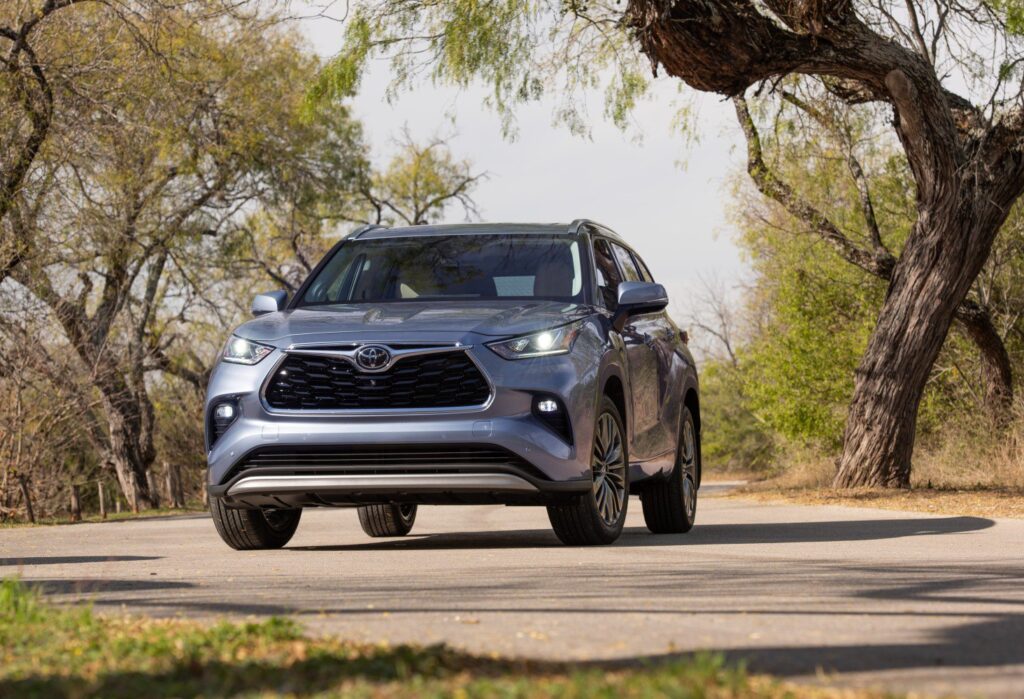
The fourth-generation Toyota Highlander features a more sculpted and aggressive design compared to its predecessors, built on the Toyota New Global Architecture (TNGA-K) platform, which enhances its rigidity and driving dynamics. As a typical mid-size SUV, it offers a practical 5-door body type and seating for 7 to 8 passengers, making it an ideal choice for larger families. Its dimensions are substantial, with a length of 4950 mm (194.88 in.), a width of 1930 mm (75.98 in.), and a height of 1730 mm (68.11 in.). The generous wheelbase of 2850 mm (112.2 in.) contributes significantly to interior space and ride comfort.
Inside, the Highlander prioritizes comfort and versatility. Minimum trunk space starts at a respectable 453 liters (16 cu. ft.) with all three rows in use, expanding to a cavernous 2387 liters (84.3 cu. ft.) when the second and third rows are folded down, accommodating a wide array of cargo needs. The vehicle’s kerb weight ranges from 1964 kg to 2018 kg (4329.88 – 4448.93 lbs.), indicating a robust construction, while its maximum permissible weight is 2692 kg (5934.84 lbs.). The Highlander also boasts a substantial towing capacity, with a permitted trailer load with brakes of 2200 kg (4850.17 lbs.), making it suitable for hauling trailers or recreational vehicles.
The driving dynamics are supported by an independent McPherson strut front suspension with a coil spring and anti-roll bar, paired with an independent multi-link spring suspension with a stabilizer at the rear. This setup provides a comfortable ride while maintaining composed handling. Stopping power is handled by ventilated disc brakes measuring 338 mm at the front and solid disc brakes of the same diameter at the rear, complemented by an Anti-lock Braking System (ABS) for enhanced safety. The electric power steering system, a rack and pinion type, offers light and responsive steering for easy maneuverability, especially in urban environments. Standard tire sizes include 235/65 R18, with an option for 235/55 R20, mounted on 8J x 18 or 8J x 20 wheel rims, respectively, contributing to both aesthetics and handling. A ground clearance of 203 mm (7.99 in.) and respectable approach (17.9°) and departure (23°) angles provide capability for light off-road excursions.
Technical Specifications: Toyota Highlander IV 3.5 V6 (295 Hp) AWD Direct Shift
| Category | Specification | US Equivalent |
|---|---|---|
| Brand | Toyota | |
| Model | Highlander | |
| Generation | Highlander IV | |
| Type (Engine) | 3.5 V6 (295 Hp) AWD Direct Shift | |
| Start of production | 2020 year | |
| End of production | 2022 year | |
| Powertrain Architecture | Internal Combustion engine | |
| Body type | SUV | |
| Seats | 7-8 | |
| Doors | 5 | |
| Performance Specs | ||
| Fuel consumption (economy) – urban (EPA) | 11.8 l/100 km | 19.9 US mpg |
| Fuel consumption (economy) – extra urban (EPA) | 8.7 l/100 km | 27 US mpg |
| Fuel consumption (economy) – combined (EPA) | 10.2 l/100 km | 23.1 US mpg |
| Fuel Type | Petrol (Gasoline) | |
| Emission standard | ULEV 70 | |
| Weight-to-power ratio | 6.7 kg/Hp | 150.2 Hp/tonne |
| Weight-to-torque ratio | 5.5 kg/Nm | 181.8 Nm/tonne |
| Engine Specs | ||
| Power | 295 Hp @ 6600 rpm | |
| Power per liter | 85.4 Hp/l | |
| Torque | 357 Nm @ 4700 rpm | 263.31 lb.-ft. @ 4700 rpm |
| Engine layout | Front, Transverse | |
| Engine Model/Code | 2GR-FKS | |
| Engine displacement | 3456 cm3 | 210.9 cu. in. |
| Number of cylinders | 6 | |
| Engine configuration | V-engine | |
| Cylinder Bore | 94 mm | 3.7 in. |
| Piston Stroke | 83 mm | 3.27 in. |
| Compression ratio | 11.8:1 | |
| Number of valves per cylinder | 4 | |
| Fuel injection system | Direct injection and Multi-port manifold injection | |
| Engine aspiration | Naturally aspirated engine | |
| Valvetrain | DOHC, Dual VVT-i | |
| Engine oil capacity | 5.5 l | 5.81 US qt |
| Coolant | 12.2 l | 12.89 US qt |
| Engine systems | Start & Stop System | |
| Space, Volume and Weights | ||
| Kerb Weight | 1964-2018 kg | 4329.88 – 4448.93 lbs. |
| Max. weight | 2692 kg | 5934.84 lbs. |
| Max load | 674-728 kg | |