
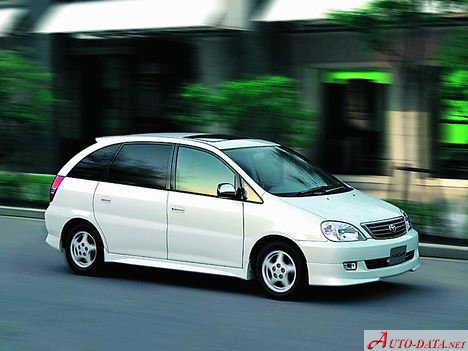
The Toyota Nadia (SXN10): A JDM Minivan Pioneer
The Toyota Nadia (SXN10) represents a significant chapter in Toyota’s diverse portfolio, specifically tailored for the Japanese domestic market (JDM). Launched in 1998 and produced until 2003, the Nadia was conceived as a compact minivan that blended the practicality of a people mover with the more car-like driving dynamics of a sedan. Positioned within Toyota’s extensive lineup, the Nadia aimed to offer a versatile and comfortable solution for urban families and individuals seeking ample interior space without the bulk of larger traditional minivans. Its design ethos reflected the growing demand in Japan for vehicles that could navigate congested city streets with ease while still accommodating passengers and cargo efficiently.
The Nadia (SXN10) was part of a broader trend in the late 1990s and early 2000s where automakers experimented with various multi-purpose vehicle (MPV) formats. While never officially sold in the United States, its existence highlights a fascinating divergence in automotive preferences and market needs between regions. In its home market, the Nadia carved out a niche by offering a compelling package of Toyota’s renowned reliability, thoughtful interior packaging, and a practical, yet understated, design.
Engineering and Performance: The Toyota Nadia (SXN10) Powertrain
Engine and Drivetrain Configuration
At the heart of the Toyota Nadia (SXN10) 2.0 i 16V variant was a robust and dependable 2.0-liter inline-four engine. This naturally aspirated, 16-valve unit, designated with a DOHC (Dual Overhead Camshaft) valvetrain, was engineered for a balance of efficiency and smooth power delivery, characteristic of Toyota’s offerings during this period. With a displacement of 1998 cm³ (121.93 cubic inches), the engine featured a square bore and stroke of 86 mm (3.39 inches) each, contributing to its balanced performance characteristics and reliability.
The engine produced a respectable 145 horsepower at 6000 rpm, translating to a power per liter figure of 72.6 horsepower per liter. Torque output was equally competitive for its class, peaking at 144.56 lb-ft (196 Nm) at 4400 rpm. This power was delivered to the front wheels via a 4-speed automatic transmission, a common and reliable setup for compact family vehicles of its era. The front-wheel-drive architecture, combined with a transverse engine layout, optimized interior space and offered predictable handling, making it an ideal choice for everyday driving scenarios.
Performance and Efficiency Metrics
Despite its primary role as a practical family vehicle, the Nadia (SXN10) offered adequate performance for its segment. It was capable of reaching a maximum speed of 111.85 mph (180 km/h), which was more than sufficient for highway cruising. The weight-to-power ratio stood at 9.4 kg/Hp (105.8 Hp/tonne), indicating a solid balance between its curb weight of 3020.33 lbs (1370 kg) and its power output. The weight-to-torque ratio further highlighted its practical nature, at 7 kg/Nm (143.1 Nm/tonne).
Fuel efficiency, a crucial consideration in the Japanese market, was also a strong point for the Nadia. The urban fuel consumption was rated at approximately 19.6 US mpg, while extra-urban driving could yield around 31.4 US mpg. These figures, achieved with a multi-port manifold injection system and a compression ratio of 10:1, underscore Toyota’s commitment to optimizing engine performance for real-world economy. The 15.85 US gallon fuel tank capacity provided a reasonable cruising range, further enhancing its appeal as a versatile family vehicle.
Design and Features: Practicality Meets Urban Style
Exterior and Interior Design Philosophy
The Toyota Nadia (SXN10) adopted a distinct minivan body type, characterized by its practical 5-door configuration and a surprisingly compact footprint. Measuring 174.61 inches in length, 66.73 inches in width, and 63.98 inches in height, with a wheelbase of 107.68 inches, the Nadia was designed to be maneuverable in urban environments while maximizing interior volume. Its exterior styling was understated and functional, reflecting the prevailing design trends of the late 1990s – clean lines, a relatively tall stance for improved visibility, and large windows that contributed to an airy cabin feel.
Inside, the Nadia was configured to comfortably seat five passengers. The true strength of its design lay in its intelligent use of space. The minivan body allowed for generous headroom and legroom, even for rear passengers. A key feature was the impressive trunk space, offering a minimum of 28.6 cubic feet (810 liters) of cargo capacity. This made the Nadia exceptionally versatile, capable of handling everything from daily groceries to family road trip luggage, or even larger items with the rear seats folded down. The emphasis was on a user-friendly and adaptable interior that could cater to various lifestyle needs.
Chassis, Suspension, and Safety Features
The Nadia (SXN10) was built on a platform designed to offer a comfortable ride and stable handling. It utilized a wishbone front suspension, a configuration known for its ability to provide precise wheel control and absorb road imperfections effectively. The rear suspension employed coil springs, further contributing to ride comfort and stability. The front track measured 57.87 inches, with the rear track at 57.09 inches, providing a stable stance on the road.
Braking performance was handled by ventilated discs at the front, offering superior heat dissipation and stopping power, complemented by drum brakes at the rear. A crucial safety feature for its time, the Anti-lock Braking System (ABS), was standard, enhancing control during emergency braking situations. The steering system featured a hydraulic rack and pinion setup, delivering responsive and predictable steering feedback, which was appreciated in a vehicle of this type for ease of parking and maneuvering. The vehicle rode on 195/65 R14 tires, providing a good balance of grip and ride comfort.
Technical Specifications
| Category | Specification |
|---|---|
| Brand | Toyota |
| Model | Nadia |
| Generation | Nadia (SXN10) |
| Engine Type | 2.0 i 16V (145 Hp) |
| Production Start | 1998 year |
| Production End | 2003 year |
| Powertrain Architecture | Internal Combustion engine |
| Body Type | Minivan |
| Seats | 5 |
| Doors | 5 |
| Fuel Consumption (Urban) | 19.6 US mpg |
| Fuel Consumption (Extra Urban) | 31.4 US mpg |
| Fuel Type | Petrol (Gasoline) |
| Maximum Speed | 111.85 mph (180 km/h) |
| Weight-to-Power Ratio | 9.4 kg/Hp |
| Weight-to-Torque Ratio | 7 kg/Nm |
| Power | 145 Hp @ 6000 rpm |
| Power per Liter | 72.6 Hp/l |
| Torque | 144.56 lb.-ft. @ 4400 rpm (196 Nm) |
| Engine Layout | Front, Transverse |
| Engine Displacement | 121.93 cu. in. (1998 cm³) |
| Number of Cylinders | 4 |
| Engine Configuration | Inline |
| Cylinder Bore | 3.39 in. (86 mm) |
| Piston Stroke | 3.39 in. (86 mm) |
| Compression Ratio | 10:1 |
| Valves per Cylinder | 4 |
| Fuel Injection System | Multi-port manifold injection |
| Engine Aspiration | Naturally aspirated engine |
| Valvetrain | DOHC |
| Kerb Weight | 3020.33 lbs (1370 kg) |
| Trunk (Boot) Space – Minimum | 28.6 cu. ft. (810 l) |
| Fuel Tank Capacity | 15.85 US gal (60 l) |
| Length | 174.61 in. (4435 mm) |
| Width | 66.73 in. (1695 mm) |
| Height | 63.98 in. (1625 mm) |
| Wheelbase | 107.68 in. (2735 mm) |
| Front Track | 57.87 in. (1470 mm) |
| Rear Track | 57.09 in. (1450 mm) |
| Drivetrain Architecture | Front wheel drive (ICE drives front wheels) |
| Drive Wheel | Front wheel drive |
| Gearbox | 4 gears, automatic transmission |
| Front Suspension | Wishbone |
| Rear Suspension | Coil spring |
| Front Brakes | Ventilated discs |
| Rear Brakes | Drum |
| Assisting Systems | ABS (Anti-lock braking system) |
| Steering Type | Steering rack and pinion |
| Power Steering | Hydraulic Steering |
| Tires Size | 195/65 R14 |
Legacy and Market Impact in Japan
The Toyota Nadia (SXN10) played a crucial role in the evolving Japanese automotive landscape of the late 1990s and early 2000s. While it never reached the showrooms of North America, its impact in its primary market, Japan, was notable. The Nadia was a direct response to the growing desire among Japanese consumers for vehicles that offered enhanced versatility and interior space over traditional sedans, but were more compact and fuel-efficient than the larger minivans popular in Western markets.
Its reputation was built on Toyota’s core strengths: unparalleled reliability, low maintenance costs, and a practical design. In a market where space is at a premium and fuel efficiency is highly valued, the Nadia’s compact dimensions combined with its generous interior volume and respectable fuel economy made it a compelling option. It competed against a range of domestic rivals, including the Honda Stream, Nissan Prairie (later Liberty), and the Mitsubishi Chariot/Space Wagon, all of which aimed to capture the burgeoning compact MPV segment.
The Nadia’s significance lies in its contribution to the diversification of vehicle types in Japan. It was part of a wave of vehicles that blurred the lines between traditional wagons, hatchbacks, and minivans, ultimately paving the way for the compact crossover and smaller MPV segments that dominate many Asian markets today. Its car-like driving dynamics, derived from a sedan-based platform, offered a more engaging experience than many of its van-based competitors, appealing to drivers who still desired some level of driving enjoyment alongside practicality.
Although its production run concluded in 2003, the Nadia’s legacy as a dependable, versatile, and intelligently packaged family vehicle endures in the used car market, particularly within Japan and in countries where JDM imports are popular. It stands as a testament to Toyota’s ability to adapt its engineering and design prowess to specific regional demands, creating vehicles that perfectly fit the unique needs and preferences of their intended audience, even if those vehicles never cross international waters to markets like the United States.

