
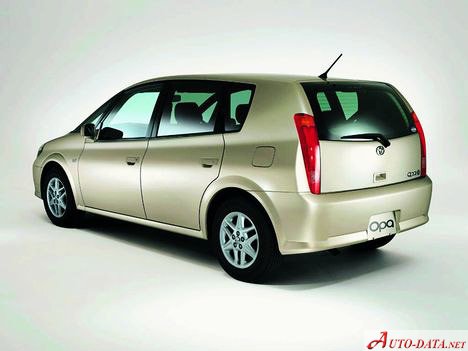
The Toyota Opa: A Unique Japanese Wagon
The Toyota Opa, a distinctive compact station wagon, represents a fascinating chapter in Toyota’s history of catering to the specific needs of the Japanese domestic market (JDM). Launched in 2000, the Opa was designed as a versatile family vehicle, blending the practicality of a minivan with the driving dynamics and footprint of a compact car. Its name, derived from the Portuguese word for “surprise” or “oh-la-la,” hinted at its unconventional styling and thoughtful interior packaging.
Positioned to offer superior space and utility in a relatively small package, the Opa was part of a trend in Japan for vehicles that maximized interior volume without becoming full-sized minivans. It shared its platform with the first-generation Toyota Wish and the popular Corolla, indicating a focus on reliability, efficiency, and car-like handling. The model discussed here, the 2.0 i 16V D-4 (152 Hp) variant, was a particularly advanced offering, featuring Toyota’s innovative direct injection engine technology, a hallmark of its commitment to efficiency and performance at the turn of the millennium. Production of the Opa continued until 2005, making it a unique, single-generation model that carved out its niche in the competitive JDM landscape.
Engine and Performance of the Toyota Opa
Under the hood, the Toyota Opa 2.0 i 16V D-4 was powered by the 1AZ-FSE engine, a 1,998 cubic centimeter (2.0-liter) inline four-cylinder unit. This engine was a significant piece of technology for its time, featuring Toyota’s D-4 direct injection system. Unlike conventional port fuel injection, direct injection sprays fuel directly into the combustion chamber, allowing for more precise fuel delivery and better control over the air-fuel mixture. This technology contributed to improved fuel efficiency and increased power output, especially noticeable in a naturally aspirated engine.
The 1AZ-FSE engine generated a respectable 152 horsepower at 6000 rpm, providing ample power for daily driving and highway cruising. Torque output stood at 200 Nm, or approximately 147.51 lb.-ft., peaking at 4000 rpm. This broad torque band ensured responsive acceleration and good pulling power, whether navigating urban streets or tackling steeper inclines. Power was sent to the front wheels via a smooth-shifting 4-speed automatic transmission, a common and reliable setup for compact family vehicles of this era.
In terms of performance, the Opa 2.0 i 16V D-4 was quite capable for its class. It could accelerate from 0 to 60 mph in an estimated 9.5 seconds, a competitive figure for a practical wagon. Its top speed was rated at 124.27 mph (200 km/h), demonstrating its ability to maintain highway speeds with ease. Fuel economy was also a strong suit, thanks to the D-4 engine. It achieved an estimated 19.6 US mpg in urban driving and an impressive 33.6 US mpg on the highway, making it an economical choice for families in Japan.
The engine’s design, with a square bore and stroke of 86 mm (3.39 inches) and a compression ratio of 9.8:1, was optimized for efficiency and durability. The dual overhead camshaft (DOHC) valvetrain with four valves per cylinder ensured optimal airflow and combustion. With an engine oil capacity of 4.2 liters (4.44 US quarts) and a coolant capacity of 5.8 liters (6.13 US quarts), maintenance was straightforward, contributing to the Opa’s reputation for long-term reliability.
Design and Features of the Toyota Opa
The Toyota Opa’s design was a clear departure from traditional station wagons, adopting a distinctive “tall wagon” or compact minivan-like silhouette. Classified as a 5-door station wagon (often referred to as an estate in other markets), it offered seating for five occupants. Its overall dimensions were compact yet intelligently utilized: a length of 167.32 inches (4250 mm), a width of 66.73 inches (1695 mm), and a height of 60.24 inches (1530 mm). These dimensions, combined with a generous 106.3-inch (2700 mm) wheelbase, allowed for a surprisingly spacious and airy cabin, a key selling point in space-conscious Japan.
Visually, the Opa featured a somewhat rounded and utilitarian aesthetic, prioritizing interior volume and ease of access. Large windows contributed to excellent visibility, and the relatively upright seating position enhanced comfort for all passengers. While not overtly stylish by international standards, its design was functional and modern for its early 2000s launch. The body-on-frame architecture was not utilized; instead, it featured a unibody construction typical of passenger cars, contributing to its car-like ride and handling.
Inside, the Opa emphasized practicality and flexibility. Though specific details on interior configurations are not provided, vehicles of this type in the JDM often featured versatile seating arrangements, including folding rear seats to create an expansive cargo area. The focus was on maximizing utility for families, whether for daily commutes, shopping, or weekend excursions. The dashboard layout was ergonomic, placing controls within easy reach of the driver.
In terms of safety and driving aids, the Toyota Opa came equipped with essential features for its time. An Anti-lock Braking System (ABS) was standard, enhancing braking control in emergency situations. The steering system was a hydraulic rack and pinion setup, providing direct and communicative feedback to the driver while offering light effort for parking and low-speed maneuvers. The vehicle rode on 195/65 R15 tires, providing a comfortable ride and adequate grip for its intended purpose. Front brakes were ventilated discs for effective stopping power, complemented by reliable drum brakes at the rear.
Technical Specifications
| Category | Specification | Value |
|---|---|---|
| General Information | ||
| Brand | Toyota | |
| Model | Opa | |
| Generation | Opa | |
| Type (Engine) | 2.0 i 16V D-4 (152 Hp) | |
| Start of Production | 2000 year | |
| End of Production | 2005 year | |
| Powertrain Architecture | Internal Combustion engine | |
| Body Type | Station wagon (estate) | |
| Seats | 5 | |
| Doors | 5 | |
| Performance Specs | ||
| Fuel Consumption (Economy) – Urban | 12 l/100 km | 19.6 US mpg |
| Fuel Consumption (Economy) – Extra Urban | 7 l/100 km | 33.6 US mpg |
| Fuel Type | Petrol (Gasoline) | |
| Acceleration 0 – 60 mph | 9.5 sec | |
| Maximum Speed | 200 km/h | 124.27 mph |
| Weight-to-Power Ratio | 8.4 kg/Hp | 119.7 Hp/tonne |
| Weight-to-Torque Ratio | 6.4 kg/Nm | 157.5 Nm/tonne |
| Engine Specs | ||
| Power | 152 Hp @ 6000 rpm | |
| Power per Liter | 76.1 Hp/l | |
| Torque | 200 Nm @ 4000 rpm | 147.51 lb.-ft. @ 4000 rpm |
| Engine Layout | Front, Transverse | |
| Engine Model/Code | 1AZ-FSE | |
| Engine Displacement | 1998 cm³ | 2.0 Liters (121.93 cu. in.) |
| Number of Cylinders | 4 | |
| Engine Configuration | Inline | |
| Cylinder Bore | 86 mm | 3.39 in. |
| Piston Stroke | 86 mm | 3.39 in. |
| Compression Ratio | 9.8:1 | |
| Number of Valves per Cylinder | 4 | |
| Fuel Injection System | Direct injection | |
| Engine Aspiration | Naturally aspirated engine | |
| Valvetrain | DOHC | |
| Engine Oil Capacity | 4.2 l | 4.44 US qt |
| Coolant Capacity | 5.8 l | 6.13 US qt |
| Space, Volume and Weights | ||
| Kerb Weight | 1270 kg | 2799.87 lbs. |
| Fuel Tank Capacity | 60 l | 15.85 US gal |
| Dimensions | ||
| Length | 4250 mm | 167.32 in. |
| Width | 1695 mm | 66.73 in. |
| Height | 1530 mm | 60.24 in. |
| Wheelbase | 2700 mm | 106.3 in. |
| Front Track | 1475 mm | 58.07 in. |
| Rear (Back) Track | 1460 mm | 57.48 in. |
| Drivetrain, Brakes and Suspension Specs | ||
| Drivetrain Architecture | The Internal combustion engine (ICE) drives the front wheels of the vehicle. | |
| Drive Wheel | Front wheel drive | |
| Number of Gears and Type of Gearbox | 4 gears, automatic transmission | |
| Front Suspension | Spring Strut | |
| Rear Suspension | Trailing arm | |
| Front Brakes | Ventilated discs | |
| Rear Brakes | Drum | |
| Assisting Systems | ABS (Anti-lock braking system) | |
| Steering Type | Steering rack and pinion | |
| Power Steering | Hydraulic Steering | |
| Tires Size | 195/65 R15 | |
Legacy and Market Impact of the Toyota Opa
The Toyota Opa, despite its relatively short production run from 2000 to 2005, left a distinct mark on the Japanese domestic market. Its reputation was largely built on Toyota’s core strengths: unwavering reliability, practical design, and efficient powertrains. For many Japanese families, the Opa represented a sensible and dependable choice, offering significant utility without the larger footprint or higher cost of a traditional minivan.
In its primary market, the Opa competed with a host of other innovative compact wagons and minivans designed for urban living and family practicality. Key rivals included vehicles like the Honda Stream, which also aimed to blend car-like driving with minivan versatility, and the Nissan Wingroad, another popular compact wagon. Toyota itself offered other options, such as the Corolla Fielder (a conventional wagon) and later the more minivan-oriented Wish, which arguably absorbed some of the Opa’s market segment.
The Opa’s historical significance lies in its embodiment of Toyota’s strategy to diversify its JDM offerings with niche models that catered to specific consumer demands for space efficiency and fuel economy. Its use of the 1AZ-FSE engine with D-4 direct injection was a notable technological advancement, showcasing Toyota’s commitment to pushing the boundaries of internal combustion engine efficiency before hybrid technology became widespread. This engine demonstrated that a naturally aspirated gasoline engine could deliver both decent performance and excellent fuel economy through advanced fuel management.
As an international automotive expert, it’s important to note why the Toyota Opa was never officially sold in the United States. Its unique styling and compact dimensions were meticulously tailored for the Japanese market, where narrow streets, dense urban environments, and specific tax classifications favored such vehicles. In North America, Toyota offered models like the Matrix (a sportier compact wagon/crossover) and larger sedans and SUVs that better suited American consumer preferences for size, power, and styling. The “Opa” name itself, while intriguing in Japanese, might also have presented marketing challenges in other regions. Ultimately, the Toyota Opa remains a compelling example of Toyota’s ability to innovate and adapt its product lineup to meet the distinct requirements of its domestic market, even if it never graced the showrooms across the Pacific.

