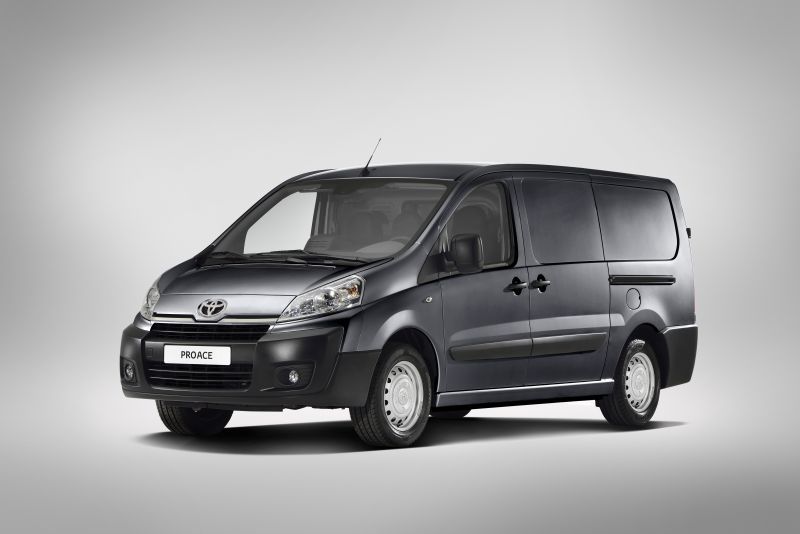
The Toyota Proace 2.0 D4-D (163 Hp) L2H2: A European Workhorse
The Toyota Proace 2.0 D4-D (163 Hp) L2H2 represents Toyota’s strategic entry into the highly competitive European light commercial vehicle (LCV) market, a segment where brand loyalty and utility are paramount. Launched in 2013, this first-generation Proace was not an independently developed Toyota product but rather a rebadged variant of the highly successful Eurovan platform, a joint venture between PSA Peugeot Citroën and Fiat. Specifically, it shared its underpinnings with the Citroën Jumpy, Peugeot Expert, and Fiat Scudo. This particular model, designated L2H2, signifies its longer wheelbase and higher roof configuration, making it a versatile and capacious minivan or panel van designed for a wide range of commercial applications, from cargo transport to specialized conversions. Positioned as a reliable and efficient option for businesses across Europe, the Proace aimed to combine Toyota’s renowned quality and durability with the proven practicality of its European siblings.
Engine & Performance: Powering the Toyota Proace
At the heart of the Toyota Proace 2.0 D4-D (163 Hp) L2H2 lies a robust and efficient 2.0-liter D4-D (Direct Injection 4-stroke Diesel) inline-four engine, designated with the internal code 4WZ-FHV. This powertrain was engineered to deliver a compelling balance of power, torque, and fuel economy, crucial attributes for a commercial vehicle. It generates a substantial 163 horsepower at 3750 RPM, providing ample grunt for hauling loads or maintaining highway speeds. More importantly for its intended purpose, the engine produces a healthy 250.77 lb.-ft. (340 Nm) of torque, available from a low 2000 RPM. This low-end torque is vital for strong acceleration from a standstill, effortless merging into traffic, and tackling inclines even when fully loaded.
The engine’s architecture includes a sophisticated Diesel Commonrail fuel injection system, ensuring precise fuel delivery and optimal combustion efficiency. Further enhancing performance and efficiency is a turbocharger coupled with an intercooler, which significantly boosts air intake density, leading to greater power output and improved throttle response. The valvetrain features a Double Overhead Camshaft (DOHC) setup, contributing to efficient valve operation and overall engine refinement. Power is transmitted to the front wheels via a smooth-shifting 6-speed manual transmission, offering drivers precise control and helping to optimize fuel consumption across various driving conditions. This configuration enables the Proace to accelerate from 0 to 60 mph in a respectable 10 seconds and reach a top speed of 105.63 mph (170 km/h), making it agile enough for urban deliveries and capable on longer hauls.
Fuel economy was a key selling point for the Proace. The 2.0 D4-D (163 Hp) L2H2 achieved a combined fuel consumption rating of 36.8 US mpg (6.4 l/100 km), with urban figures at 30.9 US mpg (7.6 l/100 km) and extra-urban figures at an impressive 40.6 US mpg (5.8 l/100 km). These figures, combined with a generous 21.13 US gallon (80 liter) fuel tank, translated into a substantial driving range, minimizing downtime for refueling. Furthermore, the engine complied with Euro 5 emission standards, and included a particulate filter, demonstrating its commitment to environmental responsibility for its era.
Design & Features of the Toyota Proace
The design of the first-generation Toyota Proace was fundamentally driven by practicality and utility, reflecting its role as a dedicated commercial vehicle. As a minivan with 5 doors and seating for 3, this L2H2 variant offered a versatile platform. The “L2H2” designation itself speaks to its dimensions: a longer wheelbase (L2) and a higher roof (H2), providing maximum cargo volume and flexibility. With an overall length of 202.48 inches (5143 mm), a width of 74.61 inches (1895 mm), and a height of 77.95 inches (1980 mm), the Proace L2H2 was engineered to accommodate substantial loads while still being maneuverable in urban environments, aided by a relatively tight minimum turning circle of 41.34 feet (12.6 meters).
The exterior styling was functional and robust, prioritizing aerodynamic efficiency and ease of loading/unloading. Large side doors and a wide rear opening facilitated access to the cargo area. Inside, the cabin was designed for durability and driver comfort during long working hours. The 3-seat configuration typically included a driver’s seat and a two-person bench, often with a fold-down central section that could serve as a workspace or storage tray. Interior materials were chosen for their hard-wearing properties and ease of cleaning, essential for a vehicle subjected to daily commercial use.
Underneath, the Proace featured a well-engineered chassis designed to handle varying loads. The front suspension utilized a double wishbone setup, providing precise steering and good ride comfort, while the rear employed a semi-independent, coil spring system, optimized for load-carrying capability and stability. Braking was handled by ventilated discs at the front and disc brakes at the rear, complemented by an Anti-lock Braking System (ABS) for enhanced safety and control, especially during emergency stops or on slippery surfaces. The electric power steering system, a rack and pinion type, offered light and responsive handling, reducing driver fatigue during extensive urban driving. The vehicle rode on 215/60 R16 tires mounted on 7J x 16 wheel rims, providing a good balance of load capacity, ride comfort, and grip.
Technical Specifications
| General Information | |
|---|---|
| Brand | Toyota |
| Model | Proace |
| Generation | Proace (First Generation) |
| Type (Engine) | 2.0 D4-D (163 Hp) L2H2 |
| Start of Production | 2013 year |
| End of Production | 2016 year |
| Powertrain Architecture | Internal Combustion engine |
| Body type | Minivan |
| Seats | 3 |
| Doors | 5 |
| Performance Specifications | |
| Fuel Consumption (economy) – urban | 7.6 l/100 km (30.9 US mpg) |
| Fuel Consumption (economy) – extra urban | 5.8 l/100 km (40.6 US mpg) |
| Fuel Consumption (economy) – combined | 6.4 l/100 km (36.8 US mpg) |
| CO2 emissions | 168 g/km |
| Fuel Type | Diesel |
| Acceleration 0 – 100 km/h | 10.5 sec |
| Acceleration 0 – 62 mph | 10.5 sec |
| Acceleration 0 – 60 mph (Calculated) | 10 sec |
| Maximum speed | 170 km/h (105.63 mph) |
| Emission standard | Euro 5 |
| Weight-to-power ratio | 11.3 kg/Hp (88.8 Hp/tonne) |
| Weight-to-torque ratio | 5.4 kg/Nm (185.2 Nm/tonne) |
| Engine Specifications | |
| Power | 163 Hp @ 3750 rpm |
| Power per liter | 81.6 Hp/l |
| Torque | 340 Nm @ 2000 rpm (250.77 lb.-ft. @ 2000 rpm) |
| Engine layout | Front, Transverse |
| Engine Model/Code | 4WZ-FHV |
| Engine displacement | 1997 cm3 (121.86 cu. in.) |
| Number of cylinders | 4 |
| Engine configuration | Inline |
| Cylinder Bore | 85 mm (3.35 in.) |
| Piston Stroke | 88 mm (3.46 in.) |
| Compression ratio | 16:1 |
| Fuel injection system | Diesel Commonrail |
| Engine aspiration | Turbocharger, Intercooler |
| Valvetrain | DOHC |
| Engine oil capacity | 5 l (5.28 US qt) |
| Engine systems | Particulate filter |
| Space, Volume and Weights | |
| Kerb Weight | 1836-1945 kg (4047.69 – 4287.99 lbs.) |
| Max. weight | 2973 kg (6554.34 lbs.) |
| Max load | 1028-1137 kg (2266.35 – 2506.66 lbs.) |
| Fuel tank capacity | 80 l (21.13 US gal) |
| Max. roof load | 170 kg (374.79 lbs.) |
| Permitted trailer load with brakes (12%) | 2000 kg (4409.25 lbs.) |
| Permitted trailer load without brakes | 750 kg (1653.47 lbs.) |
| Permitted towbar download | 80 kg (176.37 lbs.) |
| Dimensions | |
| Length | 5143 mm (202.48 in.) |
| Width | 1895 mm (74.61 in.) |
| Height | 1980 mm (77.95 in.) |
| Wheelbase | 3122 mm (122.91 in.) |
| Front track | 1570 mm (61.81 in.) |
| Rear (Back) track | 1604 mm (63.15 in.) |
| Minimum turning circle (turning diameter) | 12.6 m (41.34 ft.) |
| Drivetrain, Brakes and Suspension Specifications | |
| Drivetrain Architecture | The Internal combustion engine (ICE) drives the front wheels of the vehicle. |
| Drive wheel | Front wheel drive |
| Number of gears and type of gearbox | 6 gears, manual transmission |
| Front suspension | Double wishbone |
| Rear suspension | Semi-independent, coil spring |
| Front brakes | Ventilated discs |
| Rear brakes | Disc |
| Assisting systems | ABS (Anti-lock braking system) |
| Steering type | Steering rack and pinion |
| Power steering | Electric Steering |
| Tires size | 215/60 R16 |
| Wheel rims size | 7J x 16 |
Legacy & Market Impact of the Toyota Proace
The first-generation Toyota Proace, produced from 2013 to 2016, played a significant role in Toyota’s strategy to bolster its presence in the European light commercial vehicle market. As a rebadged product of the Sevel Nord joint venture (which produced the Citroën Jumpy, Peugeot Expert, and Fiat Scudo), the Proace allowed Toyota to offer a competitive LCV without the enormous research and development costs associated with an entirely new platform. This approach was common in the European LCV segment, where partnerships enabled manufacturers to share costs and broaden their product portfolios efficiently.
In its primary European market, the Proace competed against a formidable array of established rivals, including the Volkswagen Transporter, Ford Transit Custom, Mercedes-Benz Vito, Renault Trafic, and its PSA and Fiat siblings. Despite being a relative newcomer to the segment under the Toyota badge, the Proace benefited from Toyota’s sterling reputation for reliability and low running costs, which are highly valued by commercial operators. The 2.0 D4-D (163 Hp) L2H2 variant, in particular, was praised for its strong performance, good fuel economy, and impressive carrying capacity, making it an attractive option for small to medium-sized businesses, delivery services, and tradespeople requiring a versatile and dependable workhorse.
The L2H2 configuration, with its extended length and raised roof, was especially popular for its ability to accommodate larger volumes of cargo or facilitate more complex conversions, such as mobile workshops or specialized transport. Its robust suspension and ample payload capacity (up to 2506.66 lbs. or 1137 kg) underscored its utility. While it might not have garnered the same sales volume as some of its longer-established competitors in its initial years, the first-generation Proace successfully laid the groundwork for Toyota’s continued commitment to the European LCV market. Its legacy is one of smart collaboration, offering a practical and reliable solution that leveraged proven engineering with Toyota’s brand promise, ultimately paving the way for the development of subsequent, more integrated generations of the Proace range.