
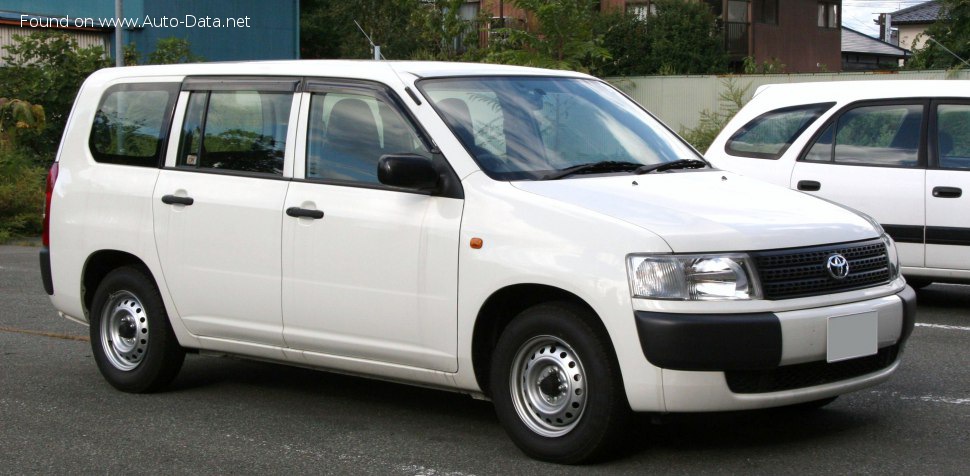
The Toyota Probox: A Utilitarian Workhorse (2002-2014)
The Toyota Probox, specifically the 1.3 i (88 Hp) variant produced between 2002 and 2014, represents a significant chapter in the history of practical and economical vehicles designed for commercial and light-duty passenger use. Primarily a staple of the Japanese Domestic Market (JDM), and subsequently exported to various Asian, African, and Oceanic regions, the Probox was engineered from the ground up to be an incredibly reliable, fuel-efficient, and highly versatile station wagon. While not officially sold in the United States, its design philosophy and mechanical robustness embody Toyota’s global reputation for durability and low cost of ownership, making it a fascinating study for international automotive experts. This particular generation of the Probox served as a quintessential example of a no-frills, function-over-form vehicle, prioritizing cargo capacity, ease of maintenance, and economical operation above all else.
Positioned firmly in the compact utility vehicle segment, the Probox carved out a niche as the vehicle of choice for small businesses, delivery services, and individuals requiring a dependable, spacious, and affordable mode of transport. Its straightforward engineering and robust construction ensured a long service life, even under demanding conditions, a testament to Toyota’s commitment to quality and longevity. The 1.3-liter engine variant, while modest in power, was perfectly suited for urban and light highway duties, emphasizing efficiency and longevity over outright performance.
Engine and Performance
At the heart of the 2002-2014 Toyota Probox 1.3 i was the venerable 2NZ-FE inline-four engine. This naturally aspirated, multi-port manifold injected gasoline engine was known for its simplicity, reliability, and fuel economy. With a displacement of 1299 cubic centimeters (approximately 79.27 cubic inches or 1.3 liters), it delivered a modest but entirely adequate 88 horsepower at 6000 rpm. Torque output stood at 123 Nm (90.72 lb.-ft.) at 4400 rpm, providing sufficient pulling power for its intended commercial applications, especially within city limits and on relatively flat terrain.
The 2NZ-FE engine featured a Double Overhead Camshaft (DOHC) valvetrain with 4 valves per cylinder, a configuration that allowed for efficient combustion and respectable power delivery for its size. Its compression ratio of 10.5:1 was optimized for regular gasoline, further contributing to its economical running costs. The front, transverse engine layout, coupled with front-wheel drive, was typical for vehicles in this class, maximizing interior space and simplifying the drivetrain architecture. This setup contributed to a favorable weight-to-power ratio of 11.7 kg/Hp (85.4 Hp/tonne) and a weight-to-torque ratio of 8.4 kg/Nm (119.4 Nm/tonne), indicating a well-balanced power delivery for a utility vehicle of its size.
The powertrain architecture, driving the front wheels, provided predictable handling and good traction, particularly important for a vehicle often loaded with cargo. The engine’s design prioritized long-term durability, with an engine oil capacity of 3.7 liters (3.91 US quarts) and a coolant capacity of 4.5 liters (4.76 US quarts), ensuring adequate lubrication and thermal management for extended operational periods. This emphasis on mechanical resilience made the Probox a favorite among fleet operators and small businesses where uptime and minimal maintenance costs were paramount.
Design and Features of the Toyota Probox
The design philosophy behind the Toyota Probox was unequivocally rooted in practicality. Its station wagon (estate) body type, featuring five doors and seating for five passengers, was characterized by a distinctly boxy and utilitarian aesthetic. This square-edged design wasn’t about style; it was about maximizing interior volume, particularly for cargo. With dimensions measuring 4195 mm (165.16 inches) in length, 1695 mm (66.73 inches) in width, and 1525 mm (60.04 inches) in height, the Probox offered a compact footprint that was easy to maneuver in congested urban environments, yet provided an impressively spacious interior.
The 2550 mm (100.39 inches) wheelbase contributed to a stable ride and allowed for a generous cargo area when the rear seats were folded down. The wide-opening rear hatch and low loading floor made it exceptionally easy to load and unload goods, a critical feature for its target commercial audience. The interior, while spartan by modern luxury standards, was built to withstand the rigors of daily commercial use. Durable materials, straightforward controls, and ample storage compartments were hallmarks of its design. The focus was on functionality, with features like robust seat upholstery, easily washable surfaces, and simple, intuitive ergonomics.
Safety features for its era were basic but effective, typically including essential airbags and ABS brakes, depending on the specific market and trim level. The vehicle rode on 175/65 R14 tires, a common and economical size that offered a good balance of ride comfort, durability, and replacement cost. The front and rear track widths of 1455 mm (57.28 inches) and 1465 mm (57.68 inches), respectively, contributed to its stable road manners, even when fully loaded. The 50-liter (13.21 US gallon) fuel tank provided a decent range, reducing the frequency of fuel stops, which is a significant advantage for commercial operations.
Technical Specifications: Toyota Probox 1.3 i (88 Hp) (2002-2014)
| Category | Specification |
|---|---|
| General Information | |
| Brand | Toyota |
| Model | Probox |
| Generation | Probox |
| Engine Type | 1.3 i (88 Hp) |
| Production Start | 2002 year |
| Production End | 2014 year |
| Powertrain Architecture | Internal Combustion engine |
| Body Type | Station wagon (estate) |
| Seats | 5 |
| Doors | 5 |
| Performance Specs | |
| Fuel Type | Petrol (Gasoline) |
| Weight-to-power ratio | 11.7 kg/Hp, 85.4 Hp/tonne |
| Weight-to-torque ratio | 8.4 kg/Nm, 119.4 Nm/tonne |
| Engine Specs | |
| Power | 88 Hp @ 6000 rpm |
| Power per liter | 67.7 Hp/l |
| Torque | 123 Nm @ 4400 rpm (90.72 lb.-ft. @ 4400 rpm) |
| Engine Layout | Front, Transverse |
| Engine Model/Code | 2NZ-FE |
| Engine Displacement | 1299 cm3 (79.27 cu. in.) |
| Number of Cylinders | 4 |
| Engine Configuration | Inline |
| Cylinder Bore | 75 mm (2.95 in.) |
| Piston Stroke | 73.5 mm (2.89 in.) |
| Compression Ratio | 10.5:1 |
| Valves per Cylinder | 4 |
| Fuel Injection System | Multi-port manifold injection |
| Engine Aspiration | Naturally aspirated engine |
| Valvetrain | DOHC |
| Engine Oil Capacity | 3.7 l (3.91 US qt) |
| Coolant Capacity | 4.5 l (4.76 US qt) |
| Space, Volume and Weights | |
| Kerb Weight | 1030 kg (2270.76 lbs.) |
| Fuel Tank Capacity | 50 l (13.21 US gal) |
| Dimensions | |
| Length | 4195 mm (165.16 in.) |
| Width | 1695 mm (66.73 in.) |
| Height | 1525 mm (60.04 in.) |
| Wheelbase | 2550 mm (100.39 in.) |
| Front Track | 1455 mm (57.28 in.) |
| Rear (Back) Track | 1465 mm (57.68 in.) |
| Drivetrain, Brakes and Suspension Specs | |
| Drivetrain Architecture | The Internal combustion engine (ICE) drives the front wheels of the vehicle. |
| Drive Wheel | Front-wheel drive |
| Tires Size | 175/65 R14 |
Legacy and Market Impact
The Toyota Probox, particularly the 2002-2014 generation, cemented its legacy as an indispensable workhorse in its primary markets. Its impact stemmed from its unwavering reliability, exceptional practicality, and remarkably low operating costs. In Japan, it became a ubiquitous sight, serving as the backbone for countless small businesses, from electricians and plumbers to florists and delivery services. Its design, while simple, was perfectly optimized for its purpose: to transport goods and personnel efficiently and economically.
Competitors in its segment, such as the Nissan AD Van or Honda Partner (which often shared similar utilitarian philosophies), struggled to match the Probox’s reputation for sheer indestructibility and widespread parts availability. Toyota’s extensive dealer network and the proven reliability of the 2NZ-FE engine meant that Probox owners could expect years of trouble-free service, translating directly into reduced downtime and higher profitability for commercial users. This made the Probox not just a vehicle, but a vital business asset.
Beyond Japan, the Probox found strong demand in emerging markets across Asia, Africa, and parts of Latin America. Its rugged construction, ability to handle varying road conditions, and ease of maintenance made it an ideal choice for regions where infrastructure might be less developed and access to specialized repair facilities limited. It became a symbol of industriousness and practical mobility in these areas, often repurposed for a variety of tasks beyond its original design, from shared taxis to mobile storefronts.
The historical significance of the Toyota Probox lies in its embodiment of Toyota’s core principles: quality, durability, and reliability (QDR). It demonstrated that a vehicle doesn’t need to be flashy or technologically advanced to be profoundly successful and impactful. Instead, by focusing relentlessly on the fundamental needs of its users – space, efficiency, and longevity – the Probox became an automotive icon of utility. Even after its production run for this generation concluded in 2014, its presence on the roads of its primary markets remains strong, a testament to its enduring design and engineering excellence. The Toyota Probox continues to be a benchmark for what a dedicated commercial utility vehicle should be, proving that sometimes, the simplest solutions are the most effective.

