
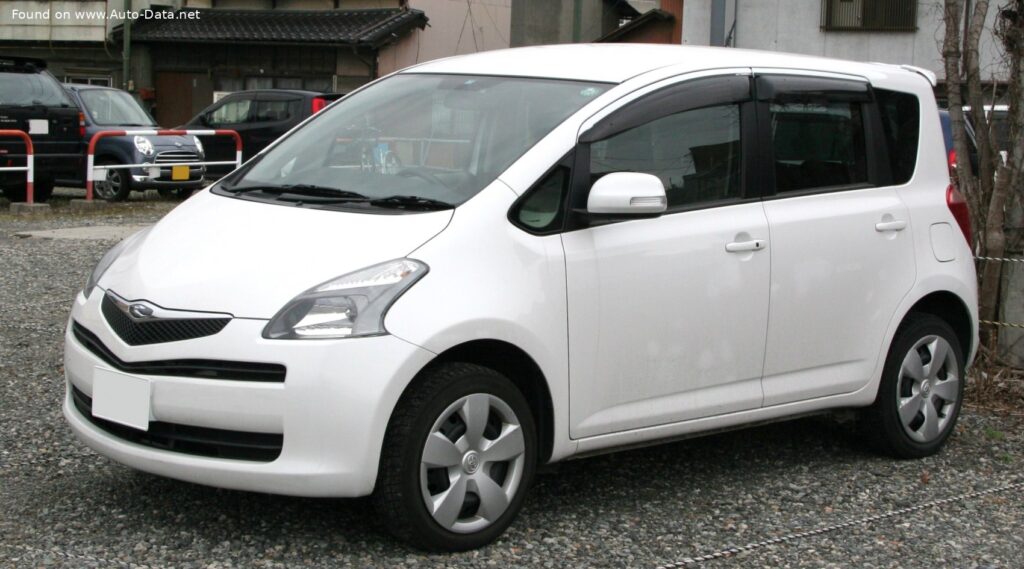
The Toyota Ractis I 1.3i (87 Hp): A Masterclass in Compact Versatility
The Toyota Ractis I, specifically the 1.3i (87 Hp) variant, represents Toyota’s thoughtful approach to urban mobility and space efficiency in its primary markets, most notably Japan. Launched in October 2005 and produced until November 2010, the Ractis I was a subcompact minivan, or a “tall-boy” hatchback, designed to offer exceptional interior room and practicality within a remarkably small footprint. Its name, a portmanteau of “Run,” “Activity,” and “Space,” perfectly encapsulated its design philosophy: a vehicle that was easy to maneuver, versatile for various activities, and offered generous interior volume. While not sold in the United States, the Ractis I was a significant player in the Japanese Domestic Market (JDM) and certain international markets where demand for compact, fuel-efficient, and highly adaptable vehicles was strong. It catered to families and individuals seeking a practical daily driver capable of handling both city commutes and occasional cargo hauling with ease.
Engine and Performance of the Toyota Ractis I 1.3i (87 Hp)
Powering the Toyota Ractis I 1.3i (87 Hp) is the venerable 2NZ-FE engine, a 1.3-liter (1296 cm3 or 79.09 cu. in.) inline four-cylinder gasoline unit. This naturally aspirated engine features a Double Overhead Camshaft (DOHC) valvetrain with four valves per cylinder, ensuring efficient breathing and smooth operation. It utilizes a multi-port manifold injection system for precise fuel delivery. The engine is configured in a front, transverse layout, driving the front wheels, a common and efficient setup for compact cars.
The 2NZ-FE engine produces a respectable 87 horsepower at 6000 rpm, which, for a vehicle of its size and intended use, provides adequate motivation. Torque output stands at 121 Nm (89.25 lb-ft) at 4200 rpm, delivering sufficient low-end grunt for urban acceleration and highway cruising. With a compression ratio of 11:1, the engine is optimized for efficiency, running on petrol (gasoline) and meeting Euro 4 emission standards.
Fuel economy was a key selling point for the Ractis I. It achieved an impressive 5.5 liters per 100 kilometers (42.8 US mpg) in extra-urban driving conditions, making it a very economical choice for daily commuting. Its weight-to-power ratio of 12.9 kg/Hp (77.7 Hp/tonne) and weight-to-torque ratio of 9.3 kg/Nm (108 Nm/tonne) highlight its lightweight construction and efficient powertrain, designed to maximize performance and economy without excessive power. The engine’s reputation for Toyota’s characteristic reliability further solidified its appeal in a market that values longevity and low running costs.
Design and Features
The Toyota Ractis I adopted a distinctive minivan body type, characterized by its tall stance and expansive glass area. With five doors and seating for five occupants, it prioritized passenger comfort and cargo flexibility. Its compact dimensions – a length of 157.28 inches, a width of 66.73 inches, and a height of 64.57 inches – made it exceptionally maneuverable in congested city streets and tight parking spaces, a crucial attribute in its primary Japanese market. The wheelbase measured 100.39 inches, contributing to a stable ride and maximizing interior volume.
Despite its exterior compactness, the Ractis I was ingeniously designed to offer a surprisingly spacious and versatile interior. The tall roofline provided ample headroom, while the flexible seating arrangements allowed for various configurations, from carrying five passengers comfortably to folding down the rear seats to create a large, flat cargo area. This adaptability made it suitable for a wide range of uses, from daily family duties to transporting groceries or even larger items.
In terms of safety and driving dynamics, the Ractis I featured a front-wheel-drive architecture. The front suspension utilized an independent McPherson strut setup, known for its balance of comfort and handling, while the rear employed a torsion beam system, which is compact and efficient for maximizing cargo space. Braking duties were handled by ventilated discs at the front and traditional drum brakes at the rear, augmented by an Anti-lock Braking System (ABS) for enhanced stopping power and control under emergency conditions. The car rode on 175/60 R16 tires, offering a good balance of grip and ride comfort. The overall design was practical and functional, focusing on utility and ease of use rather than aggressive styling cues.
Technical Specifications: Toyota Ractis I 1.3i (87 Hp)
| Category | Specification | US Equivalent / Notes |
|---|---|---|
| General Information | ||
| Brand | Toyota | |
| Model | Ractis | |
| Generation | Ractis I | |
| Engine Type | 1.3i (87 Hp) | |
| Production Start | October, 2005 | |
| Production End | November, 2010 | |
| Powertrain Architecture | Internal Combustion Engine | |
| Body Type | Minivan | |
| Seats | 5 | |
| Doors | 5 | |
| Performance Specs | ||
| Fuel Consumption (Extra Urban) | 5.5 l/100 km | 42.8 US mpg |
| Fuel Type | Petrol | Gasoline |
| Emission Standard | Euro 4 | |
| Weight-to-Power Ratio | 12.9 kg/Hp | 77.7 Hp/tonne |
| Weight-to-Torque Ratio | 9.3 kg/Nm | 108 Nm/tonne |
| Engine Specs | ||
| Power | 87 Hp @ 6000 rpm | |
| Power per Liter | 67.1 Hp/l | |
| Torque | 121 Nm @ 4200 rpm | 89.25 lb-ft @ 4200 rpm |
| Engine Layout | Front, Transverse | |
| Engine Model/Code | 2NZ-FE | |
| Engine Displacement | 1296 cm3 | 1.3 Liters (79.09 cu. in.) |
| Number of Cylinders | 4 | |
| Engine Configuration | Inline | |
| Cylinder Bore | 72 mm | 2.83 in. |
| Piston Stroke | 79.6 mm | 3.13 in. |
| Compression Ratio | 11:1 | |
| Valves per Cylinder | 4 | |
| Fuel Injection System | Multi-port manifold injection | |
| Engine Aspiration | Naturally aspirated | |
| Valvetrain | DOHC | |
| Engine Oil Capacity | 3.7 l | 3.91 US qt |
| Coolant Capacity | 4.5 l | 4.76 US qt |
| Space, Volume and Weights | ||
| Kerb Weight | 1120 kg | 2469.18 lbs. |
| Max. Weight (Gross Vehicle Weight) | 1395 kg | 3075.45 lbs. |
| Max Load | 275 kg | 606.27 lbs. |
| Dimensions | ||
| Length | 3995 mm | 157.28 in. |
| Width | 1695 mm | 66.73 in. |
| Height | 1640 mm | 64.57 in. |
| Wheelbase | 2550 mm | 100.39 in. |
| Front Track | 1485 mm | 58.46 in. |
| Rear Track | 1475 mm | 58.07 in. |
| Drivetrain, Brakes and Suspension | ||
| Drivetrain Architecture | ICE drives front wheels | |
| Drive Wheel | Front wheel drive | |
| Front Suspension | Independent type McPherson | |
| Rear Suspension | Torsion | |
| Front Brakes | Ventilated discs | |
| Rear Brakes | Drum | |
| Assisting Systems | ABS (Anti-lock braking system) | |
| Tires Size | 175/60 R16 |
Legacy and Market Impact
The Toyota Ractis I, particularly the 1.3i (87 Hp) model, carved out a significant niche in its primary markets, particularly Japan. It was a direct competitor to other compact, high-roof hatchbacks and subcompact minivans such as the Honda Fit (Jazz in some markets), Nissan Note, and Mazda Demio (Mazda2). Its appeal lay in Toyota’s renowned reputation for reliability, exceptional build quality, and a strong focus on practical utility.
In the crowded Japanese domestic market, where space is at a premium and fuel efficiency is paramount, the Ractis I offered a compelling package. Its compact exterior dimensions made it ideal for navigating narrow city streets and parking in tight spots, while its surprisingly spacious and flexible interior catered to the diverse needs of urban families. The ability to easily reconfigure the seating for either passengers or cargo was a major draw, making it a versatile workhorse for daily errands, family outings, and light hauling.
The Ractis also contributed to Toyota’s broader strategy of offering a wide range of specialized vehicles for specific market segments. It demonstrated Toyota’s expertise in designing practical, user-friendly vehicles that resonate with consumer needs in space-constrained environments. While it never officially made its way to the North American market, its design philosophy and engineering principles can be seen echoed in other global Toyota models that prioritize efficiency and intelligent packaging.
Its legacy is one of quiet competence and enduring practicality. Owners praised its low running costs, dependable mechanicals, and clever interior design. The Ractis I effectively bridged the gap between a traditional hatchback and a full-sized minivan, offering the best attributes of both in a compact, economical package. It remains a testament to Toyota’s ability to innovate within the compact car segment, delivering vehicles that are not only efficient and reliable but also remarkably adaptable to the demands of modern urban life. The Ractis name continued for a second generation, further cementing its place as a successful and influential model in its segment, even transitioning to be known as the Verso-S in some European markets for its second iteration.

