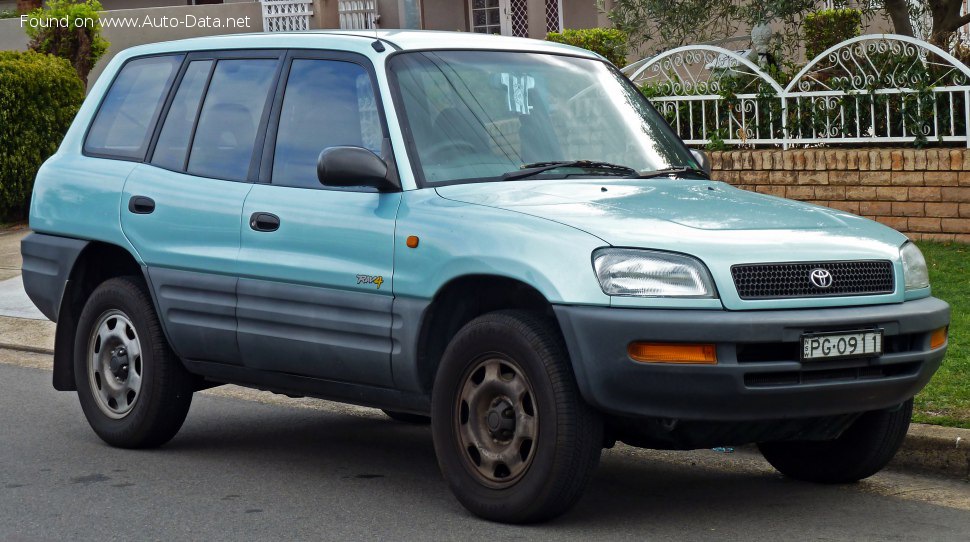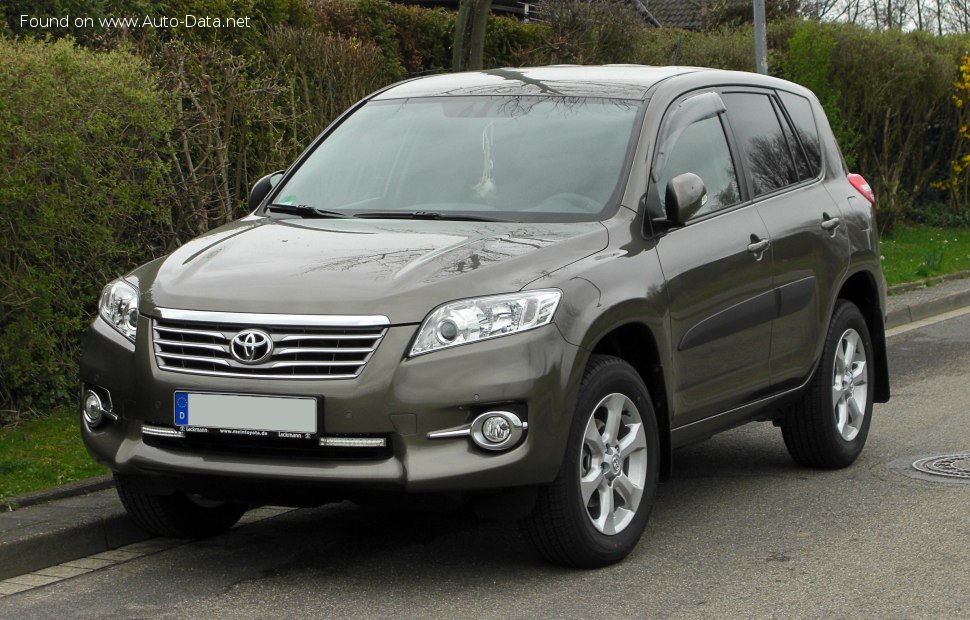
Toyota RAV4 III (XA30, facelift 2010) 2.2 D-CAT (177 Hp) 4WD
The Toyota RAV4 III (XA30, facelift 2010) represents a significant evolution in the compact SUV segment, building upon Toyota’s pioneering efforts in the crossover market. Introduced in May 2010 as a refreshed version of the third-generation RAV4 (XA30), this model aimed to maintain its competitive edge in a rapidly expanding global market. While the RAV4 nameplate is synonymous with versatility and reliability worldwide, this particular variant, the 2.2 D-CAT (177 Hp) 4WD, was primarily targeted at European and other international markets where diesel powertrains were highly favored for their fuel efficiency and torque characteristics. It offered a compelling blend of robust performance, all-wheel-drive capability, and impressive fuel economy, making it a strong contender against its rivals until the end of its production run in February 2013.
The XA30 generation marked a departure from the smaller, more car-like dimensions of its predecessors, growing in size to appeal to a broader audience seeking more interior space and a more commanding road presence. The 2010 facelift brought subtle but effective styling updates, refining the exterior aesthetics and enhancing interior features, ensuring the RAV4 remained a popular choice for families and adventurers alike. This iteration solidified the RAV4’s reputation as a practical, dependable, and capable compact SUV, albeit with a powertrain specifically tailored for regions outside of the conventional North American gasoline-dominated landscape.
Engine and Performance: The 2.2 D-CAT (177 Hp) 4WD Powertrain
At the heart of this particular Toyota RAV4 III (XA30, facelift 2010) variant was Toyota’s advanced 2.2-liter D-CAT (Diesel Clean Advanced Technology) inline-four engine, designated by the code 2AD-FHV. This sophisticated diesel unit was engineered to deliver a balance of strong performance and environmental responsibility, complying with the Euro 5 emission standard prevalent at the time. With a displacement of 2231 cubic centimeters (136.14 cubic inches), the engine produced a healthy 177 horsepower at 3600 rpm, a substantial output for a compact SUV of its era.
More impressive than its horsepower, especially for an SUV, was its torque output. The 2.2 D-CAT generated a robust 295.02 lb.-ft. (400 Nm) of torque, available at a low 2000 rpm. This ample low-end torque was crucial for the RAV4’s all-wheel-drive (4WD) system, providing excellent tractive effort for off-road excursions, towing, or simply accelerating with confidence. Power was sent to all four wheels through a smooth and precise 6-speed manual transmission, offering engaging control for the driver.
Performance figures for the 2.2 D-CAT (177 Hp) 4WD were quite respectable. The RAV4 could accelerate from 0 to 60 mph in a brisk 8.8 seconds, making it one of the quicker options in its segment. Its top speed was rated at 124.27 mph (200 km/h), demonstrating its capability on highways. Despite its performance, fuel economy remained a strong suit, particularly in a European context. The combined fuel consumption was an estimated 35.1 US mpg (6.7 l/100 km), with extra urban figures reaching nearly 39.9 US mpg (5.9 l/100 km). This efficiency, coupled with a 15.85 US gallon (60-liter) fuel tank, provided a considerable driving range.
The engine’s design featured a DOHC (Dual Overhead Camshaft) valvetrain with 4 valves per cylinder, a common rail direct fuel injection system, and was bolstered by both a turbocharger and an intercooler to maximize power and efficiency. A particulate filter was also standard, highlighting Toyota’s commitment to reducing emissions in line with European regulations.
Design and Features
The Toyota RAV4 III (XA30, facelift 2010) maintained the contemporary SUV styling that characterized the third generation, presenting a more mature and refined aesthetic than its predecessors. With its five-door, five-seat SUV body type, it struck a balance between urban usability and rugged capability. The facelift introduced subtle changes, including revised front fascias, grilles, and taillights, contributing to a more modern and cohesive look.
Dimensionally, the RAV4 was compact enough for city driving while offering ample interior space. It measured 170.67 inches (4335 mm) in length, 73.03 inches (1855 mm) in width, and 66.34 inches (1685 mm) in height, with a wheelbase of 100.79 inches (2560 mm). The ground clearance of 7.17 inches (182 mm) contributed to its SUV stance and light off-road capability. Inside, the cabin was designed for practicality and comfort, offering generous headroom and legroom for five occupants. The trunk (boot) space was substantial, ranging from 20.69 cubic feet (586 liters) with all seats up, expanding to an impressive 61.87 cubic feet (1752 liters) with the rear seats folded, making it highly versatile for cargo and family needs.
For its time, the RAV4 came equipped with a range of features aimed at enhancing safety and convenience. Standard assisting systems included ABS (Anti-lock Braking System), a crucial safety feature. The suspension setup featured an independent McPherson strut system with coil springs and an anti-roll bar at the front, paired with a double wishbone setup at the rear, providing a comfortable ride and stable handling. Braking was handled by ventilated discs at the front and solid discs at the rear, ensuring confident stopping power. The vehicle rode on 235/55 R18 tires mounted on 7.5J x 18-inch alloy wheels, contributing to both its appearance and road holding.
While specific interior amenity details are not provided, typical features for this segment and era would have included air conditioning, power windows, remote central locking, and a multi-speaker audio system, with higher trims offering more advanced options like navigation and leather upholstery. The overall design philosophy focused on creating a user-friendly and durable vehicle, hallmarks of the Toyota brand.
Technical Specifications
| Category | Specification |
|---|---|
| General Information | |
| Brand | Toyota |
| Model | RAV4 |
| Generation | RAV4 III (XA30, facelift 2010) |
| Type (Engine) | 2.2 D-CAT (177 Hp) 4WD |
| Start of production | May, 2010 year |
| End of production | February, 2013 year |
| Powertrain Architecture | Internal Combustion engine |
| Body type | SUV |
| Seats | 5 |
| Doors | 5 |
| Performance Specs | |
| Fuel consumption (economy) – urban | 7.9 l/100 km (29.8 US mpg) |
| Fuel consumption (economy) – extra urban | 5.9 l/100 km (39.9 US mpg) |
| Fuel consumption (economy) – combined | 6.7 l/100 km (35.1 US mpg) |
| CO2 emissions | 177 g/km |
| Fuel Type | Diesel |
| Acceleration 0 – 60 mph (Calculated) | 8.8 sec |
| Acceleration 0 – 100 km/h | 9.3 sec |
| Maximum speed | 200 km/h (124.27 mph) |
| Emission standard | Euro 5 |
| Weight-to-power ratio | 9.5 kg/Hp, 105.7 Hp/tonne |
| Weight-to-torque ratio | 4.2 kg/Nm, 238.8 Nm/tonne |
| Engine Specs | |
| Power | 177 Hp @ 3600 rpm |
| Power per liter | 79.3 Hp/l |
| Torque | 400 Nm @ 2000 rpm (295.02 lb.-ft. @ 2000 rpm) |
| Engine layout | Front, Transverse |
| Engine Model/Code | 2AD-FHV |
| Engine displacement | 2231 cm3 (136.14 cu. in.) |
| Number of cylinders | 4 |
| Engine configuration | Inline |
| Cylinder Bore | 86 mm (3.39 in.) |
| Piston Stroke | 96 mm (3.78 in.) |
| Compression ratio | 15.7:1 |
| Number of valves per cylinder | 4 |
| Fuel injection system | Diesel Commonrail |
| Engine aspiration | Turbocharger, Intercooler |
| Valvetrain | DOHC |
| Engine oil capacity | 5.9 l (6.23 US qt) |
| Coolant | 7.3 l (7.71 US qt) |
| Engine systems | Particulate filter |
| Space, Volume and Weights | |
| Kerb Weight | 1675 kg (3692.74 lbs.) |
| Max. weight | 2190 kg (4828.12 lbs.) |
| Max load | 515 kg (1135.38 lbs.) |
| Trunk (boot) space – minimum | 586 l (20.69 cu. ft.) |
| Trunk (boot) space – maximum | 1752 l (61.87 cu. ft.) |
| Fuel tank capacity | 60 l (15.85 US gal) |
| Max. roof load | 100 kg (220.46 lbs.) |
| Permitted trailer load with brakes (12%) | 2000 kg (4409.25 lbs.) |
| Permitted trailer load without brakes | 750 kg (1653.47 lbs.) |
| Permitted towbar download | 80 kg (176.37 lbs.) |
| Dimensions | |
| Length | 4335 mm (170.67 in.) |
| Width | 1855 mm (73.03 in.) |
| Height | 1685 mm (66.34 in.) |
| Wheelbase | 2560 mm (100.79 in.) |
| Ride height (ground clearance) | 182 mm (7.17 in.) |
| Minimum turning circle (turning diameter) | 11.6 m (38.06 ft.) |
| Approach angle | 28.0° |
| Departure angle | 24.0° |
| Ramp-over (brakeover) angle | 20.0° |
| Wading depth | 300 mm (11.81 in.) |
| Drivetrain, Brakes and Suspension Specs | |
| Drive wheel | All wheel drive (4×4) |
| Number of gears and type of gearbox | 6 gears, manual transmission |
| Front suspension | Independent, type McPherson with coil spring and anti-roll bar |
| Rear suspension | Double wishbone |
| Front brakes | Ventilated discs |
| Rear brakes | Disc |
| Assisting systems | ABS (Anti-lock braking system) |
| Steering type | Steering rack and pinion |
| Tires size | 235/55 R18 |
| Wheel rims size | 7.5J x 18 |
Legacy and Market Impact
The Toyota RAV4 III (XA30, facelift 2010) 2.2 D-CAT (177 Hp) 4WD played a crucial role in Toyota’s global strategy, particularly in markets where diesel engines dominated the SUV segment. While the North American market primarily received gasoline-powered RAV4 models, this diesel variant was a strong performer in Europe, Australia, and parts of Asia. Its reputation was built on Toyota’s core principles of reliability, durability, and low running costs, further enhanced by the diesel engine’s fuel efficiency and robust towing capabilities (up to 4409.25 lbs. with brakes).
In its primary markets, the RAV4 competed fiercely with other popular compact SUVs such as the Honda CR-V, Volkswagen Tiguan, Ford Kuga (Escape in North America), Nissan Qashqai (Rogue Sport), and the Hyundai ix35 (Tucson). The 2.2 D-CAT engine, with its 177 horsepower and nearly 300 lb.-ft. of torque, positioned it favorably against many rivals, offering a more powerful and refined driving experience than some of its direct competitors. Its all-wheel-drive system, combined with decent ground clearance and approach/departure angles, also provided a level of confidence for light off-road excursions or challenging weather conditions that two-wheel-drive crossovers couldn’t match.
The XA30 generation, including this facelifted model, was instrumental in transitioning the RAV4 from its niche “Recreational Activity Vehicle: 4-wheel drive” roots into a mainstream family SUV. It moved away from the smaller, more quirky styling of the first two generations, adopting a more conventional and spacious form factor that resonated with a broader consumer base. This strategic shift helped Toyota solidify its dominance in the burgeoning compact SUV segment globally.
The 2.2 D-CAT variant, in particular, showcased Toyota’s engineering prowess in diesel technology, offering a clean and potent powertrain option. Its compliance with Euro 5 emissions standards demonstrated a commitment to environmental performance, a growing concern in European markets. Although succeeded by the XA40 generation in 2013, the RAV4 III (XA30, facelift 2010) remains a testament to Toyota’s ability to adapt its product offerings to diverse market demands, providing a reliable, efficient, and capable vehicle that upheld the brand’s reputation for quality and value in the international automotive landscape.