Toyota RAV4 III (XA30) Long 2.4 VVT-i (166 Hp) 4WD Automatic: A Detailed Overview
The Toyota RAV4 III (XA30) Long 2.4 VVT-i (166 Hp) 4WD Automatic represents a significant evolution in Toyota’s pioneering compact SUV lineup. Launched in November 2005 and produced through 2009, this third-generation RAV4 marked a departure from its predecessors, growing in size, sophistication, and capability. The XA30 generation, specifically the “Long” variant, was designed to appeal to a broader audience, offering increased interior space, enhanced comfort, and, notably, a seven-seat option in some markets, including the United States. This particular model, equipped with the robust 2.4-liter VVT-i engine and an automatic all-wheel-drive system, solidified the RAV4’s position as a dominant force in the increasingly competitive compact crossover SUV segment, balancing practicality, reliability, and a refined driving experience.
Engine and Performance: The 2.4 VVT-i Heart of the Toyota RAV4 III (XA30) Long
At the core of the Toyota RAV4 III (XA30) Long 2.4 VVT-i (166 Hp) 4WD Automatic lies Toyota’s well-regarded 2AZ-FE engine. This naturally aspirated, inline four-cylinder gasoline engine boasts a displacement of 2362 cubic centimeters (144.14 cubic inches). Utilizing a dual overhead camshaft (DOHC) valvetrain with Toyota’s Variable Valve Timing with intelligence (VVT-i) technology, the engine was engineered for an optimal balance of power, fuel efficiency, and smooth operation. It produces a respectable 166 horsepower at 6000 rpm, translating to a power-per-liter output of 70.3 Hp/l. Torque is equally impressive for its class, peaking at 224 Nm (165.21 lb.-ft.) at 4000 rpm, ensuring ample pulling power for daily driving and light off-road excursions.
Power is channeled through a five-speed automatic transmission to an on-demand all-wheel-drive (4×4) system. This setup provides confident traction in various conditions, from slippery roads to unpaved trails, without the complexity or weight penalties of a full-time heavy-duty 4WD system. The vehicle’s weight-to-power ratio stands at 9.4 kg/Hp (106.3 Hp/tonne), contributing to a responsive feel for a vehicle of its size. Fuel economy figures for this powertrain were competitive for its era, with an urban consumption of 10.2 liters per 100 kilometers (23.1 US mpg) and an extra-urban consumption of 8.4 liters per 100 kilometers (28 US mpg), thanks in part to the efficient VVT-i system and the relatively low drag coefficient of 0.33. The 60-liter (15.85 US gallon) fuel tank provided a decent cruising range.
Design and Features: Expanding Comfort and Versatility
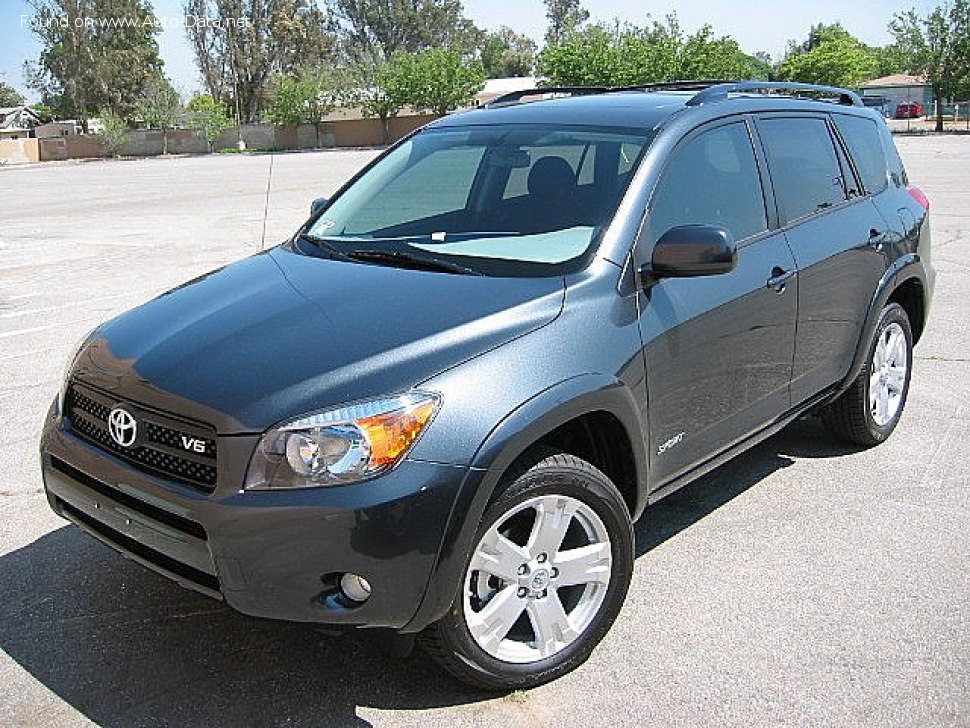
The third-generation RAV4 underwent a significant transformation in its exterior and interior design. The XA30 Long model adopted a more mature and substantial aesthetic, moving away from the more rugged, utilitarian look of its predecessors towards a more refined, car-like SUV profile. With a length of 4600 mm (181.1 inches), a width ranging from 1815-1855 mm (71.46-73.03 inches), and a height of 1745-1755 mm (68.7-69.09 inches), the RAV4 Long offered a significantly larger footprint. The extended 2660 mm (104.72 inches) wheelbase was crucial for accommodating the optional third row of seats, transforming it into a practical 7-seater SUV, a key selling point in markets like the US.
The body type remained a five-door SUV, but with smoother lines, integrated fenders, and a more aerodynamic stance. Inside, the cabin was designed for improved ergonomics and material quality, offering a comfortable and spacious environment. The minimum trunk space of 348 liters (12.29 cubic feet) was practical for daily use, expanding to a cavernous 2067 liters (73 cubic feet) with the rear seats folded, showcasing its versatility for cargo hauling.
Underneath, the RAV4 featured an independent McPherson strut front suspension with coil springs and an anti-roll bar, paired with a double wishbone rear suspension, providing a comfortable ride and stable handling characteristic of modern crossovers. Braking was handled by ventilated discs at the front and solid discs at the rear, augmented by an Anti-lock Braking System (ABS) for enhanced safety. The steering system was a responsive rack and pinion setup. Standard tire size was 225/65 R17, mounted on 7J x 17-inch wheel rims, contributing to both aesthetics and ride quality. With a ground clearance of 190 mm (7.48 inches), approach angle of 29.3°, and departure angle of 25.4°, the RAV4 III Long was capable of tackling light off-road conditions and urban obstacles with ease.
Technical Specifications
| General Information | |
|---|---|
| Brand | Toyota |
| Model | RAV4 |
| Generation | RAV4 III (XA30) Long |
| Type (Engine) | 2.4 VVT-i (166 Hp) 4WD Automatic |
| Start of Production | November, 2005 year |
| End of Production | 2009 year |
| Powertrain Architecture | Internal Combustion engine |
| Body type | SUV |
| Seats | 7 |
| Doors | 5 |
| Performance Specs | |
| Fuel consumption (economy) – urban | 10.2 l/100 km (23.1 US mpg) |
| Fuel consumption (economy) – extra urban | 8.4 l/100 km (28 US mpg) |
| Fuel Type | Petrol (Gasoline) |
| Weight-to-power ratio | 9.4 kg/Hp (106.3 Hp/tonne) |
| Weight-to-torque ratio | 7 kg/Nm (143.4 Nm/tonne) |
| Engine Specs | |
| Power | 166 Hp @ 6000 rpm |
| Power per liter | 70.3 Hp/l |
| Torque | 224 Nm @ 4000 rpm (165.21 lb.-ft. @ 4000 rpm) |
| Maximum engine speed | 6500 rpm |
| Engine layout | Front, Transverse |
| Engine Model/Code | 2AZ-FE |
| Engine displacement | 2362 cm3 (144.14 cu. in.) |
| Number of cylinders | 4 |
| Engine configuration | Inline |
| Cylinder Bore | 88.5 mm (3.48 in.) |
| Piston Stroke | 96 mm (3.78 in.) |
| Compression ratio | 9.8:1 |
| Number of valves per cylinder | 4 |
| Fuel injection system | Multi-port manifold injection |
| Engine aspiration | Naturally aspirated engine |
| Valvetrain | DOHC, VVT-i |
| Engine oil capacity | 4.3 l (4.54 US qt) |
| Coolant | 6.8 l (7.19 US qt) |
| Space, Volume and Weights | |
| Kerb Weight | 1562 kg (3443.62 lbs.) |
| Max. weight | 2057 kg (4534.91 lbs.) |
| Max load | 495 kg (1091.29 lbs.) |
| Trunk (boot) space – minimum | 348 l (12.29 cu. ft.) |
| Trunk (boot) space – maximum | 2067 l (73 cu. ft.) |
| Fuel tank capacity | 60 l (15.85 US gal) |
| Permitted trailer load without brakes | 680 kg (1499.14 lbs.) |
| Dimensions | |
| Length | 4600 mm (181.1 in.) |
| Width | 1815-1855 mm (71.46 – 73.03 in.) |
| Height | 1745-1755 mm (68.7 – 69.09 in.) |
| Wheelbase | 2660 mm (104.72 in.) |
| Front track | 1560 mm (61.42 in.) |
| Rear (Back) track | 1560 mm (61.42 in.) |
| Ride height (ground clearance) | 190 mm (7.48 in.) |
| Drag coefficient (Cd) | 0.33 |
| Minimum turning circle (turning diameter) | 11.4 m (37.4 ft.) |
| Approach angle | 29.3° |
| Departure angle | 25.4° |
| Drivetrain, Brakes and Suspension Specs | |
| Drive wheel | All wheel drive (4×4) |
| Number of gears and type of gearbox | 5 gears, automatic transmission |
| Front suspension | Independent, type McPherson with coil spring and anti-roll bar |
| Rear suspension | Double wishbone |
| Front brakes | Ventilated discs |
| Rear brakes | Disc |
| Assisting systems | ABS (Anti-lock braking system) |
| Steering type | Steering rack and pinion |
| Tires size | 225/65 R17 |
| Wheel rims size | 7J x 17 |
Legacy and Market Impact of the Toyota RAV4 III (XA30) Long
The third-generation Toyota RAV4, particularly the XA30 Long variant, played a pivotal role in shaping the compact and mid-size crossover SUV market during its production run from 2005 to 2009. Building on the foundation of its predecessors, which essentially pioneered the segment, the XA30 RAV4 evolved into a more substantial and refined vehicle, directly responding to consumer demand for greater space, comfort, and versatility. Its availability with a third row of seats in the “Long” configuration was a strategic move, allowing it to compete not just with smaller compact SUVs but also to encroach upon the territory of larger, more traditional mid-size SUVs.
In the North American market, the RAV4 III (XA30) Long was a formidable competitor against rivals such as the Honda CR-V, Ford Escape, Nissan Rogue, and the Subaru Forester. Its reputation for bulletproof reliability, low running costs, and strong resale value, hallmarks of the Toyota brand, ensured its continued popularity. The 2.4-liter VVT-i engine, while not the most powerful in its class (a V6 option was available in some markets for those desiring more grunt), provided an excellent balance of performance for daily driving and reasonable fuel economy, making it a practical choice for families and commuters alike.
The XA30 generation further cemented the RAV4’s status as a global sales success. Its car-like driving dynamics, derived from its unibody construction, offered a more comfortable and agile experience compared to truck-based SUVs, a trend that would define the crossover segment for years to come. The independent suspension system (McPherson front, double wishbone rear) provided a compliant ride while maintaining respectable handling characteristics. Safety features, including ABS, became standard, underscoring Toyota’s commitment to passenger protection.
The legacy of the Toyota RAV4 III (XA30) Long is one of continuous adaptation and market leadership. It demonstrated Toyota’s ability to evolve a successful formula, recognizing changing consumer preferences for more spacious, comfortable, and versatile vehicles without sacrificing the core values of reliability and efficiency. This generation helped solidify the RAV4’s position as a benchmark in the compact SUV category, influencing subsequent models and contributing significantly to the widespread acceptance of crossovers as the primary family vehicle for millions worldwide. Its enduring presence on roads today is a testament to its robust engineering and timeless appeal.