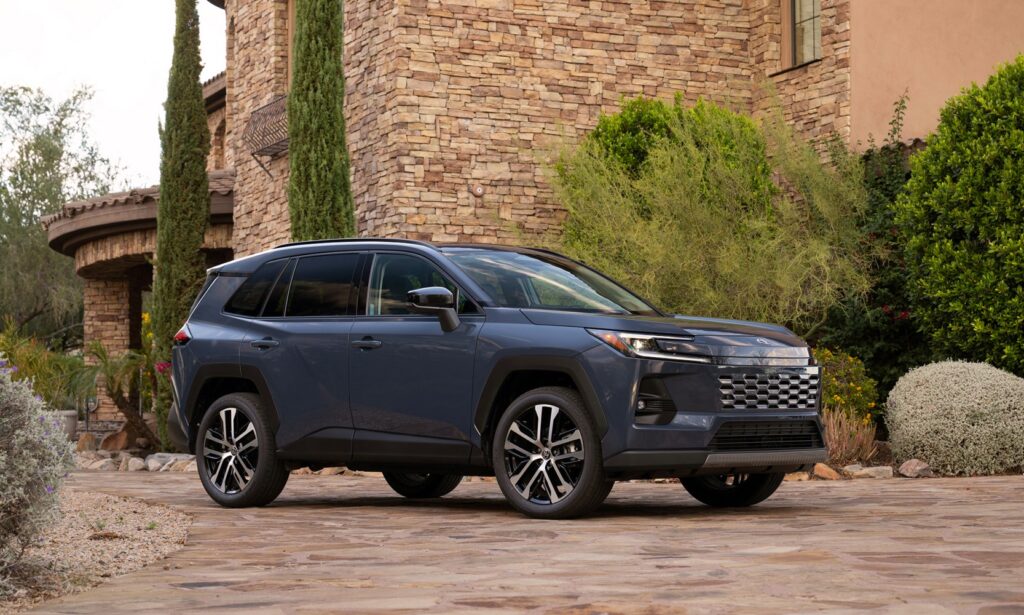
The Toyota RAV4 VI 2.5 (236 Hp) Hybrid AWD ECVT, slated for production beginning in October 2025, represents the latest evolution in Toyota’s pioneering compact SUV lineage, further solidifying its position as a leader in hybrid technology and the increasingly competitive utility vehicle segment. This sixth-generation RAV4 variant, a Full Hybrid Electric Vehicle (FHEV), combines robust performance with exceptional fuel efficiency and sophisticated all-wheel-drive capabilities, designed to meet the demands of modern drivers seeking a versatile, environmentally conscious, and reliable vehicle. Building upon a legacy of innovation, the 2025 RAV4 VI showcases Toyota’s commitment to sustainable mobility without compromising on the utility and driving experience that have made the RAV4 a global success story.
The Toyota RAV4 VI 2.5 (236 Hp) Hybrid AWD ECVT in Detail
Powertrain and Performance
At the heart of the 2025 Toyota RAV4 VI 2.5 (236 Hp) Hybrid AWD ECVT lies an advanced FHEV powertrain architecture, meticulously engineered to deliver a harmonious blend of power and efficiency. The system combines a potent 2.5-liter Dynamic Force A25A-FXS inline 4-cylinder gasoline engine with two electric motors, culminating in a formidable total system output of 236 horsepower. The internal combustion engine itself contributes 183 Hp at 6000 rpm and 163 lb.-ft. of torque across a broad range from 3600-5200 rpm. This engine is a marvel of modern engineering, featuring a high 14:1 compression ratio, dual overhead camshafts (DOHC) with Toyota’s intelligent variable valve timing (VVT-iE on the intake and VVT-i on the exhaust), and a sophisticated fuel injection system that utilizes both direct and multi-port manifold injection for optimal combustion and efficiency. Despite being naturally aspirated, its power density is impressive at 73.6 Hp per liter.
The hybrid system integrates two synchronous electric motors. The primary electric motor, integrated into the eCVT (electronically controlled continuously variable transmission), provides 134 Hp and a substantial 152.68 lb.-ft. of torque to the front wheels. A second, smaller electric motor, positioned on the rear axle, delivers an additional 89.25 lb.-ft. of torque, providing on-demand all-wheel drive (AWD) without a mechanical connection between the front and rear axles. This electronic AWD system enhances traction and stability in various driving conditions, offering a refined and responsive driving experience. Power for the electric motors is supplied by a compact 1 kWh Lithium-ion battery operating at 247.5 volts. This full hybrid system allows the RAV4 VI to operate in pure electric mode for short distances, in mixed mode, or solely on the gasoline engine, seamlessly transitioning between power sources for maximum efficiency.
The result is an SUV that excels in fuel economy, with an EPA-estimated combined rating of 42 US mpg (5.6 l/100 km). Urban driving sees an even more impressive 45.2-44.4 US mpg (5.2-5.3 l/100 km), while highway driving achieves 39.2 US mpg (6 l/100 km). These figures underscore the RAV4 VI Hybrid’s commitment to environmental responsibility, further evidenced by its SULEV (Super Ultra-Low Emission Vehicle) emission standard classification. With a weight-to-power ratio of 7.4 kg/Hp and a weight-to-torque ratio of 7.9 kg/Nm, the vehicle promises sprightly acceleration and confident performance, making it an ideal choice for both daily commutes and longer journeys.
Design, Features, and Dimensions
The Toyota RAV4 VI retains its popular SUV body type, offering a practical and stylish package with five doors and seating for five occupants. Its contemporary design language is expected to evolve from its predecessor, emphasizing a rugged yet refined aesthetic that appeals to a broad audience. The exterior dimensions are well-proportioned for the compact SUV segment: a length of 180.98 inches (4597 mm), a width of 72.99 inches (1854 mm), and a height of 66.69 inches (1694 mm). A generous wheelbase of 105.91 inches (2690 mm) contributes to a stable ride and a spacious cabin, while the 8.11-inch (206 mm) ground clearance ensures capability over varied terrain and urban obstacles. The minimum turning circle of 36.75 feet (11.2 meters) enhances maneuverability in tight spaces.
Inside, the RAV4 VI offers exceptional versatility and cargo capacity. The trunk space is substantial, ranging from 37.79 cubic feet (1070 liters) with all seats in place, expanding to an expansive 70.42 cubic feet (1994 liters) when the rear seats are folded down. This considerable volume makes it highly practical for hauling luggage, groceries, or sports equipment. The vehicle’s kerb weight ranges from 3864.7 to 3919.82 lbs (1753-1778 kg), with a maximum permissible weight of 4920.72 lbs (2232 kg), allowing for a maximum payload of up to 1056.01 lbs (479 kg). Furthermore, the RAV4 VI is capable of towing a permitted trailer load with brakes of up to 3500.94 lbs (1588 kg), underscoring its utility.
In terms of chassis and safety, the RAV4 VI features an independent McPherson strut front suspension and an independent multi-link rear suspension, both with anti-roll bars, providing a comfortable ride and agile handling. Braking is handled by ventilated discs at the front (305 mm) and solid discs at the rear (282 mm), complemented by an Anti-lock Braking System (ABS) for enhanced stopping power. Electric power steering with a rack and pinion setup ensures precise control and ease of maneuvering. Standard features like a Start & Stop System contribute to the vehicle’s overall efficiency. Tire options range from 235/65 R17 to 235/50 R20, mounted on wheel rims sized 7.5J x 17 to 7.5J x 20, allowing for customization of ride and aesthetics.
Technical Specifications for the Toyota RAV4 VI 2.5 (236 Hp) Hybrid AWD ECVT
| Category | Specification | Value | US Equivalent |
|---|---|---|---|
| General Information | |||
| Brand | Toyota | ||
| Model | RAV4 | ||
| Generation | RAV4 VI | ||
| Type (Engine) | 2.5 (236 Hp) Hybrid AWD ECVT | ||
| Start of Production | October, 2025 | ||
| Powertrain Architecture | FHEV (Full Hybrid Electric Vehicle) | ||
| Body Type | SUV | ||
| Seats | 5 | ||
| Doors | 5 | ||
| Performance Specs | |||
| System Power | 236 Hp | ||
| Fuel Consumption (Economy) – Urban (EPA) | 5.2-5.3 l/100 km | 45.2 – 44.4 US mpg | |
| Fuel Consumption (Economy) – Extra Urban (EPA) | 6 l/100 km | 39.2 US mpg | |
| Fuel Consumption (Economy) – Combined (EPA) | 5.6 l/100 km | 42 US mpg | |
| Fuel Type | Petrol (Gasoline) | ||
| Emission Standard | SULEV | ||
| Weight-to-Power Ratio | 7.4 kg/Hp | 134.6 Hp/tonne | |
| Weight-to-Torque Ratio | 7.9 kg/Nm | 126.1 Nm/tonne | |
| Electric Cars and Hybrids Specs | |||
| Gross Battery Capacity | 1 kWh | ||
| Battery Voltage | 247.5 V | ||
| Battery Technology | Lithium-ion (Li-Ion) | ||
| Electric Motor 1 Power | 134 Hp | ||
| Electric Motor 1 Torque | 207 Nm | 152.68 lb.-ft. | |
| Electric Motor 1 Location | Integrated into the transmission | ||
| Electric Motor 1 Type | Synchronous | ||
| Electric Motor 2 Torque | 121 Nm | 89.25 lb.-ft. | |
| Electric Motor 2 Location | Rear axle, Transverse | ||
| Electric Motor 2 Type | Synchronous | ||
| Internal Combustion Engine Specs | |||
| Power | 183 Hp @ 6000 rpm | ||
| Power per Liter | 73.6 Hp/l | ||
| Torque | 221 Nm @ 3600-5200 rpm | 163 lb.-ft. @ 3600-5200 rpm | |
| Engine Layout | Front, Transverse | ||
| Engine Model/Code | Dynamic Force / A25A-FXS | ||
| Engine Displacement | 2487 cm3 | 151.77 cu. in. | |
| Number of Cylinders | 4 | ||
| Engine Configuration | Inline | ||
| Cylinder Bore | 87.5 mm | 3.44 in. | |
| Piston Stroke | 103.4 mm | 4.07 in. | |
| Compression Ratio | 14:1 | ||
| Number of Valves per Cylinder | 4 | ||
| Fuel Injection System | Direct injection and Multi-port manifold injection | ||
| Engine Aspiration | Naturally aspirated engine | ||
| Valvetrain | DOHC, VVT-iE, VVT-i | ||
| Engine Oil Capacity | 4.5 l | 4.76 US qt | |
| Engine Systems | Start & Stop System | ||
| Space, Volume and Weights | |||
| Kerb Weight | 1753-1778 kg | 3864.7 – 3919.82 lbs. | |
| Max. Weight | 2232 kg | 4920.72 lbs. | |
| Max Load | 454-479 kg | 1000.9 – 1056.01 lbs. | |
| Trunk (Boot) Space – Minimum | 1070 l | 37.79 cu. ft. | |
| Trunk (Boot) Space – Maximum | 1994 l | 70.42 cu. ft. | |
| Fuel Tank Capacity | 55 l | 14.53 US gal | |
| Permitted Trailer Load with Brakes (12%) | 1588 kg | 3500.94 lbs. | |
| Permitted Towbar Download | 159 kg | 350.53 lbs. | |
| Dimensions | |||
| Length | 4597 mm | 180.98 in. | |
| Width | 1854 mm | 72.99 in. | |
| Height | 1694 mm | 66.69 in. | |
| Wheelbase | 2690 mm | 105.91 in. | |
| Ride Height (Ground Clearance) | 206 mm | 8.11 in. | |
| Minimum Turning Circle (Turning Diameter) | 11.2 m | 36.75 ft. | |
| Approach Angle | 19° | ||
| Departure Angle | 23° | ||
| Drivetrain, Brakes and Suspension Specs | |||
| Drivetrain Architecture | An Internal combustion engine (ICE) drives the front wheels, one electric motor drives the front wheels, one electric motor drives the rear wheels. There is an ability for running in full electric or mixed mode. | ||
| Drive Wheel | All wheel drive (4×4) | ||
| Number of Gears and Type of Gearbox | automatic transmission ECVT | ||
| Front Suspension | Independent, type McPherson with coil spring and anti-roll bar | ||
| Rear Suspension | Independent multi-link spring suspension with stabilizer | ||
| Front Brakes | Ventilated discs | 305 mm | |
| Rear Brakes | Disc | 282 mm | |
| Assisting Systems | ABS (Anti-lock braking system) | ||
| Steering Type | Steering rack and pinion | ||
| Power Steering | Electric Steering | ||
| Tires Size | 235/65 R17; 235/60 R18; 235/50 R20 | ||
| Wheel Rims Size | 7.5J x 17; 7.5J x 18; 7.5J x 20 | ||
Legacy and Market Impact
The Toyota RAV4 has long been a foundational pillar in the compact SUV segment, consistently setting benchmarks for reliability, practicality, and efficiency. The introduction of the Toyota RAV4 VI 2.5 (236 Hp) Hybrid AWD ECVT in October 2025 is poised to further cement this legacy, particularly in a market increasingly prioritizing electrified powertrains and advanced all-wheel-drive systems. Toyota’s early and sustained investment in hybrid technology, spearheaded by models like the Prius and subsequently integrated across its SUV lineup, has given the RAV4 a significant competitive edge.
In its primary markets, including North America, Europe, and Asia, the RAV4 VI Hybrid will face stiff competition from other hybrid and conventional compact SUVs such as the Honda CR-V Hybrid, Hyundai Tucson Hybrid, Kia Sportage Hybrid, and Ford Escape Hybrid. However, the RAV4’s reputation for bulletproof reliability, low cost of ownership, and strong resale value, combined with the proven efficiency and performance of its FHEV system, positions it as a formidable contender. The electronic on-demand AWD, powered by a dedicated rear electric motor, offers a sophisticated solution for enhanced traction without the weight and complexity of a traditional mechanical AWD system, appealing to consumers in diverse climates and driving conditions.
The sixth generation’s focus on a powerful yet highly efficient hybrid powertrain, exemplified by its SULEV emission rating and impressive 42 US mpg combined fuel economy, aligns perfectly with evolving global environmental regulations and consumer demand for greener vehicles. Its substantial cargo capacity and respectable