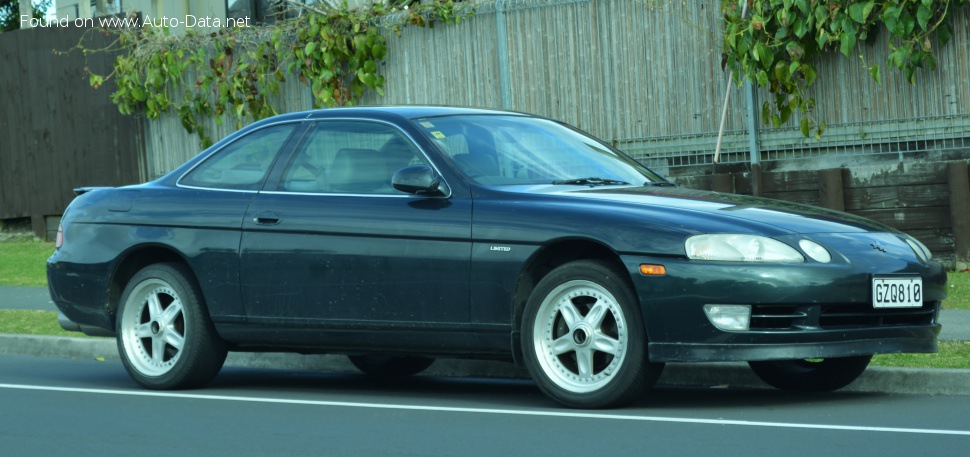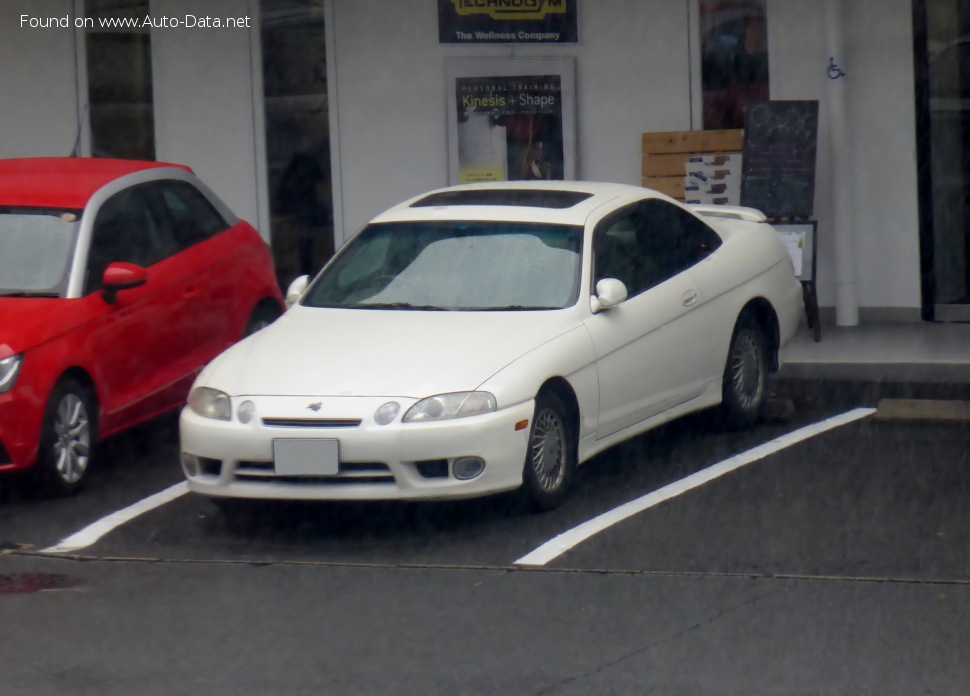
The Toyota Soarer III, specifically the highly sought-after facelift model from 1995, represented the pinnacle of Japanese luxury grand touring during its production run from 1995 to 2001. Known internally as the Z30 series, this generation of the Soarer was a distinctly Japanese Domestic Market (JDM) vehicle, never officially sold in North America or Europe, where its platform-mate, the Lexus SC, held sway. However, the Toyota Soarer III (facelift 1995) 2.5 Twin-turbo 24V GT (280 Hp) offered a unique blend of sophisticated styling, advanced technology for its time, and formidable performance, particularly in its twin-turbocharged guise. Positioned as a high-performance luxury coupe, the Soarer aimed to provide a premium driving experience with a sporty edge, appealing to enthusiasts and discerning buyers seeking a blend of comfort and exhilarating power. Its post-facelift iteration refined an already successful design, incorporating subtle visual and technical enhancements that kept it competitive in a rapidly evolving automotive landscape.
The Toyota Soarer III (facelift 1995): A JDM Performance Icon
The 1995 facelift of the Toyota Soarer III brought a series of refinements that solidified its status as a JDM legend. While the core elegant coupe silhouette remained, the updated model featured subtle aesthetic tweaks, improved interior materials, and minor mechanical revisions designed to enhance its appeal. The Soarer was always envisioned as Toyota’s answer to premium European grand tourers, offering a compelling alternative with its distinct Japanese engineering philosophy. The “GT” designation in the 2.5 Twin-turbo 24V GT trim underscored its performance aspirations, distinguishing it from the more comfort-oriented naturally aspirated variants. Its existence as a JDM-only model has only amplified its mystique and desirability among international enthusiasts, who often import these vehicles years later to experience their unique blend of luxury and high-performance engineering. This particular variant, with its potent twin-turbo engine, was a direct competitor to other Japanese sports coupes of the era, offering a more luxurious and refined package than many of its rivals.
Engine and Performance
At the heart of the Toyota Soarer III (facelift 1995) 2.5 Twin-turbo 24V GT (280 Hp) lies the legendary 1JZ-GTE engine, a 2.5-liter (2492 cubic centimeter or 152.07 cubic inches) inline-six powerplant. This engine, known for its robust construction and tuning potential, featured a DOHC (Double Overhead Camshaft) valvetrain with four valves per cylinder, ensuring efficient breathing and high-revving capability. The twin-turbocharger setup, a hallmark of performance engines of this era, provided a potent boost, contributing significantly to its impressive output. The engine produced a formidable 280 horsepower at 6200 rpm, a figure that was often cited as the “gentlemen’s agreement” limit for Japanese manufacturers at the time, though many speculate its true output was slightly higher. Torque was equally impressive, reaching 278.8 pound-feet (378 Nm) at a relatively low 2400 rpm, providing a broad powerband and excellent throttle response. This combination of horsepower and torque, coupled with a kerb weight of 3439.21 pounds (1560 kg), resulted in a compelling power-to-weight ratio of 5.6 kg/Hp, or 179.5 Hp per tonne, allowing the Soarer to accelerate with authority.
Power was delivered to the rear wheels via a precise 5-speed manual transmission, offering an engaging driving experience that appealed to enthusiasts. The car’s powertrain architecture, with its front, longitudinal engine layout driving the rear wheels, adhered to the classic grand tourer formula, emphasizing balanced weight distribution and dynamic handling. The Soarer boasted a maximum speed of 161.56 miles per hour (260 km/h), a testament to its engineering and aerodynamic efficiency. Fuel efficiency, while not the primary concern for a performance-oriented grand tourer, was rated at an estimated 20.5 US miles per gallon combined (11.5 liters/100 km), with urban consumption at 16.8 US mpg (14 l/100 km) and extra-urban at 26.1 US mpg (9 l/100 km). This made it a capable cruiser for long distances, balancing its performance credentials with a degree of practicality for its class.
Design and Features
The design of the Toyota Soarer III, particularly the facelifted 1995 model, embodies the late-20th-century Japanese aesthetic of understated luxury and aerodynamic efficiency. As a 2-door coupe with seating for five, it offered a blend of sporty appeal and practical passenger capacity, making it suitable for both spirited drives and comfortable cruising. Its dimensions—191.34 inches (4860 mm) in length, 70.47 inches (1790 mm) in width, and 53.15 inches (1350 mm) in height—contributed to its imposing yet graceful road presence. A generous wheelbase of 105.91 inches (2690 mm) was instrumental in providing a stable ride and ample interior space, characteristic of a true grand tourer.
Suspension duties were handled by a sophisticated double wishbone setup at the front, offering precise steering and excellent road holding, complemented by a coil spring rear suspension designed for comfort and control. This combination ensured the Soarer maintained its composure during high-speed maneuvers while isolating occupants from road imperfections. Braking performance was robust, featuring ventilated discs at both the front and rear, enhanced by an Anti-lock Braking System (ABS) as a standard assisting system, a crucial safety feature for vehicles of this performance caliber in the mid-1990s. Steering was managed by a hydraulic rack and pinion system, providing direct feedback and a connected feel to the road. The car rode on 225/55 R16 tires mounted on 16-inch wheel rims, a practical and performance-oriented choice for the era. The fuel tank capacity of 20.61 US gallons (78 liters) further underscored its grand touring capabilities, allowing for extended journeys without frequent refueling stops. The maximum load capacity of 606.27 pounds (275 kg) and a gross weight of 4045.48 pounds (1835 kg) indicated its robust construction and ability to carry passengers and luggage in comfort.
Technical Specifications: Toyota Soarer III (facelift 1995) 2.5 Twin-turbo 24V GT (280 Hp)
| Brand | Toyota |
| Model | Soarer |
| Generation | Soarer III (facelift 1995) |
| Type (Engine) | 2.5 Twin-turbo 24V GT (280 Hp) |
| Start of production | 1995 year |
| End of production | 2001 year |
| Powertrain Architecture | Internal Combustion engine |
| Body type | Coupe |
| Seats | 5 |
| Doors | 2 |
| Fuel consumption (economy) – urban | 14 l/100 km (16.8 US mpg) |
| Fuel consumption (economy) – extra urban | 9 l/100 km (26.1 US mpg) |
| Fuel consumption (economy) – combined | 11.5 l/100 km (20.5 US mpg) |
| Fuel Type | Petrol (Gasoline) |
| Maximum speed | 260 km/h (161.56 mph) |
| Weight-to-power ratio | 5.6 kg/Hp (179.5 Hp/tonne) |
| Weight-to-torque ratio | 4.1 kg/Nm (242.3 Nm/tonne) |
| Power | 280 Hp @ 6200 rpm |
| Power per liter | 112.4 Hp/l |
| Torque | 378 Nm @ 2400 rpm (278.8 lb.-ft. @ 2400 rpm) |
| Engine layout | Front, Longitudinal |
| Engine Model/Code | 1JZGTE |
| Engine displacement | 2492 cm3 (152.07 cu. in.) |
| Number of cylinders | 6 |
| Engine configuration | Inline |
| Cylinder Bore | 86 mm (3.39 in.) |
| Piston Stroke | 71.5 mm (2.81 in.) |
| Compression ratio | 9:1 |
| Number of valves per cylinder | 4 |
| Fuel injection system | Multi-port manifold injection |
| Engine aspiration | Turbocharger |
| Valvetrain | DOHC |
| Kerb Weight | 1560 kg (3439.21 lbs.) |
| Max. weight | 1835 kg (4045.48 lbs.) |
| Max load | 275 kg (606.27 lbs.) |
| Fuel tank capacity | 78 l (20.61 US gal) |
| Length | 4860 mm (191.34 in.) |
| Width | 1790 mm (70.47 in.) |
| Height | 1350 mm (53.15 in.) |
| Wheelbase | 2690 mm (105.91 in.) |
| Front track | 1520 mm (59.84 in.) |
| Rear (Back) track | 1520 mm (59.84 in.) |
| Drivetrain Architecture | Internal combustion engine (ICE) drives the rear wheels |
| Drive wheel | Rear wheel drive |
| Number of gears and type of gearbox | 5 gears, manual transmission |
| Front suspension | Double wishbone |
| Rear suspension | Coil spring |
| Front brakes | Ventilated discs |
| Rear brakes | Ventilated discs |
| Assisting systems | ABS (Anti-lock braking system) |
| Steering type | Steering rack and pinion |
| Power steering | Hydraulic Steering |
| Tires size | 225/55 R16 |
| Wheel rims size | 16 |