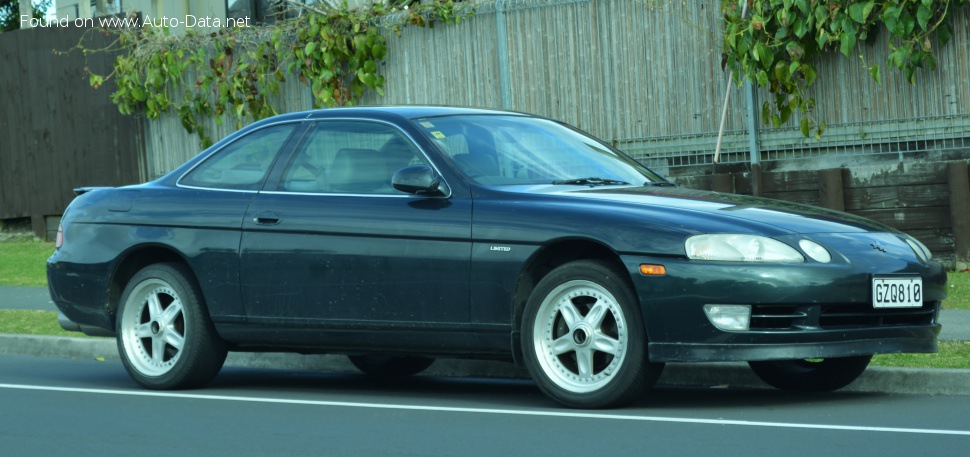
The Toyota Soarer III (facelift 1995) represents a pinnacle of Japanese luxury grand touring during its era, a segment where performance, sophisticated engineering, and opulent comfort converged. This particular variant, the 3.0i 24V GT (230 Hp), served as a cornerstone of the Soarer lineup following its mid-cycle refresh in 1995. Primarily developed for the discerning Japanese Domestic Market (JDM), the Soarer carved out a niche for itself as a high-performance luxury coupe, offering a compelling alternative to European rivals. While many in North America might recognize its platform twin, the Lexus SC300, the Soarer maintained its unique identity and specific trim levels within its home market. The third generation, known internally as the Z30 series, debuted in 1991 and underwent a significant facelift in 1995, introducing subtle styling revisions and crucial mechanical updates that refined its appeal and kept it competitive through the late 1990s. This updated model continued production until 2001, solidifying its legacy as a stylish and capable personal luxury vehicle.
Engine and Performance of the Toyota Soarer III (facelift 1995)
At the heart of the 1995 Toyota Soarer III 3.0i 24V GT lies a meticulously engineered 3.0-liter inline-six engine, a powerplant renowned for its smoothness, reliability, and robust performance. Despite some common nomenclature from its time that might have included “V6,” the detailed technical specifications confirm an inline configuration, a hallmark of Toyota’s high-performance and luxury offerings from this period, particularly the famed JZ-series engines. This naturally aspirated, DOHC (Double Overhead Camshaft) engine, designated as the 2JZ-GE, delivers a respectable 230 horsepower at 6000 rpm. Its advanced 24-valve design, with four valves per cylinder, facilitated excellent volumetric efficiency, contributing to its strong power delivery across the rev range. The engine’s bore and stroke measurements are identical at 86 mm (3.39 inches), indicating a “square” design that typically balances torque and horsepower characteristics effectively for a broad powerband.
The torque output is equally impressive for a naturally aspirated engine of its size, peaking at 209.47 lb.-ft. (284 Nm) at 4800 rpm. This ample torque, available at a relatively accessible engine speed, ensures responsive acceleration and effortless cruising, hallmarks of a true grand tourer. Fuel is delivered via a multi-port manifold injection system, providing precise fuel metering for optimal combustion and efficiency. The compression ratio of 10.1:1 further enhances power output and throttle response. Paired exclusively with a four-speed automatic transmission, the powertrain architecture is designed for a refined driving experience, prioritizing smooth shifts and comfortable long-distance travel over raw, aggressive performance, though it was certainly capable of spirited driving when called upon.
The Soarer’s performance metrics reflect its grand touring aspirations. With a kerb weight of 3395.12 lbs. (1540 kg), the vehicle achieves a weight-to-power ratio of 149.4 Hp per tonne (6.7 kg/Hp), which for its time, placed it firmly in the competitive luxury coupe segment. The weight-to-torque ratio stands at 184.4 Nm per tonne (5.4 kg/Nm), indicating strong pulling power relative to its mass. Despite its focus on performance and luxury, the 1995 Toyota Soarer III 3.0i 24V GT also offered reasonable fuel economy for its class, rated at a combined 25 US mpg (9.4 l/100 km). This blend of power, refinement, and efficiency made the Soarer a highly desirable vehicle in its target market, appealing to those who sought a sophisticated and capable coupe without compromising on comfort or practicality for everyday use.
Design and Features of the Toyota Soarer III (facelift 1995)
The design philosophy behind the Toyota Soarer III (facelift 1995) was one of understated elegance and aerodynamic efficiency, a clear departure from the more angular designs of previous generations. Its sleek, two-door coupe body style exuded a timeless appeal that has aged remarkably well, often drawing comparisons to contemporary European luxury coupes. Measuring 191.34 inches (4860 mm) in length, 70.47 inches (1790 mm) in width, and 53.15 inches (1350 mm) in height, the Soarer possessed a substantial road presence. The long wheelbase of 105.91 inches (2690 mm) contributed significantly to both its stable high-speed cruising ability and its surprisingly spacious interior, comfortably accommodating five occupants despite its coupe designation. The front and rear tracks were identical at 59.84 inches (1520 mm), providing a balanced stance and aiding in predictable handling dynamics.
Inside, the Soarer was a showcase of Toyota’s commitment to luxury and ergonomic design. While specific interior features are not detailed in the provided data, the Z30 generation Soarer was known for its high-quality materials, plush seating, advanced automatic climate control systems, and an array of power-operated amenities that were cutting-edge for the mid-1990s. These often included power-adjustable seats, a premium sound system, and comprehensive instrumentation. Its driver-focused cockpit, coupled with comfortable seating for five, underscored its grand touring credentials, making it suitable for both spirited drives and long journeys across Japan’s extensive highway network. The facelift in 1995 brought subtle refinements to the exterior, often including revised front and rear lighting elements, grille designs, and new wheel options, ensuring the Soarer remained fresh and contemporary in a competitive market.
Underpinning the Soarer’s refined ride and handling was a sophisticated chassis and suspension setup. The vehicle employed a double wishbone front suspension, a design typically found in higher-performance and luxury vehicles for its ability to maintain optimal tire contact with the road surface, enhancing both ride comfort and handling precision. The rear suspension utilized a coil spring setup, further contributing to its compliant and composed ride. Braking duties were handled by ventilated discs at the front and solid discs at the rear, providing strong and consistent stopping power, an essential attribute for a car of its performance capabilities. An Anti-lock Braking System (ABS) was standard, offering an important safety enhancement by preventing wheel lock-up during hard braking, allowing the driver to maintain steering control.
The steering system comprised a hydraulic rack and pinion setup, delivering precise and communicative feedback to the driver, a characteristic highly valued by enthusiasts for its natural feel. The standard tire size of 215/60 R15 indicated a focus on a comfortable ride and good grip, appropriate for a luxury coupe designed for both highway cruising and occasional spirited driving. With a generous fuel tank capacity of 20.61 US gallons (78 liters), the Soarer offered an excellent cruising range, further cementing its role as a capable grand tourer. The overall powertrain architecture, with its front-longitudinal engine layout driving the rear wheels, provided a classic and desirable setup for a performance-oriented luxury coupe, contributing to its balanced weight distribution and engaging driving dynamics, making the Toyota Soarer III a truly distinguished vehicle of its era.
Technical Specifications: Toyota Soarer III (facelift 1995) 3.0i 24V GT (230 Hp)
| Brand | Toyota |
| Model | Soarer |
| Generation | Soarer III (facelift 1995) |
| Type (Engine) | 3.0i 24V GT (230 Hp) |
| Start of production | 1995 year |
| End of production | 2001 year |
| Powertrain Architecture | Internal Combustion engine |
| Body type | Coupe |
| Seats | 5 |
| Doors | 2 |
| Fuel consumption (economy) – combined | 25 US mpg (9.4 l/100 km) |
| Fuel Type | Petrol (Gasoline) |
| Weight-to-power ratio | 6.7 kg/Hp, 149.4 Hp/tonne |
| Weight-to-torque ratio | 5.4 kg/Nm, 184.4 Nm/tonne |
Power

|